
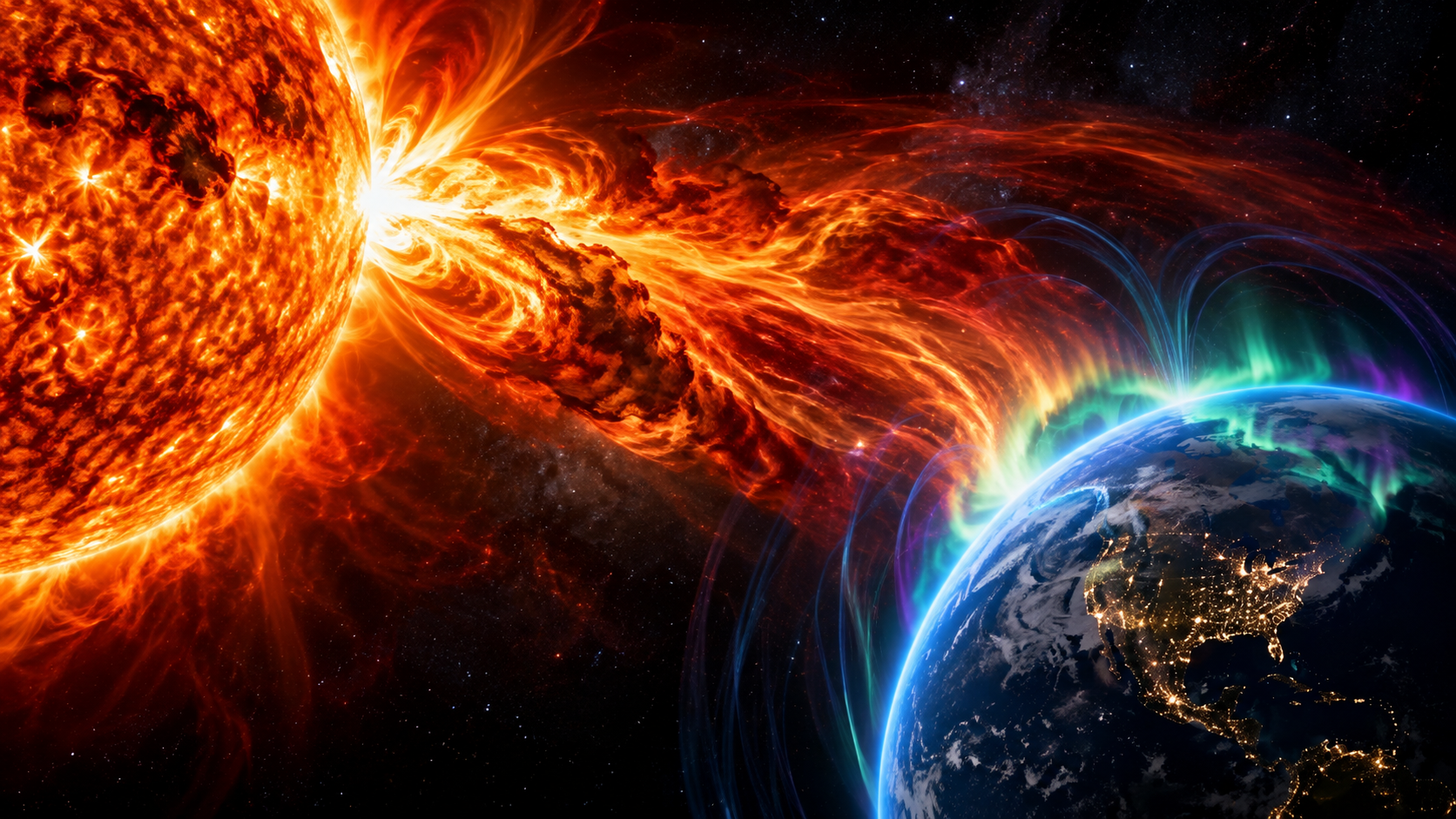
On 1 September 1859, English astronomer Richard Carrington was observing a group of sunspots when he saw two brilliant patches of light suddenly appear. Within about 17 hours, Earth was engulfed by an extraordinary geomagnetic storm.
Auroras appeared far beyond their usual polar regions. Telegraph equipment sparked, operators received electric shocks, and fires were reported in some telegraph offices. In some cases, induced electrical currents were strong enough for telegraph operators to continue sending messages even after disconnecting their batteries.
The event now bears Carrington’s name. More than a century and a half later, it remains a benchmark for one of the most unsettling natural hazards facing a technological civilisation: extreme space weather.
What actually happened in 1859?
The Sun is not a quiet ball of light. Its magnetic field can store enormous amounts of energy. Solar flares release radiation, while coronal mass ejections, or CMEs, can hurl vast clouds of magnetised plasma into space.
When a powerful Earth-directed CME reaches us, its magnetic field can interact with Earth’s magnetosphere and produce a geomagnetic storm. That interaction can induce electrical currents in long conductors on the ground.
In 1859, the telegraph network was one of the few large electrical systems spanning long distances. It therefore provided an accidental demonstration of what extreme space weather can do to technology.
A world built on electricity
The modern world is vastly more dependent on vulnerable technology than the world Carrington knew. Electricity grids stretch across countries. Satellites support communications, navigation, weather forecasting and financial timing. GPS is woven into transport, agriculture, shipping and emergency services.
A severe geomagnetic storm could disturb or damage some satellites, degrade GPS and radio communications, and induce currents in high-voltage transmission networks. Operators may need to alter grid conditions or take protective action to reduce the risk of equipment damage.
That does not mean a Carrington-scale storm would automatically switch off civilisation. The consequences would depend on the storm’s exact characteristics, where it struck, the resilience of infrastructure and the precautions taken. Modern monitoring also gives us something the Victorians did not have: warning.
We have already seen smaller warnings
The Carrington Event is extreme, but disruptive space weather is not merely a nineteenth-century story. In March 1989, a geomagnetic storm contributed to the collapse of the Hydro-Québec power system, leaving millions of people without electricity for hours.
Then, in July 2012, an exceptionally powerful solar eruption crossed Earth’s orbit but missed our planet. NASA scientists described it as a solar superstorm and examined what might have happened had Earth been in its path.
These events are important because they show that the underlying hazard has not disappeared. Our star is still active; what has changed is our dependence on technology.
Would the internet disappear?
Claims that a solar storm would simply “destroy the internet” are too simplistic. The internet is not a single system, and much of its fibre-optic infrastructure does not conduct geomagnetically induced current in the same way as long metallic conductors.
But the services surrounding the internet depend on electricity, data centres, terrestrial networks, satellites and other infrastructure. Large regional power failures or damage to critical equipment could therefore cause serious communication disruption even if the internet itself were not somehow erased.
Could satellites be lost?
Satellites face several forms of space-weather risk. Energetic particles can interfere with electronics, while changes in Earth’s upper atmosphere can increase drag on satellites in low Earth orbit. Radio signals travelling through the ionosphere can also be disturbed, affecting navigation and communications.
Spacecraft operators can sometimes place satellites into safer configurations when dangerous conditions are forecast. Again, prediction and preparation matter.
How much warning would we have?
Scientists continuously observe the Sun using spacecraft and ground-based instruments. A solar flare can be detected almost immediately, and an Earth-directed CME can then be tracked as it travels through space.
The exact severity of the resulting geomagnetic storm is harder to determine far in advance because the orientation of the CME’s magnetic field is crucial. Measurements closer to Earth can provide more precise short-term warning before the disturbance arrives.
That warning can give grid operators, satellite controllers and other organisations time to prepare.
Could another Carrington Event happen?
Yes. Nothing about the physics of the Sun suggests that 1859 was a unique event that can never be repeated.
What scientists cannot tell us is the exact date of the next extreme storm. Solar activity follows an approximately 11-year cycle, but an individual Carrington-scale eruption cannot currently be predicted months or years beforehand.
This is an important distinction. A hazard can be real without being imminent.
The lesson of 1859
The Carrington Event is compelling because it sits at the intersection of history and modern vulnerability. Victorian technology was primitive by today’s standards, yet the storm was powerful enough to make electrical systems behave in ways their operators had never seen.
Our civilisation is now connected by technologies Carrington could scarcely have imagined.
That makes us more vulnerable in some ways, but also better prepared. We observe the Sun continuously. Space-weather agencies issue alerts. Engineers understand geomagnetically induced currents. Grid and satellite operators can take protective measures.
The sensible conclusion is therefore neither complacency nor apocalypse.
A severe solar storm is a genuine natural hazard. Its effects could be costly and disruptive. But statements that the next solar eruption will inevitably end modern civilisation go beyond what the evidence supports.
The Sun has always shaped life on Earth. Usually it provides the energy that makes our world possible. Occasionally, it reminds us that the star we depend upon is also a vast, dynamic and extraordinarily powerful object.