

Lowering global temperature after an overshoot could reduce future harm. It would not rewind the Earth to its previous condition. That distinction matters whenever climate reporting describes a route back to 1.5°C.
Evidence reviewed: 22 October 2026. This explainer distinguishes assessed pathways, model experiments and observations. It is not original research.
What the emissions headline actually means
The Guardian’s headline compresses a conditional pathway; the full story includes important qualifications. [10] Here we examine the underlying science rather than infer motives from the wording.
UNEP’s Emissions Gap Report 2026 examines a pathway with warming peaking around 1.7–1.8°C near mid-century and about a 50% chance of returning to 1.5°C or below by 2100. It requires global greenhouse gas emissions to fall 18% by 2030, 45% by 2035 and 69% by 2040, relative to 2025, alongside increasing carbon dioxide removal. [1]
These are conditional milestones, not a prediction that governments will deliver them. The percentages concern greenhouse gases collectively, not CO₂ alone. An 18% reduction is one early step in a much longer pathway; it does not promise that warming immediately stops.
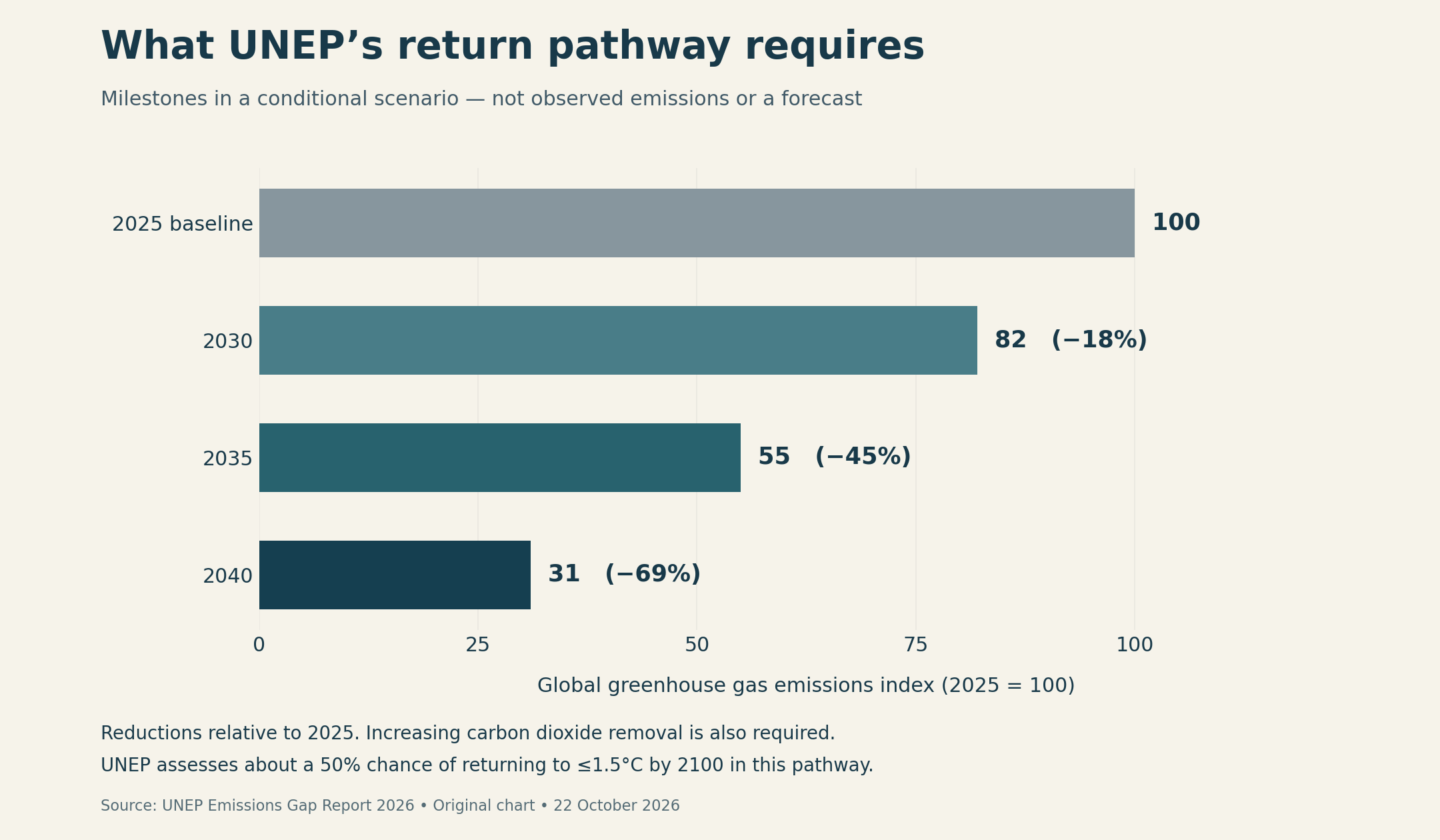
| Year | Emissions index | Reduction from 2025 |
|---|---|---|
| 2025 | 100 | Baseline |
| 2030 | 82 | 18% |
| 2035 | 55 | 45% |
| 2040 | 31 | 69% |
The correct reading is demanding but conditional: emissions cuts and removals might bring the global average back down. That says nothing, on its own, about which losses would recover.
What does “overshoot” mean?
Temperature overshoot means exceeding a warming level and subsequently returning below it. The height of the peak and the time spent above the target both matter. A small, brief overshoot and a large, prolonged one expose people and ecosystems to different risks. UNEP explicitly warns against treating overshoot as harmless. [2]
The 1.5°C goal concerns long-term warming above the pre-industrial climate, not the temperature of one unusually hot year. Annual temperatures also reflect natural variability. The peer-reviewed Indicators of Global Climate Change 2025 update separates observed warming from the human contribution and reports both annual and longer-term indicators. Comparing like with like prevents an annual record from being confused with a formally established long-term threshold crossing. [8]
Nor is 1.5°C a switch below which damage disappears and above which every system collapses. It is a risk-limiting goal. The practical question remains how much warming can be prevented, how quickly, and for whom.
Stopping warming and reversing warming are different tasks
The IPCC assesses that reaching net-zero CO₂, together with strong reductions in other greenhouse gases, is needed to stabilise human-caused warming. Sustained net-negative CO₂ emissions could gradually lower temperatures. [3]
Net zero balances continuing CO₂ emissions with removals. Net negative means removing more CO₂ than is emitted. A removal used to compensate for a remaining emission cannot simultaneously be counted as an additional removal that draws down past pollution. Methane and other gases also affect the temperature outcome.
A cooler future would be valuable. But the IPCC finds that overshoot adds risks and can cause irreversible impacts. Returning to a temperature target is therefore different from having stayed below it throughout. [3]
Which damage might remain?
Glaciers and water supplies
A 2025 peer-reviewed glacier study modelled the consequences of exceeding 1.5°C and later returning. Its illustrative 3°C peak-and-decline experiment produced 11% more global glacier mass loss by 2500 than a pathway that avoided overshooting 1.5°C. That is a different, much higher peak than UNEP’s 1.7–1.8°C pathway; the result must not be transferred between them. [5]
The study also found that glacier recovery can take centuries and that regrowing glaciers may temporarily reduce downstream glacier runoff as they store water again. This is evidence that a falling global average does not instantly restore ice or water availability—not a prediction that every glacier responds identically.
Permafrost carbon
Thaw lets microbes decompose previously frozen organic matter, releasing carbon. A 2026 study using three climate models found that permafrost carbon losses increased with accumulated warming exposure during overshoot. The authors also examined how cooling associated with a weakened Atlantic overturning circulation could partly reduce those losses. That interaction is not a climate remedy: ocean-circulation disruption brings its own risks. [6]
These are idealised model experiments, not a dated forecast for all Russian permafrost. They do not establish a single worldwide collapse threshold. They do show why a later temperature decline cannot simply be assumed to recover carbon accumulated in frozen soils over thousands of years.
Coasts, ecosystems and communities
UNEP’s overshoot assessment explains that some effects persist beyond a temperature return, including long-lived sea-level impacts and losses in ecosystems. A global average is a summary measure; it cannot describe every local condition or reverse every consequence. [2]
There is also a straightforward human distinction: preventing future displacement is valuable, but a lower temperature later cannot undo the years a community has already spent displaced. Recovery needs its own evidence, rather than being inferred from a temperature target.
Carbon removal is real. Its future scale is uncertain.
Carbon dioxide removal includes approaches such as increasing carbon stored in vegetation and soils, producing biochar, and capturing atmospheric CO₂ for durable storage. The State of Carbon Dioxide Removal report assesses very different methods and stages of deployment; they should not be presented as one interchangeable technology. [7]
What matters is verified net removal after the process’s own emissions, the duration of storage, and whether the carbon would otherwise have remained in the atmosphere. Land, energy, costs, monitoring and storage durability constrain different methods in different ways. A purchased promise of future removal is not the same as carbon already removed and securely stored.
Schleussner and colleagues’ 2024 Nature paper, Overconfidence in climate overshoot, examines uncertainty in bringing temperatures down and the risks that remain. Its warning is not that cooling is physically impossible. It is that confident promises of a safe, timely return can outrun the evidence, particularly when they assume large future removals and favourable climate responses. [4]
That uncertainty strengthens the case for earlier emissions cuts: they reduce the burden placed on future removal systems and the amount of warming experienced before any return.
Watch the report presented by its authors
The UNEP–ODI Global launch on 21 October 2026 includes lead author Dr Anne Olhoff presenting the report’s findings, followed by policy discussion. It is a useful primary-source companion, although a launch event is not itself a peer-reviewed scientific paper. [9]
How to judge a climate claim
Before accepting a headline, ask what is being measured, which baseline is used, whether the number is observed or modelled, what probability accompanies it, and what assumptions must hold. For a claim about recovery, ask which physical or social outcome is supposed to recover—and over what timescale.
The evidence supports urgent action without promising a planetary reset. Lower peaks and shorter overshoots reduce risks. Lowering temperature later could prevent further harm, while some damage would remain. Neither guaranteed rescue nor inevitable total collapse is a faithful description of the science.
Sources and verification
UNEP and IPCC reports are scientific assessments; the journal articles below are peer-reviewed studies. The removal report is a specialist evidence synthesis. The video is an author presentation and discussion. The newspaper item is the reporting examined, not the scientific authority for our conclusions. Different studies use different scenarios; their numbers are not interchangeable.
- UNEP (2026), Emissions Gap Report: The Point of Return
- UNEP, Limiting Overshoot: executive summary
- IPCC (2023), AR6 Synthesis Report, Summary for Policymakers, B.6–B.7
- Schleussner et al. (2024), Overconfidence in climate overshoot, Nature. DOI: 10.1038/s41586-024-08020-9
- Schuster et al. (2025), Irreversible glacier change and trough water for centuries after overshooting 1.5°C, Nature Climate Change. DOI: 10.1038/s41558-025-02318-w
- Steinert et al. (2026), Permafrost carbon release scales linearly with overshoot warming mediated by AMOC tipping, Nature Communications. DOI: 10.1038/s41467-026-73612-0
- The State of Carbon Dioxide Removal, third edition (2026)
- Forster et al. (2026), Indicators of Global Climate Change 2025, Earth System Science Data. DOI: 10.5194/essd-18-3889-2026
- ODI Global / UNEP (21 October 2026), Emissions Gap Report launch and recording
- Reporting examined: The Guardian, 21 October 2026
Graphics: original bar graphic calculated as 100 minus UNEP’s stated percentage reduction. Any accompanying AI-generated landscape is a conceptual illustration, not observational evidence. References checked 22 October 2026; conclusions should be updated as assessments and observations change.