
Markets, monopolies and the price of getting a start
Research cut-off: 24 November 2026. A British perspective, with international comparisons. Historical data are dated explicitly; projections, allegations and findings are distinguished.

The wrong date, but the right question
When did capitalism stop being capitalism? Perhaps when companies discovered that controlling access could be more dependable than competing on quality. Perhaps when a home became an investment strategy before it was somewhere to live. Perhaps when a person could have a promising business idea and still find that the essential ingredient was already owning something valuable.
Those are recognisable grievances. But the question contains a historical trap. Capitalism has never been a single, unchanging arrangement in which everybody starts equal and the best idea wins. Private ownership, investment for profit, wage labour and markets have coexisted with slavery, empire, state protection, public investment, welfare systems and trade unions. There was no pristine starting point from which the system suddenly fell.[1]
The more useful question is this: when does a capitalist economy reward creating useful things, and when does it reward owning the gate through which everyone else must pass?
That distinction runs through this article. A business can produce something valuable and also accumulate power to overcharge, exclude or dictate terms. A government can make markets work better, or help incumbents shelter themselves. Competition can encourage innovation; successful competitors can then spend their profits preventing the next competitor from emerging.
The same contradiction lies behind the argument about rags to riches. It has happened. It still can happen. But possibility is a poor measure of fairness. We need to ask how often it happens, who gets the opportunity, what support they receive, and how many equally capable people never get a chance.
Profit, economic rent and the difference between them
Profit is an accounting result: revenue left after the costs counted in the accounts. Its existence does not tell us whether a business has innovated, taken a worthwhile risk, benefited from scarcity or excluded competitors. We have to examine how it was earned.
Economic rent has a more specific meaning: a return above what is necessary to keep a resource in its current use, allowing for the relevant costs and a normal, risk-adjusted return. It is not simply another name for a landlord’s monthly charge. A payment described as rent can cover maintenance, depreciation and services as well as a scarcity return. A technology company can earn economic rent without owning a single rental home.
The distinction is easiest to see through examples. A business developing a better process may earn a temporary advantage that attracts imitators and rewards useful experimentation. Another may hold an exclusive right or control an unavoidable gateway that lets it charge more without improving the service. The same business can do both, and the balance can change over time.
We cannot identify the precise amount of economic rent simply by looking at a large gross margin. We need a defensible comparison with costs, risks and feasible competition. Nor does a return become socially useless merely because it arises from an intangible asset: research and development can be expensive and uncertain.
For this article, the test is therefore not “is somebody making money?” It is whether the return depends on supplying additional value, or on maintaining a position from which others cannot readily escape. That distinction makes criticism more demanding, but also more difficult to dismiss.
1. Before the factory: who owned the starting line?
Markets are much older than capitalism. People traded goods, borrowed money and sought profits long before industrial Britain. What gradually developed in early modern Europe was a more extensive system of private capital accumulation, organised finance, enterprises employing wage labour and production directed towards markets. There is no universally accepted birthday, and Adam Smith did not invent it in 1776.[1]
Property rights are often described as if they simply existed before governments arrived. In practice, governments define and enforce them. England’s enclosure movement illustrates the point. Parliament records more than 5,200 enclosure measures between 1604 and 1914, affecting around 6.8 million acres. Land subject to customary and common rights became enclosed holdings. Agricultural improvement was one argument for the process; the distribution of its benefits and losses was another matter.[2]
Common land was not a universal right for anybody to take anything. Rights differed by place and status. Nevertheless, losing access could remove part of a household’s means of survival. A legal reorganisation that looked like efficiency from one position could look like dispossession from another.
The lesson is larger than enclosure. The initial allocation of assets shapes who must sell their labour, who can lend, who collects rent, and who can afford to experiment. If two people meet in a formally free market after one has lost their livelihood and the other has acquired land, their freedom to refuse a bad bargain is very different.
This does not make every property right illegitimate. It means that an argument about merit cannot sensibly begin after the assets have already been divided.
2. Monopoly was there near the beginning
The East India Company is an awkward ancestor for the story that capitalism flourishes only when the state gets out of the way. Chartered in 1600, it enjoyed state-backed trading privileges and developed into a commercial and territorial power. Its history connects private investment, monopoly rights, military force and empire.[3]
Parliament gradually dismantled its trading monopolies: the India trade monopoly ended in 1813, and the remaining China trade monopoly in 1833. Crown rule replaced Company rule in India in 1858. This was a changing political settlement, rather than an unregulated market naturally correcting itself.[4]
Slavery makes the moral problem more fundamental. Enslaved people were treated as property and forced to produce wealth for others. Britain’s abolition settlement compensated slave-owners, with £20 million allocated, rather than compensating the people who had been enslaved. UCL’s research documents the people and institutions connected to those payments and the legacies of slave ownership.[5]
It would be historically crude to claim that every subsequent British fortune has a single origin in slavery. It would be equally crude to describe wealth accumulation as the outcome of voluntary exchange while excluding coercion from the account.
A system can generate profits without generating freedom for everybody involved. That was true before the first modern technology platform existed.
3. Adam Smith was not advertising a cartel
Smith is frequently recruited as a spokesman for whatever business already wants. Yet his discussion of people in the same trade warned of collusion and “some contrivance to raise prices”. The passage is not a defence of unrestricted corporate power. It recognises that sellers have incentives that can conflict with the public interest.[6]
The distinction matters. A competitive market asks firms to win customers. A cartel asks firms to agree how customers will lose. A monopoly may arise through superior performance, exclusive rights, acquisition, exclusionary practices or the economics of a network. Those routes raise different questions and require different responses.
Nor does “leave it to the market” remove the need for institutions. Contracts require enforcement. Fraud must have consequences. Customers need information. Workers need the practical ability to leave. New entrants need a route to customers. Without those conditions, the language of choice can conceal a shortage of meaningful alternatives.
Smith’s warning does not prove that every large company is abusive. It does undermine the idea that criticising business power is automatically an attack on markets.
4. Industrial capitalism: extraordinary production, unequal power
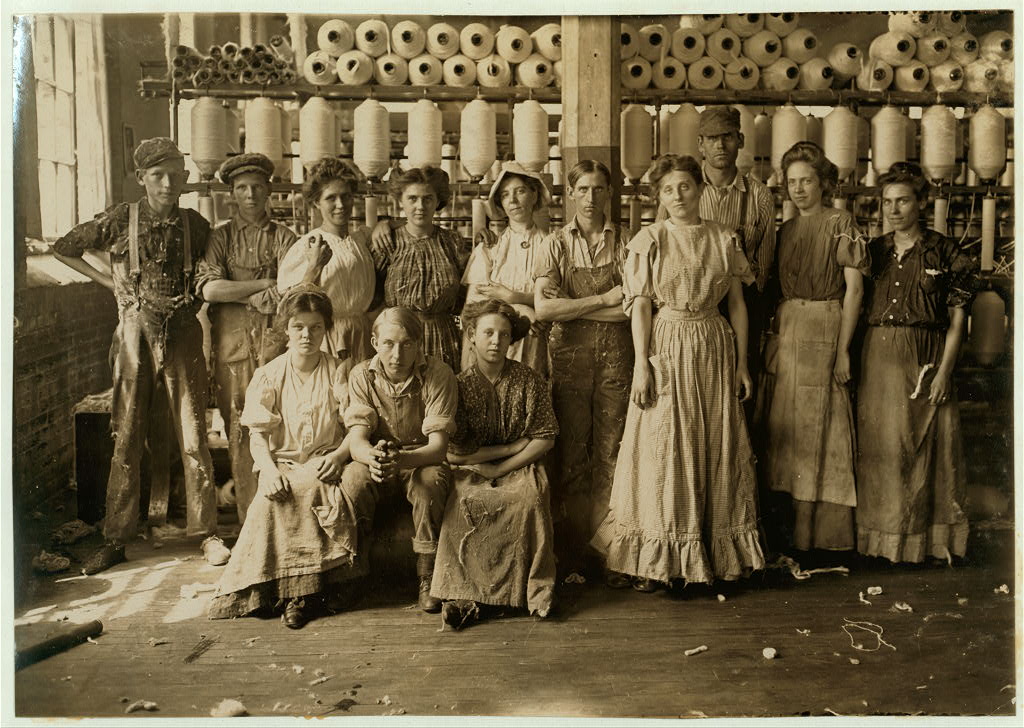
Industrialisation transformed what economies could produce. Mechanisation, energy use, transport and larger-scale organisation helped make goods available on a previously unimaginable scale. That productive achievement belongs in any serious assessment.
So do the working conditions. The 1833 Factory Act restricted child labour in textile factories and established an inspectorate. The surviving records show both the need for protection and the difficulty of enforcing it. Improvement did not arrive simply because employers collectively decided that better conditions would be more profitable.[7]
The political argument was about who would bear the cost of production: owners through safer workplaces and shorter hours, or workers through injury, exhaustion and lost childhoods. That argument has modern equivalents in insecure employment, unpaid platform work, environmental damage and supply chains that keep the cheapest stage of production far from the consumer’s view.
Technology does not decide how its gains are shared. Ownership, bargaining power, law and public policy help decide that. A machine can shorten working time, increase output, displace workers, raise profits or do several of those things at once.
5. The original oil platform
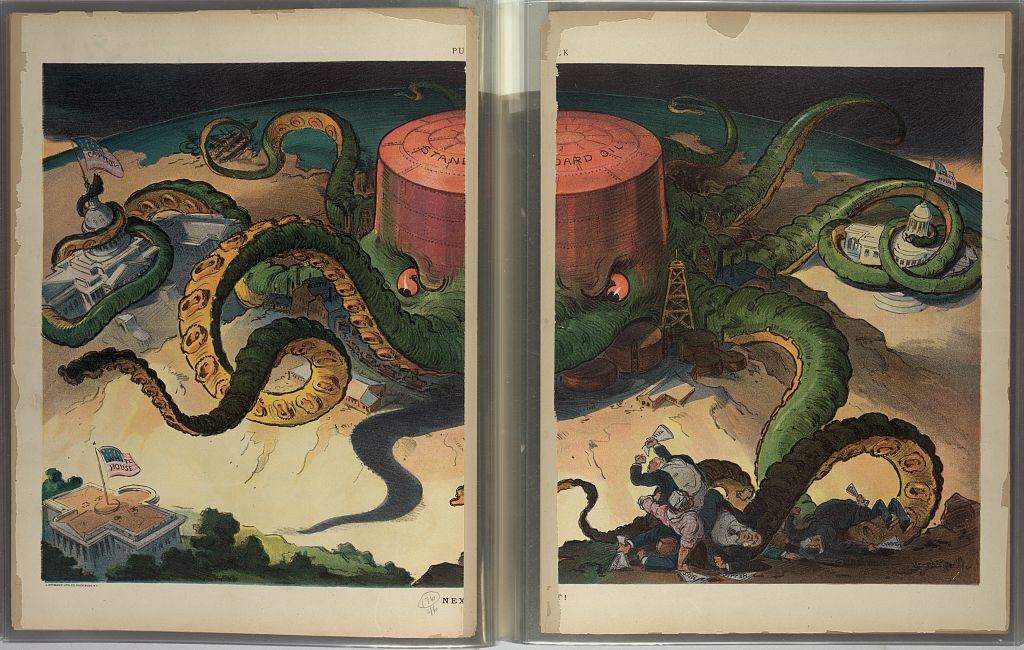
Standard Oil offers a historical answer to the suggestion that dominant firms are a new departure. The Sherman Antitrust Act became law in 1890. In 1911, the US Supreme Court upheld the finding against Standard Oil and ordered its combination dissolved; the restructuring produced 34 companies.[8][9][10]
The important point is not that refining oil efficiently was an offence. Competition law distinguished business success from unlawful restraints and monopolisation. The public question was whether an organisation’s conduct closed markets to others and entrenched control.
That distinction remains essential. Large scale can lower unit costs, fund research and support infrastructure. Breaking up a firm without understanding the market may destroy useful coordination. But allowing scale to become an excuse for exclusion can leave customers paying whatever the gatekeeper demands.
A century later, the product may be a search engine, cloud platform or AI accelerator. The underlying question is familiar: can another business reach customers without obtaining permission from the dominant intermediary?
6. Rags to riches was real. So was the ladder beside it
Andrew Carnegie rose from a poor immigrant background to immense industrial wealth. That is not a myth. But the detailed story includes employment relationships, investment opportunities and assistance. His early investment in Adams Express involved his mentor Thomas Scott and his mother raising money against the family home. The famous rise was not a solitary act performed outside a network.[30]
Nor does the rise erase what happened after success. The 1892 Homestead conflict involved the Carnegie steel business, Henry Clay Frick’s management, a lockout and a violent confrontation with Pinkerton agents. The life of an entrepreneur can contain both remarkable upward mobility and the use of corporate power against workers.[31]
Madam C. J. Walker offers another powerful example: a Black woman who moved from poverty and laundry work into building a substantial beauty business. Her achievement deserves recognition precisely because the barriers were formidable. The Smithsonian’s collection documents the business, her work and her networks.[32]
But a successful individual cannot stand in for everyone with similar ability. We hear about the exceptional survivor because there is a biography to read. We hear far less about people whose equally serious efforts ended in an unpaid bill, an illness or a lender’s refusal.
To establish opportunity, we need a denominator: how many people started in comparable circumstances, and what happened to them? A list of millionaires is not a social mobility study.
7. When capitalism was made to share more of the gain
The Great Depression strengthened the argument that finance required stronger public safeguards. The US Banking Act of 1933 introduced deposit insurance and restrictions associated with Glass–Steagall. The purpose was to change the architecture of banking, not merely tell depositors to choose better banks.[11]
In Britain, the Beveridge Report and the creation of the NHS helped establish a post-war settlement in which market activity coexisted with greater social protection. Healthcare, education, housing policy, infrastructure and organised labour affected what ordinary households could expect from economic growth.[12][13]
A safety net also changes the ability to take a business risk. If losing a job threatens access to essential treatment or the family home, the cost of experimentation is different from the cost faced by someone with savings and relatives able to help. Public services can support entrepreneurship by reducing the consequences of failure.
The post-war decades were not a golden age for everyone. Racial discrimination, unequal opportunities for women and colonial relationships complicate any nostalgic picture. Nor can every improvement be attributed to one tax rate or one institution. Reconstruction, technology, demographics and international conditions mattered too.
Still, the experience challenges a false choice. A society can have private businesses and substantial public provision. The argument concerns which institutions make prosperity both productive and widely accessible.
8. The turn towards liberalisation
The inflation and economic difficulties of the 1970s weakened confidence in existing arrangements. The Federal Reserve’s account of the Great Inflation describes a prolonged policy and economic failure, not a minor inconvenience invented to justify later reforms.[14]
From the late twentieth century, governments increasingly emphasised privatisation, deregulation, competition, financial liberalisation and shareholder returns. The details differed between countries and sectors. Some reforms opened markets; others created opportunities for concentration or transferred assets without creating effective competition.
Britain’s 1986 financial “Big Bang”, for example, ended fixed commissions and changed restrictions on how market firms operated. It is too simple to label every aspect anti-competitive: some longstanding barriers were removed. The harder question is what happened to power as finance became larger and more interconnected.[15]
This is where the language of efficiency needs interrogation. Efficiency for whom, over what period, and with which risks excluded from the calculation? A company can improve its reported return by cutting resilience, outsourcing responsibilities or using debt. Society may discover the omitted cost only when the system fails.
A good market reform should make it easier for a better business to displace an incumbent. A reform that merely replaces a public monopoly with a protected private one has achieved a change of owner, not necessarily a competitive market.
9. 2008: private upside meets public necessity
The financial crisis made the allocation of risk impossible to ignore. Britain committed cash and guarantees to stabilise banks because a collapse threatened payments, savings, employment and the wider economy. The National Audit Office records £133 billion of cash support alongside much larger guarantee arrangements.[17]
Those categories must not be added together and described as money permanently lost. Guarantees are contingent exposure, cash investments can be recovered, and the figures changed over time. An honest criticism of the rescue does not require pretending that every pound of support became a final taxpayer loss.
The NAO also recognised the case for intervention to preserve financial stability. Letting the system collapse would not have punished only bank executives and shareholders. Depositors, workers and viable businesses would have suffered.[18]
The deeper issue is the incentive created before the rescue. If an institution becomes so important that government cannot readily let it fail, its private decisions can create a public obligation. Effective regulation, credible resolution arrangements and adequate loss-absorbing capital are attempts to address that contradiction.
We should therefore ask the difficult question before the next crisis: who receives the return while things go well, and who is expected to provide the backstop when they do not?
10. Today's gatekeepers: three different kinds of power
The word monopoly is often used too loosely. A dominant firm, a concentrated market and a legally established abuse are not interchangeable. A water network has different economics from a search engine; both differ from a manufacturer accused of overcharging for medicine.
The CMA’s 2024 assessment found that estimated markups across the British economy had increased by around 10% between 1997 and 2022. That is a change in the estimated markup measure, not proof that every retail price rose by ten percentage points. Its wider findings were mixed: aggregate concentration did not simply rise everywhere, while business dynamism had weakened.[19]
Google provides a specific legal example. Following the US court’s 2024 search monopoly liability decision, remedies announced in September 2025 restricted exclusive distribution arrangements and required forms of data access. These are identified proceedings and remedies, not a claim that every Google product is unlawful or every appeal exhausted.[20]
Cloud computing shows a different problem. The CMA’s 2025 investigation identified an adverse effect on competition, including barriers connected to switching and software licensing. Its October 2026 update described further action, including work on Microsoft’s business software ecosystem. That is an ongoing regulatory response, not a declaration that cloud competition has been fixed.[21][22]
Medicine offers a particularly direct public cost. In July 2026, the Court of Appeal upheld infringement findings in the hydrocortisone case. The CMA described tablet prices rising from below £1 to above £70 between 2007 and 2016, and annual NHS spending increasing from roughly £500,000 to more than £80 million. Penalty issues still required further consideration.[23]
The significance is not that profitable medicine must be wrong. It is that proven anti-competitive conduct can divert public money away from other care. Here, the link between market abuse and the general public is concrete.
Private equity: improving the business or extracting from it?
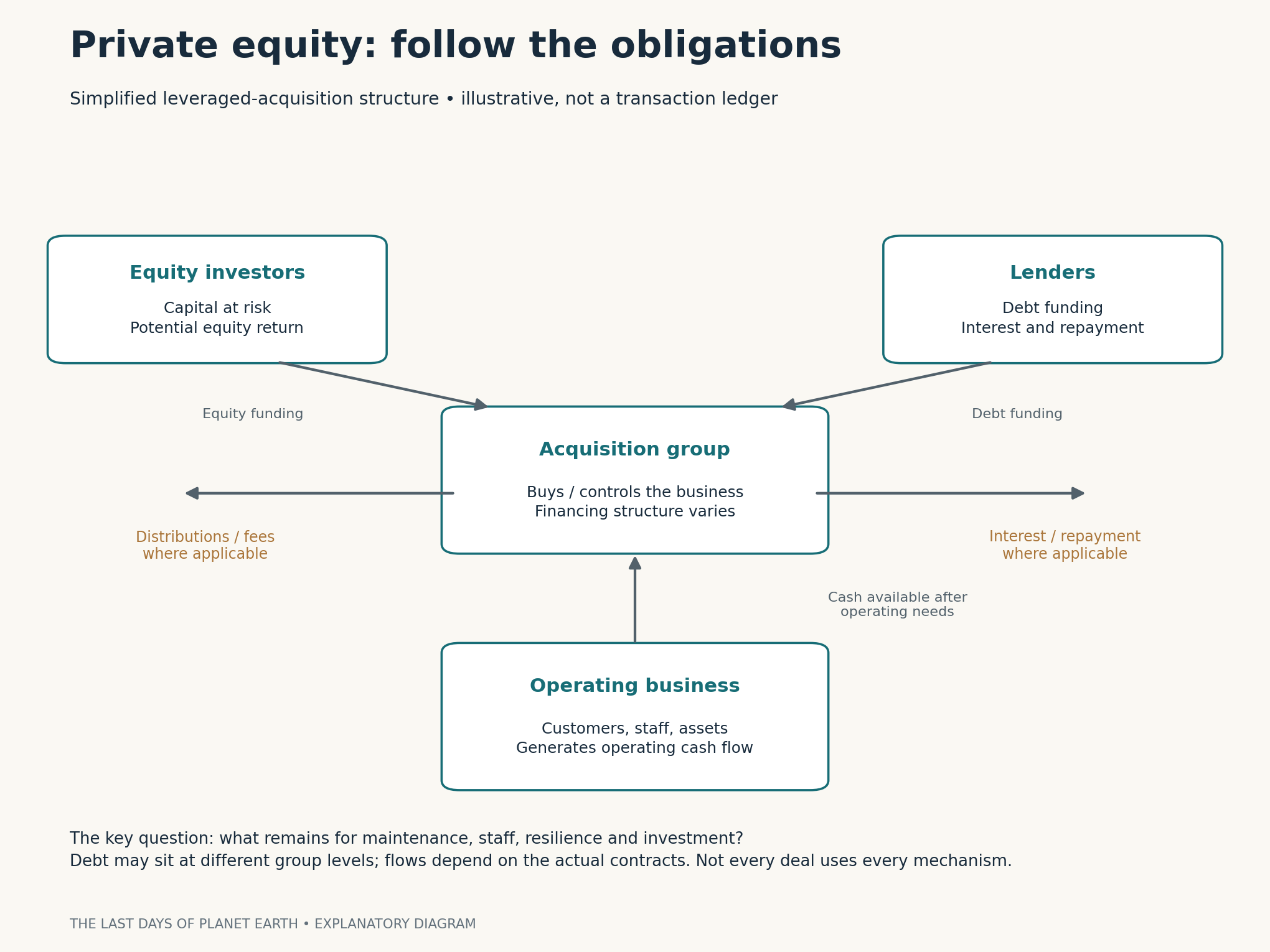
Private equity is an ownership and financing model, not a synonym for asset stripping. Funds acquire stakes in businesses, often seeking operational changes and a later sale. They can bring capital, management expertise and a way for a founder to retire or expand. A leveraged buyout adds substantial borrowing to the arrangement; the borrowing may sit within the acquired business or its ownership structure.
That creates a question which reported investor returns cannot answer on their own: did the operating business become better, or did financial arrangements allow owners to take money out while leaving more risk behind?
The difference matters because a successful investment and a resilient service are not necessarily the same outcome. If owners have already received distributions, a later failure may fall heavily on creditors, employees and customers. Equally, investors can lose their equity, and debt can finance genuine improvements. We have to follow the transactions rather than infer the result from the ownership label.
How the extraction mechanisms can work
Borrowing amplifies outcomes. Imagine a £100 million acquisition funded with £40 million of equity and £60 million of debt. If the business is later sold for £120 million with the debt unchanged, £60 million remains for equity before fees and other adjustments: a 50% gain on the original £40 million, although the enterprise value rose 20%. If its value falls to £80 million, equity falls to £20 million. This simplified illustration excludes interest, tax, cash flows and transaction costs. It shows leverage, not a real deal.
A dividend recapitalisation uses additional borrowing to fund a distribution. It can return capital without selling the business, while increasing future servicing obligations. A sale and leaseback releases property value but replaces ownership with rent commitments. Management and advisory fees can pay for real work; related-party charges also require scrutiny over price, purpose and transparency.
None of those transactions is automatically unlawful. The assessment should examine the combined effect: cash generated by operations, debt and lease obligations, distributions, fees, maintenance, staff and investment. A business can appear healthy before financing and property costs while having little room left after them.
A documented warning from children’s care
The CMA’s 2022 study of children’s social care found insufficient suitable placements and problems with how the market operated. Within its dataset, children’s home providers had average operating margins of 22.6% over 2016–20. It also identified particularly high debt among some private-equity-owned providers and warned about the risk of disorderly failure disrupting children’s homes.[66]
Those historical, sample-specific figures are not a November 2026 margin for every provider. Operating margin is not cash available after interest and other financing obligations. Nor did the study establish that all private providers offered poor care. Its importance is the interaction of profitability, fragile financing and a service whose users cannot safely be treated as ordinary customers switching suppliers.
The counter-evidence matters
Research by Davis and colleagues on thousands of US buyouts found highly varied effects across deal types and economic conditions, alongside average productivity gains. Its findings do not support a universal claim that private equity always destroys jobs or always improves a company. The underlying buyouts span 1980–2013, so this is historical evidence, rather than a census of present-day British care ownership.[65]
The practical test is whether returns arise from additional productive value and sustainable operations, or depend heavily on transferring risk to parties with less choice. In essential services, regulators and commissioners should understand the ownership chain, related-party transactions and financing obligations before a crisis. Private management does not remove the public’s exposure when continuity of care cannot be allowed to disappear.
11. Nvidia: selling the machinery, financing the customers
Nvidia belongs at the centre of this discussion because its position extends beyond selling a powerful chip. It supplies hardware and software, invests in parts of the AI ecosystem and enters agreements to buy cloud capacity. Those relationships can help the industry expand. They can also reinforce dependence on the supplier already occupying a crucial bottleneck.
The latest reported numbers show the scale. For its quarter ending 25 October 2026, Nvidia reported revenue of $115.8 billion and a GAAP gross margin of 74.8%. The comparable margin a year earlier was 73.4%, while the immediately preceding quarter was 75.0%. The company forecast 71–72% for the following quarter.[44]
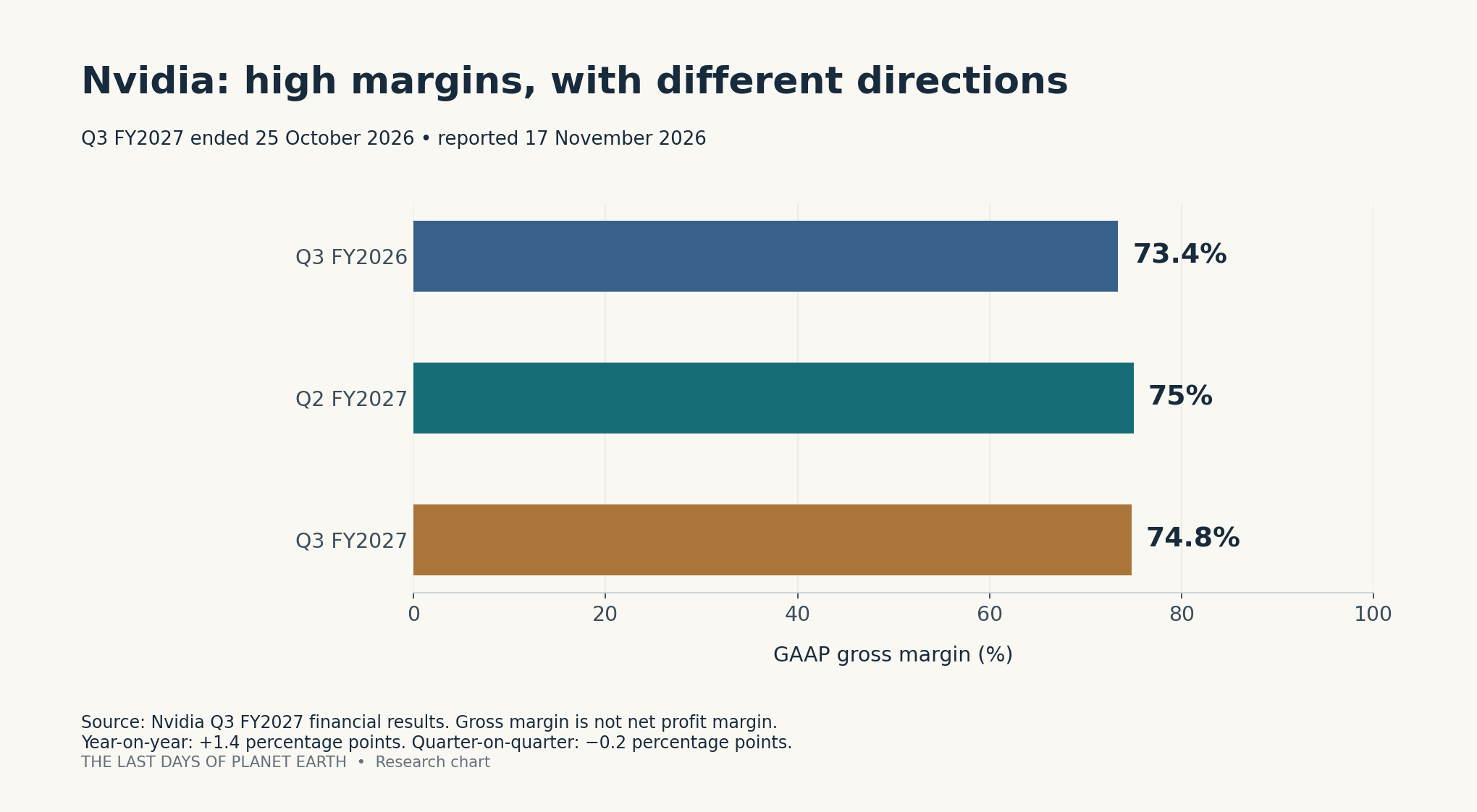
These are exceptionally large margins, but the direction matters. “Nvidia’s margins keep rising” would misdescribe the sequential comparison and the outlook. Gross margin also does not mean that 74.8 cents of every revenue dollar becomes distributable profit. Research, operating costs, tax and other items remain to be accounted for.
The moat includes software
Advanced AI computing is not a market where a newcomer merely orders a machine and starts competing on equal terms. Developers rely on software tools, libraries, expertise and compatible infrastructure. Moving workloads can involve expense, engineering work and performance uncertainty.
France’s competition authority highlighted dependence on Nvidia’s CUDA software environment in its 2024 generative AI opinion, alongside chip availability and investment relationships as potential competition concerns. It also recognised competing approaches. This was an assessment of risks, not a judgment that Nvidia had committed an infringement.[45]
The commercial logic is powerful. A useful development ecosystem attracts developers; their work makes the platform more attractive; businesses then prefer the platform their staff already know. This is not automatically abuse. It can reflect genuine technical advantages. But it can make a theoretically available alternative less practical than a price list suggests.
The investment can come back as demand
The September 2025 OpenAI–Nvidia announcement described a letter of intent involving at least 10 gigawatts of Nvidia systems and an intention for Nvidia to invest up to $100 billion progressively as deployment occurred. That announcement was not evidence of a completed $100 billion cash transfer.[46]
The proposed structure illustrates the issue: a supplier can help finance an organisation whose expansion depends on purchasing that supplier’s products, directly or through infrastructure partners. Nvidia can potentially benefit both from selling the systems and from the value of its investment.
That does not establish fake revenue. Supplier finance and strategic equity can fund real assets and genuine services. The test is whether the completed infrastructure produces enough independently paying demand to justify the expenditure, without needing a continuing chain of fresh investment to support the next purchase.
Nvidia can also support the cloud buyer
Its quarterly filing for July 2026 disclosed approximately $36 billion of commitments to purchase AI cloud capacity from selected partners, generally over six years, with possible revenue-sharing arrangements. The filing also described substantial equity investments and investment commitments.[47]
The duration and conditions matter. A multiyear commitment is not the same as one year’s expenditure. Nor can investment assets, future commitments and reported sales be added together to manufacture a single measure of circular money.
Nevertheless, a purchase commitment from a strong counterparty can help an infrastructure provider demonstrate future demand and attract finance. That provider may then acquire Nvidia equipment. The supplier is no longer standing entirely outside the market it serves: it is helping support both capacity and demand.
| Relationship | Mechanism | What to examine |
|---|---|---|
| Supplier investment | Nvidia invests in an AI company | Can fund expansion that uses Nvidia systems; not proof of a completed circular cash flow. |
| Cloud demand support | Nvidia commits to buying cloud services | Can support a partner’s financing and equipment purchases; also creates a future obligation. |
| Independent demand | Users pay for useful AI services | Sustainable end-customer demand is the economic test; capacity spending alone does not establish it. |
This diagram describes a possible economic mechanism, not a traced accounting flow for every contract. Equity ownership, revenue recognition, financing guarantees and future service purchases are different legal and accounting relationships. Treating them as identical would obscure the risks rather than expose them.
Where can the public lose?
The first possible cost is a gatekeeper premium. If effective substitutes remain weak, businesses buying AI computing may pay more than they would in a more contestable market. Some of that can be passed into subscriptions, business services or public procurement. The extent of pass-through requires evidence; a supplier’s high margin alone does not quantify the consumer loss.
The second is dependence. A hospital, university, government department or small company can find itself reliant on a chain of AI providers whose own costs and technical choices depend on a narrow set of suppliers. Procurement should therefore consider switching, interoperability and long-term access, alongside the headline price.
The third is infrastructure allocation. Data centres require electricity, land, connections and cooling. If public bodies subsidise expansion or customers fund network reinforcement through bills, the distribution of costs needs scrutiny. It is not enough to count private investment as a public benefit while leaving enabling costs outside the calculation. Equally, we cannot assume that every project receives the same subsidy or raises household bills by the same amount.
The fourth is financial spillover. If financed capacity substantially outruns sustainable demand, investors and lenders may take losses, and projects may be cancelled. That is a risk scenario, not a forecast of an inevitable crash or a claim that taxpayers have already guaranteed the entire AI industry.
The defence deserves a hearing
Nvidia has produced technology people actively want. Supplying a difficult, fast-changing product at scale requires research, skilled staff, manufacturing partnerships and execution. Strong margins may reward innovation and scarcity as well as market power. Customer investments can accelerate useful deployment rather than merely entrench an incumbent.
The CMA’s 2024 foundation-model update described a network of more than 90 partnerships and investments involving major technology firms. Such relationships can bring resources and expertise; the concern is whether control of essential inputs restricts future competition.[48]
The right criticism is therefore precise: Nvidia’s overlapping roles can reinforce its commercial position and deserve scrutiny. It is not established merely by those relationships that every sale is artificial, that every margin dollar is extraction, or that management intended to impoverish the public.
What should be disclosed? Material financing conditions; obligations to buy particular hardware; the exposure of customers to a single supplier; the assumptions behind capacity commitments; and who bears the downside if demand disappoints. Where public support is involved, the public should also see the expected benefit and the route by which that benefit reaches them.
The global bill: what the purchase price leaves out
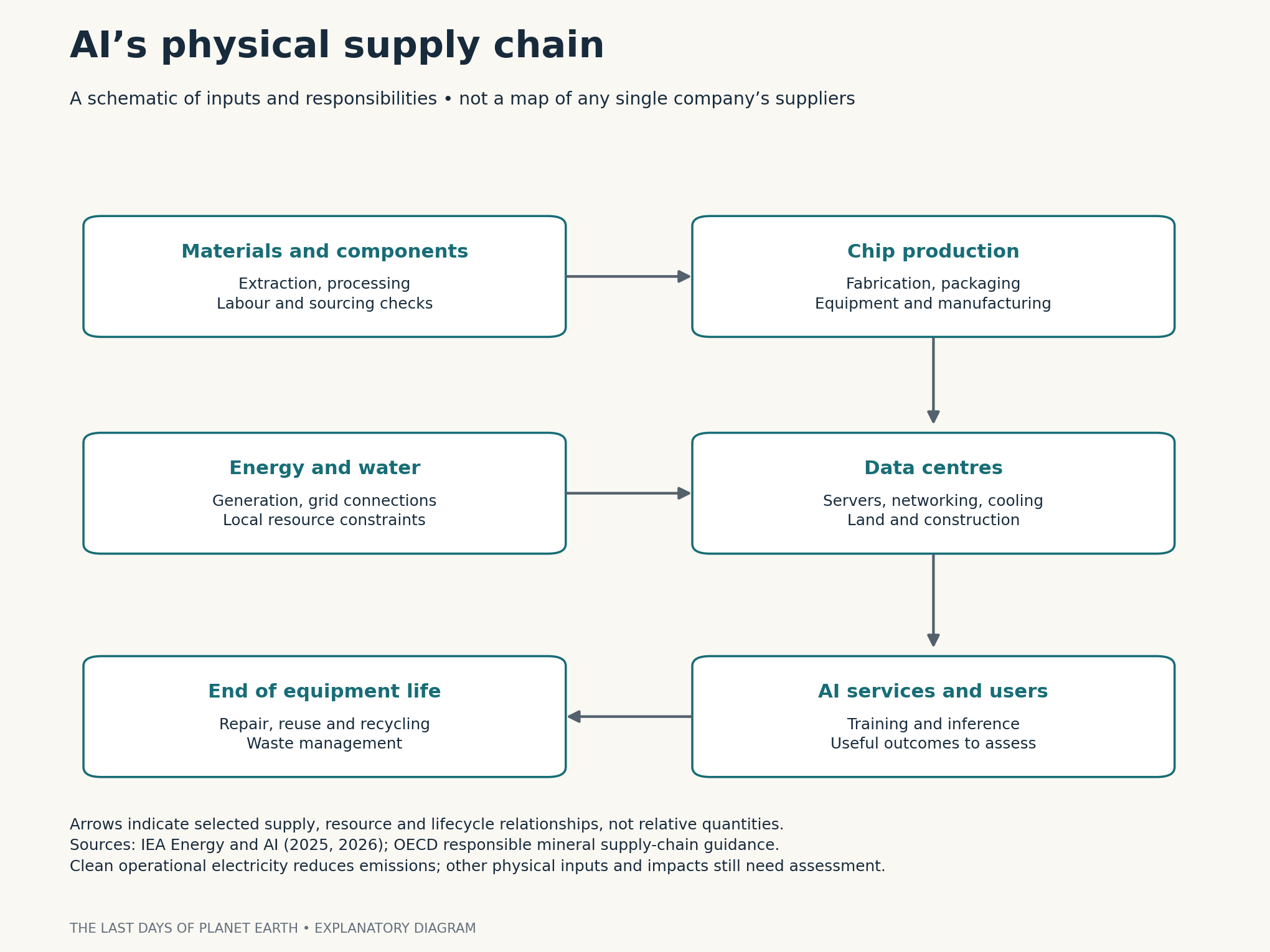
An account centred on British consumers and US technology companies can hide the people and places supplying the inputs. Extraction, manufacturing, assembly, shipping, electricity and disposal are part of production even when they sit outside the company selling the final product.
Low prices can reflect better technology and organisation. They can also reflect workers having few alternatives, weak enforcement or environmental damage borne by somebody else. The existence of a global supply chain proves neither explanation; we need evidence about the particular activity.
The ILO’s 2022 global estimates, referring to 2021, put forced labour at 27.6 million people, including 17.3 million in the private economy outside forced commercial sexual exploitation. These are historical global estimates, not a finding about Nvidia, a particular supplier or every imported product.[71]
The OECD’s minerals guidance provides a framework for identifying and addressing risks involving serious human-rights abuse, conflict and financial crime. Due diligence is meant to follow the supply chain, rather than end with the reassurance that the immediate contractor signed a policy.[74]
Corporate responsibility should therefore involve traceability, investigation and remedies. A consumer cannot reasonably audit a mine from a product listing. Neither can a company establish that all risks have been removed merely by publishing an ethical-sourcing statement. The standard should be what it knows, what it checks and what it does when problems emerge.
AI does not float above the physical economy
The IEA estimated that all data centres consumed about 415 terawatt-hours of electricity in 2024, around 1.5% of global electricity demand. This is not AI alone. Its 2025 report also examined the potential for AI to improve energy operations; assessing costs does not require denying possible benefits.[72]
In April 2026, the IEA reported that data-centre electricity demand had risen 17% in 2025, compared with roughly 3% growth globally. It also stressed that greater demand need not automatically raise electricity prices: infrastructure, policy and integration matter. More efficient individual AI tasks can coexist with growing overall consumption when use expands.[73]
Clean electricity would substantially change the emissions calculation. It would not make the hardware, grid capacity, cooling, land and materials disappear. The public question is whether added demand is matched with appropriate infrastructure and whether its costs are allocated fairly. A claim to buy renewable electricity should be examined for what it covers, when and where power is supplied, and which residual impacts remain.
This closes a gap in the familiar argument about capitalism’s efficiency. A business may be efficient at minimising its own bill while leaving others to meet costs excluded from the price. Equally, new technology can reduce resource use elsewhere. We should compare credible whole-system outcomes, not assume either a disaster or a free benefit from the company’s accounts alone.
12. The household balance sheet is part of the business plan
Arguments about entrepreneurship often begin with an idea and omit the rent. A person still needs somewhere to live while developing a product, finding customers and waiting to be paid.
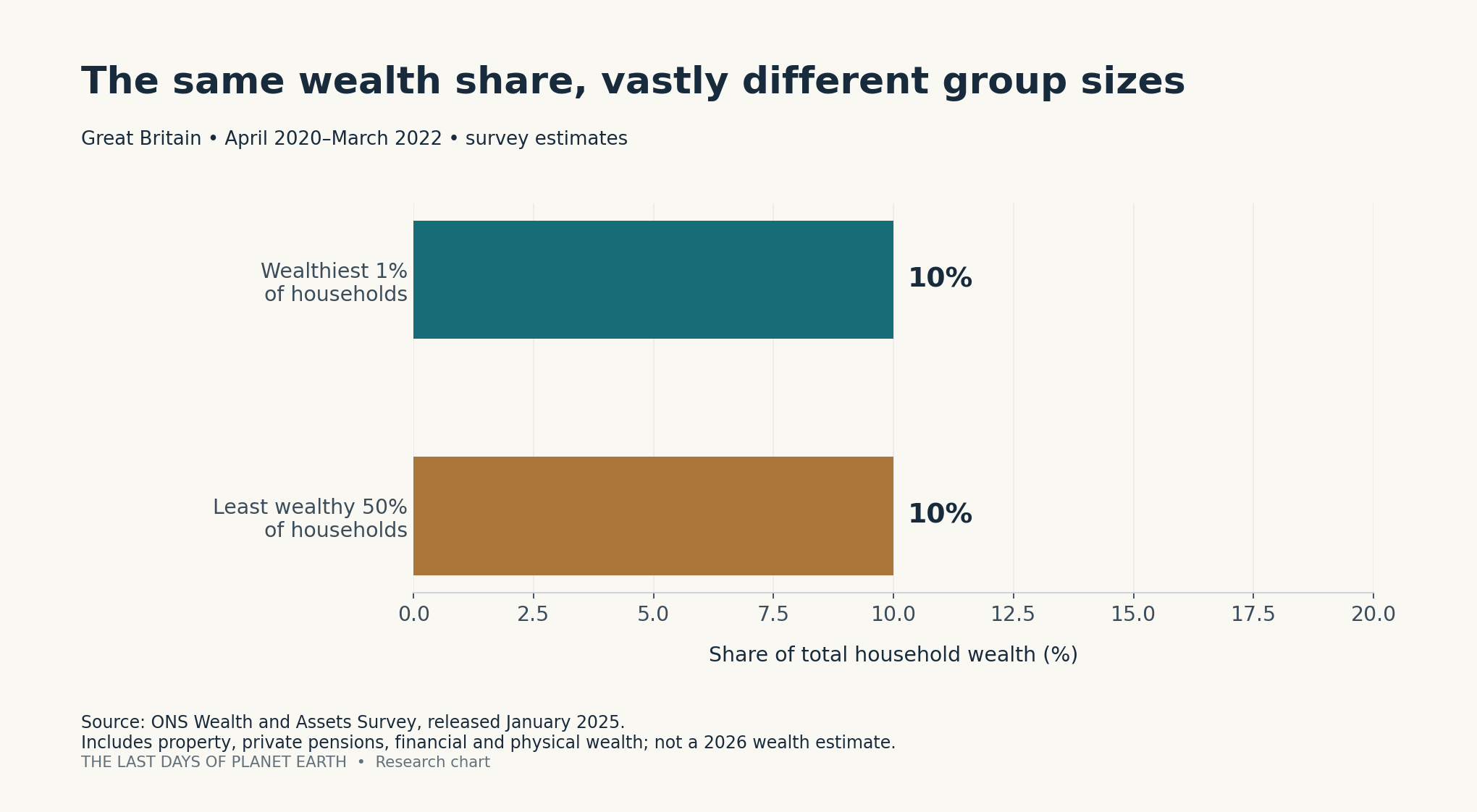
The ONS estimated that the wealthiest 1% of households held about 10% of household wealth in Great Britain in 2020–22, approximately the same share as the least wealthy half combined. This measure includes property, financial wealth, physical wealth and private pensions. It is a dated survey estimate, not an exact account of wealth in November 2026; surveys also have difficulty capturing the very richest.[24]
Housing then affects the room available to take risks. For 2025, the ONS reported median house-price-to-full-time-earnings ratios of 7.6 in England and 6.0 in Wales. These compare prices with individual earnings, not combined household incomes. Affordability had improved from its 2021 peak, so a claim that it becomes worse every single year would be false.[25]
Improvement does not remove the importance of family help. IFS research published in 2026 examines how house prices and parental resources interact with mobility, including the ability to access places with better opportunities. The housing market influences who can move to where the jobs and networks are.[26]
Imagine two equally capable founders. One has £15,000 saved and must meet every household bill. The other has the same savings, but a family willing to cover a year’s housing and living costs. This is an illustration, not a survey finding. The second person can test more ideas, wait longer for a customer and recover from a mistake more easily. The difference is not necessarily ambition. It is runway.
Housing and essential services: investment, scarcity and customers who cannot leave
Buying an existing home transfers ownership. Building an additional usable home expands the stock. Both can be legitimate transactions, but their immediate effects on supply are different. Refurbishment, conversion and management can add value too; the relevant distinction is what the investment actually changes.
A landlord’s income can cover finance, maintenance, insurance, management and risk as well as a return from scarce land or restricted alternatives. We should examine those components rather than describe every rent payment as pure extraction. Conversely, a rising property valuation does not establish that the owner supplied a corresponding improvement.
The CMA’s 2024 housebuilding study identified problems involving the planning system and the speculative development model. It described incentives to pace private sales with local absorption rates rather than build beyond the rate at which homes could be sold without reducing prices. This is an account of incentives and constraints, not proof that every undeveloped site is deliberately hoarded.[69]
The lesson is that relying on commercial builders to maximise sale value is not identical to instructing them to maximise the number of affordable homes. Planning reform, infrastructure and different forms of delivery need to be assessed together. An intervention that increases purchasing power without enabling supply can operate differently from one that adds homes; the local response matters.
The captive customer problem
A household can postpone a discretionary purchase. It cannot indefinitely postpone water, heating or a safe place to live. Network services may also have natural-monopoly characteristics: duplicating every pipe is different from opening a competing shop. Those conditions make regulation, service obligations and financing resilience central to the assessment.
Thames Water offers a documented example. In May 2025, Ofwat announced penalties totalling £122.7 million following wastewater and dividend investigations, including £18.2 million relating to dividend-rule breaches. It stated that the penalties were to be borne by the company and investors, not customers.[70]
That decision must not be represented as a fine formally added to household bills. Nor does it prove that every dividend from a utility is improper. It does establish why owners’ distributions should be assessed against obligations to maintain an essential service.
Whether the owner is private, public or cooperative, the same questions deserve answers: what is being invested, how is performance measured, what return is justified, and who has to intervene if the service fails? Changing ownership without answering them can leave the underlying accountability problem intact.
Inherited advantage: when the starting line moves with the family
Inherited wealth is more than money received after a parent dies. An outright inheritance, a deposit provided years earlier, a family guarantee and free accommodation during a business launch arrive at different times and perform different jobs. A late-life bequest may improve retirement security; earlier help can determine whether somebody buys a home or starts a company at all.
Research using the UK’s Understanding Society study found stronger intergenerational persistence in wealth than in earnings. Only around half of the measured persistence in wealth could be accounted for by persistence in earnings and education. That is not proof that inheritance explains the whole remainder, but it shows why earnings alone cannot describe the transmission of advantage.[61]
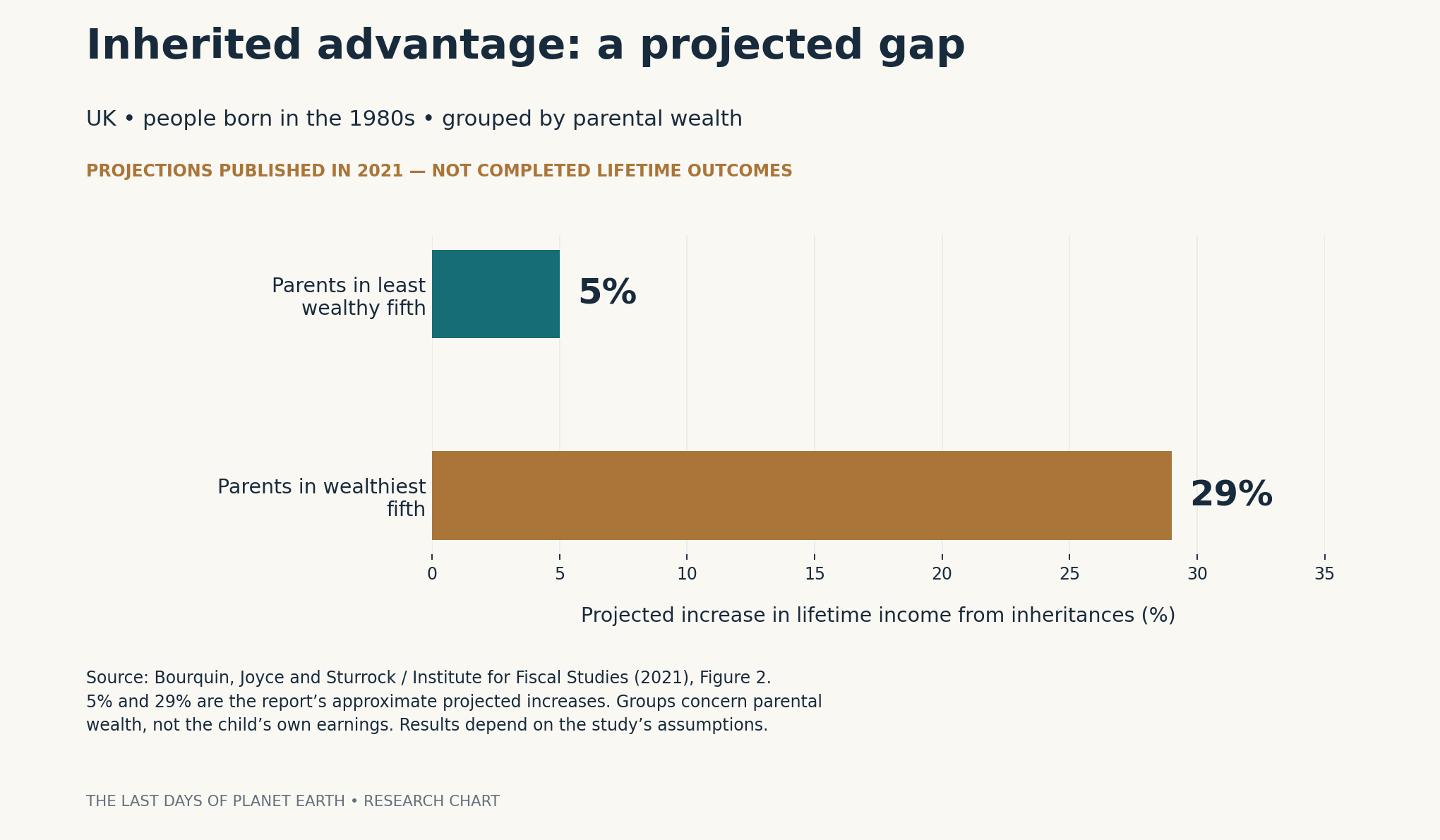
IFS modelling published in 2021 projected that, among people born in the 1980s, inheritances would increase lifetime incomes by around 5% for those with parents in the bottom fifth of the wealth distribution, compared with 29% for those whose parents were in the top fifth. These are projections under the study’s assumptions, not completed outcomes observed for an entire generation.[60]
It would be misleading to turn those findings into a claim that every heir is rich or every person without an inheritance is permanently poor. Families differ; care needs, asset prices, longevity and personal decisions change what is transferred. The relevant finding is that parental resources can affect lifetime opportunity beyond what a person earns themselves.
Taxing work, gains and transfers
A fair comparison must follow the tax base as well as the headline rate. Wages, dividends, asset gains and inheritances are different legal categories. Timing matters too: a tax payable when an asset is sold operates differently from a deduction made as wages arrive.
An OECD paper published in 2025 found that most member countries tax capital gains on realisation, often at preferential rates or with exemptions. It recognised stronger arguments for some adjustments, including inflation and double taxation, while finding mixed evidence for claims that preferential treatment necessarily promotes investment and entrepreneurship.[62]
Britain’s treatment of assets at death illustrates why rates alone are insufficient. HMRC’s manual states that assets are generally treated as acquired at their market value at death for capital gains tax purposes; death itself does not trigger that charge. Inheritance tax is a separate question. These rules must not be compressed into the false claim that every inherited asset is entirely tax-free.[63]
Consider a hypothetical asset bought for £100,000 and worth £400,000 at death. A later sale at £450,000 would ordinarily use the death valuation, rather than the deceased owner’s £100,000 purchase cost, as the starting point for calculating the beneficiary’s gain, subject to the applicable rules and adjustments. That illustration explains the basis reset; it is not a calculation of any particular estate’s total tax bill.
Trusts need equal care. They can separate control, entitlement and the timing of distributions, including providing for children or vulnerable beneficiaries. They are not automatic tax exemptions: HMRC describes circumstances involving charges on entry, ten-year anniversaries and exit, with treatment varying by trust type.[64]
Lawful planning, arrangements challenged under anti-avoidance rules, and tax evasion are not interchangeable. We should identify which mechanism is being criticised and why. The political question is whether the overall system fairly balances support for family provision, revenue needs, productive investment and an open starting line for people born without assets.
A ladder, or a family escalator?
Parents helping their children is understandable. The public issue is what happens when essential opportunities depend increasingly on assistance that some families cannot provide. A system can reward a parent’s effort while still entrenching the child’s advantage over another child who has done nothing wrong.
The answer need not be hostility to families. It can include broader access to housing, education, suitable startup finance and security against catastrophic setbacks. But an honest account of merit has to distinguish what the current owner created from what they received.
What evidence would answer the opportunity question?
We need studies that follow people from different parental-income and parental-wealth backgrounds through business entry, survival, owner earnings and eventual wealth. They should record family gifts, guarantees, outside finance and the household costs borne while the business develops. We should distinguish people who never apply for finance from those who apply and are refused, and business closure from personal financial ruin.
Comparisons would also need to account for age, location, sector, education and other relevant differences. Even then, an observed association would not automatically identify a single cause. This is a research requirement, not a claim that one existing dataset supplies every answer. Until such evidence is available for the question being asked, the article should say what is known and what remains uncertain. A succession of founder profiles cannot fill that gap.
Workers: does a more productive economy mean a better life?
The rags-to-riches debate can become an argument exclusively about founders. Most people will build their livelihoods through work rather than selling a company. An economy that offers a few spectacular exits while failing to provide secure, improving lives for ordinary workers has not answered the opportunity question.
But we must test the familiar claim that productivity rises while workers receive nothing. The ONS’s 2024 analysis of 1997–2023 found that Britain had not experienced the same aggregate decoupling between average labour compensation and productivity reported in some other economies. Its measure includes non-wage compensation and treats the self-employed carefully; it is not simply take-home pay.[67]
Research published through the International Productivity Monitor likewise found that UK mean hourly employee compensation broadly tracked productivity between 1981 and 2019, while median hourly wages grew more slowly. Its analysis highlights why averages and the experience of a typical employee can differ.[68]
These findings belong in the article because they prevent a misleading imported story. They do not establish that every worker benefited equally or that living standards were satisfactory. Mean compensation can rise while its distribution changes. Employer pension contributions are part of compensation, but cannot be spent on this month’s rent. A household can also be squeezed by housing, childcare and other costs despite an improvement in an aggregate pay measure.
Power is not captured by the hourly rate alone
The meaningful questions include whether hours are reliable, whether time is paid, whether workers can refuse unsafe work and whether changing employer is practical. A nominally independent contractor may value flexibility, or may carry risks without much effective control over price and conditions. The contractual label cannot settle which experience applies.
Employee ownership and profit-sharing offer routes to participation in gains, but their design matters. Shares with little voting influence are different from meaningful governance rights. A worker whose employment and savings depend on the same company also faces concentrated risk. Ownership should complement dependable pay and enforceable rights, rather than replace them with an uncertain promise.
A serious assessment would compare productivity, median wages, total compensation, working time, security and disposable income after essential costs. No single line on a chart is a complete verdict on whether prosperity reaches the people producing it.
13. Are people still getting ahead?
We must separate three questions. Absolute mobility asks whether people are better off than their parents. Relative mobility asks how strongly a person’s position depends on their parents’ position. Rags to riches asks about a much more dramatic jump, often into exceptional wealth. The answers need not move together.
Chetty and colleagues estimated that roughly 90% of Americans born in 1940 earned higher inflation-adjusted household incomes than their parents at age 30, compared with around 50% of those born in the 1980s. This is a comparison of cohorts, not a current probability that a British child will become rich.[29]
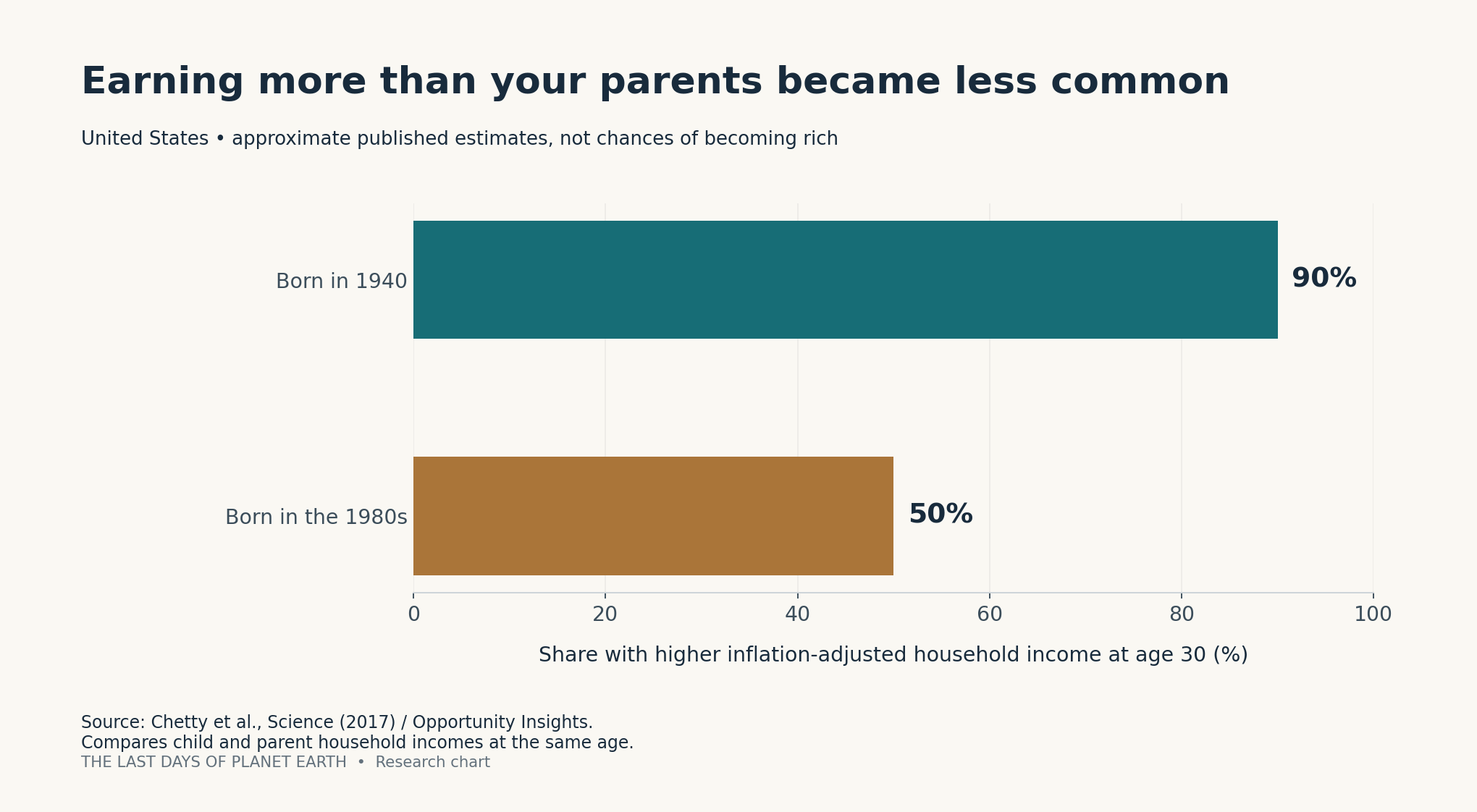
The study identified the distribution of economic growth as central to that decline. It cannot fairly be compressed into “nobody can succeed any more”, or used to calculate a present-day billionaire’s odds.
Britain’s Social Mobility Commission presents a mixed picture in its 2026 report. Some measures of relative occupational mobility for people early in their careers improved, while others showed stability. Housing and wealth add further dimensions. A blanket declaration that all mobility has collapsed would ignore the distinctions.[27][28]
Watch: Raj Chetty discusses the American dream, PBS/Amanpour and Company, 2019. The interview explains the research; the original study is linked in the sources.[41] Watch on YouTube.
The uncomfortable conclusion is more useful than a slogan: many people can improve their position, while advantages remain unevenly distributed and different forms of mobility tell different stories.
14. Must somebody bankroll you?
Every enterprise needs resources. That has always been true. But “resources” does not have to mean a billionaire patron. They can come from savings, wages earned alongside the business, customer revenue, deposits, loans, grants, cooperative ownership, retained profits or outside equity.
The capital required also depends on the activity. Starting a consulting practice is different from building a semiconductor fabrication plant. Prototyping a digital service can be much cheaper than training a frontier AI model; reaching customers at scale may still involve expensive platforms and marketing. Talking about “starting a business” as one uniform financial problem is misleading.
Sara Blakely describes beginning Spanx with $5,000 of savings and building without outside equity. Blackstone later acquired a majority stake in a transaction valuing the business at $1.2 billion in 2021. That is a useful counterexample to the claim that outside equity is always necessary. It is not evidence that she began in destitution, or that every founder has comparable chances.[33][34]
Watch: Sara Blakely at Stanford Graduate School of Business, 2018. An entrepreneur’s account of starting and growing a company, rather than a statistical sample of founders.[42] Watch on YouTube.
Research can also challenge the easy version of the bankroll argument. Hurst and Lusardi’s 2004 US study found that the relationship between household wealth and entry into business was relatively flat over much of the wealth distribution, rising at the very top. It also questioned the use of inheritance as straightforward evidence of financing constraints. Historical US findings do not settle present-day British conditions or capital-intensive AI, but they caution against a universal claim.[35]
Other evidence shows how opportunity is structured before a company is formed. Research by Bell and colleagues found that children from the top 1% of the parental income distribution were about ten times as likely to become inventors as those from below-median-income families. Exposure to innovation mattered. That does not mean rich children were ten times as talented; nor does it identify money as the only mechanism.[36]
Access to people, institutions, examples, time and finance can all matter. The question is not simply whether the cheque arrived. It is whether the person ever reached a position where somebody would consider writing one.
15. Follow the finance, and look beyond London
The British Business Bank’s 2026 Equity Tracker reported £12.3 billion invested in smaller businesses during 2025. London accounted for 48% of deals and 57% of investment value; seed-stage deal numbers fell 27%.[37]
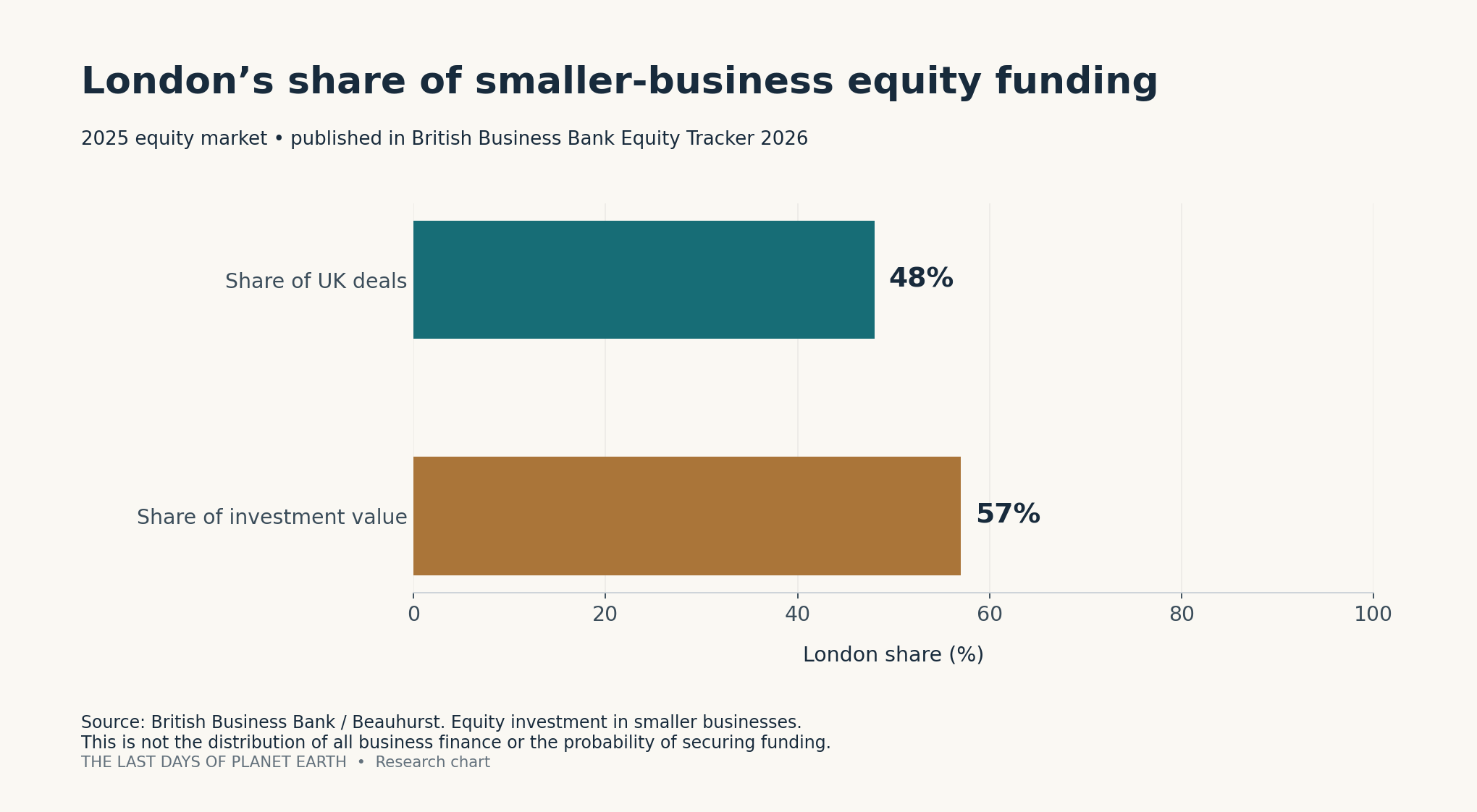
Geographic concentration does not prove that every rejected regional business deserved funding. Investors can have legitimate reasons for clustering around expertise and networks. But the pattern raises a policy question: does talent outside those networks receive an adequate opportunity to be assessed?
Government business population statistics also show that Britain contains millions of private-sector businesses. That is incompatible with a claim that entrepreneurship has ceased. It does not tell us how many owners earn a secure living, accumulate wealth or escape a disadvantaged background.[38]
Counting company registrations is not the same as measuring opportunity. We should also examine survival, owner income, access to suitable finance and the consequences of failure.
16. What a serious defence of capitalism must admit
There is a substantial case for markets and enterprise. Businesses can coordinate dispersed knowledge, develop new products and respond to needs that a central authority would struggle to anticipate. Competition can improve quality and reduce costs. Profit can reward taking a useful risk.
The development record also contains enormous material gains. The World Bank’s assessment of China’s poverty reduction describes more than 800 million people moving above the international extreme-poverty line over four decades. It attributes the experience to a combination of economic transformation and targeted policies. That is not a clean experiment proving that an entirely laissez-faire model produced the result.[39]
Equally, public ownership is not an automatic guarantee of competent management or accountability. Governments can misallocate resources; public monopolies can become unresponsive; regulation can be captured by the organisations it is meant to oversee.
A serious comparison therefore asks which arrangement works for a particular activity and how its failures will be corrected. It does not give either a company or a ministry unlimited credit in advance.
The most damaging defence of capitalism is to deny its abuses. If every cartel becomes “enterprise”, every inherited advantage becomes “merit” and every rescue becomes somebody else’s responsibility, the argument has ceased to defend competitive markets. It is defending whoever already holds power.
17. What would an economy with a real ladder look like?
First, competition policy must protect the ability to enter and challenge a market. That can involve merger scrutiny, action against exclusion, interoperability and practical switching. The remedy should match the market; a slogan about breaking up everything large is no more adequate than a slogan about leaving everything alone.
Second, finance should be assessed by what it enables. Does it support a productive business, or primarily inflate the price of an existing asset? Who receives a return, who bears risk, and what happens if the project fails? For AI infrastructure, those questions must follow the whole chain of supplier investment, customer finance and future service commitments.
Third, public support should come with a public account. A subsidy, guarantee or favourable contract needs an explanation of its purpose, expected benefit and downside. If the argument is that society must share the risk, society is entitled to ask how it shares the reward.
Fourth, the cost of having a go must fall. Affordable housing, dependable healthcare, education, transport, childcare and a functioning safety net can make enterprise accessible to people who lack a private financial cushion. These are conditions for opportunity as well as social policies.
Fifth, workers need meaningful bargaining power and routes to share gains. Competition for labour, enforceable rights, collective bargaining and employee ownership are different tools; none should be judged solely by whether an incumbent employer finds it convenient.
Finally, we should measure the outcome honestly. How many people from low-wealth backgrounds build secure livelihoods? How much does parental wealth predict later wealth? Can a viable small business reach customers without surrendering most of its value to a platform? Can someone fail once and still start again?
Those questions are harder than finding an inspirational billionaire. They are also more revealing.
Business and politics: who gets to write the rules?
A company does not have to defeat every competitor in the marketplace if it can help determine the conditions under which competitors are allowed to operate. That is why an account of capitalism which stops at prices, profits and ownership is incomplete. We also have to examine the relationship between accumulated wealth and political power.
The concern is not that business should have no voice. Governments need technical knowledge, employees need viable employers, and investment decisions affect communities. Trade unions, charities and campaigners lobby too. The democratic question is whether different interests receive a fair hearing, and whether public decisions can be examined by the people who bear their consequences.
There is a potentially self-reinforcing process here: commercial success generates resources; resources support access and advocacy; favourable rules can protect the successful business; protected returns provide more resources. This is an analytical mechanism, not proof that every profitable company has bought a government. But it explains why economic competition and democratic accountability belong in the same article.
Donations: disclosure does not establish equal influence
The Electoral Commission’s published guidance states that UK political organisations can accept donations and loans from permissible sources without an overall limit on their value. Reporting and source-checking requirements apply. The Commission publishes information allowing the public to identify reported donors and amounts.[49]
Those records are a starting point, not a verdict. A donation might reflect an existing political belief rather than a purchased policy. A favourable decision after a contribution does not establish a bargain. Equally, complying with disclosure requirements does not settle whether a funding system gives wealthy interests disproportionate opportunities to be heard.
For a specific allegation, the investigation should connect the donor, relevant business interests, meetings or communications, requested changes and subsequent decisions. It should also test alternative explanations and ask whether officials followed an established policy before the donation occurred. Without that work, a list of large cheques is suggestive rather than conclusive.
The broader issue requires no secret contract: does a party dependent on a small number of wealthy supporters have incentives to anticipate their preferences? That is a question about institutional design. It should be assessed across parties, rather than raised only when the donor supports somebody we dislike.
Lobbying: whose problem reaches the minister’s desk?
A major company can employ specialists to follow consultations, draft responses and explain the commercial consequences of a proposed rule. A small business owner may be occupied keeping the business alive. A dispersed group of customers may each have too little at stake individually to organise, even when their combined loss is large.
This unequal capacity matters before any vote takes place. Policy influence can involve defining the problem, selecting the evidence and narrowing the options considered feasible. A proposal described as “technical simplification” can contain important choices about who pays and who obtains an advantage.
The OECD’s 2026 integrity assessment found that member countries met, on average, 43% of its criteria for lobbying regulation. That is a benchmark of regulatory arrangements, not a finding that 57% of lobbying is corrupt. Its discussion also recognises that influence extends beyond conventional meetings into wider information campaigns.[50]
The practical demand is therefore for visibility: who is advocating, on whose behalf, with what funding, about which decision? Consultation evidence should be examined for its substance, while its sponsorship remains visible. Expertise is valuable; an undisclosed commercial interest is relevant context, not a substitute for answering the evidence.
The revolving door: expertise or a saleable address book?
Movement between government and business can bring useful knowledge in both directions. It can also create conflicts where a person moves into a sector they previously oversaw, uses privileged information or obtains access unavailable to an ordinary applicant. The OECD identifies both the benefits of expertise transfer and the risks of unchecked movement.[51]
Greensill provides a specific British example. In 2021, the Treasury Committee criticised former prime minister David Cameron’s use of informal lobbying channels on the company’s behalf and questioned the strength of the applicable rules. It noted that he had not broken the rules governing lobbying by former ministers.[52]
The same committee also credited Treasury ministers and officials with integrity in their handling of the lobbying and supported the decision to refuse Greensill access to the Covid Corporate Financing Facility. Omitting that finding would turn a documented problem about access into a misleading story about a successful purchase of the decision.
The lesson is more precise: privileged access can exist even when the requested outcome is refused. Rules need to address the use of public office as a later commercial asset, while allowing legitimate employment and advice. Appropriate safeguards include conflict checks, restrictions tailored to the previous role, disclosure and enforceable consequences. A declaration that nobody broke the existing rules is not, on its own, proof that the rules were adequate.
Public contracts: an unequal route to the customer
Government is a customer with enormous purchasing power. Who obtains a contract can determine whether a business grows, survives or never gets the chance to compete. Procurement is therefore part of the opportunity economy, not an administrative footnote.
The National Audit Office’s investigation of early pandemic procurement found that 47 of 493 potential suppliers in the PPE high-priority lane obtained contracts, compared with 104 of 14,892 in the ordinary lane. Referrals included officials, ministers’ offices, parliamentarians and health professionals. The NAO identified shortcomings in documentation and transparency.[53]
Those figures describe two differently selected groups; they are not a controlled experiment proving that a referral caused success. Nor does inclusion in the lane establish corruption or that every resulting contract was poor value. The emergency also created a real need to obtain equipment quickly.
Nevertheless, the disparity makes the public question unavoidable. Could an equally capable supplier without the right route in receive a comparable assessment? To answer that, we need documented reasons for selection, conflict checks, price and quality comparisons, delivery records and publication of outcomes. “We needed to move quickly” explains urgency. It does not remove the need to account for the choices made.
Media and platforms: influence over what counts as a problem
Political power also operates through attention. An issue that receives sustained coverage can become a ministerial priority; one that remains invisible may never reach a decision. Ownership, editorial choices, advertising economics and online distribution can all affect that process. This does not mean that readers are passive or that an owner dictates every journalist’s work.
Ofcom describes media ownership rules as safeguards for a plurality of viewpoints and against undue influence. Its work on online news also examines intermediaries that curate and recommend what audiences see.[54][55]
The distinction between making an argument and controlling access to an audience matters. More publications do not necessarily mean more independent routes to readers if distribution depends on a few platforms. Conversely, the existence of a wealthy owner does not demonstrate that any particular report is false. We should examine sourcing, editorial conduct and conflicts rather than substitute an ownership label for fact-checking.
For this article’s central argument, the concern is the combination of powers: an organisation may have a commercial interest in a policy, access to decision-makers and influence over the debate through which the policy is judged. That combination deserves scrutiny without assuming its effects in advance.
Nvidia: industrial policy and commercial advantage can overlap
Nvidia’s connection to politics is documented, not merely inferred from its size. US Federal Election Commission records identify the Nvidia Corporation Employees Federal Political Action Committee, connected to Nvidia, with a registration date of 27 August 2026. Registration establishes the committee’s existence; it does not show that any named politician received a contribution or granted a favour.[56]
Bloomberg Law reported in November 2026 that Nvidia’s federal lobbying disclosures covered semiconductor trade policy, AI and export controls, with approximately $4.7 million spent through the third quarter. These are reported lobbying expenses, not campaign donations, and do not establish that lobbying caused a particular policy outcome.[57]
The commercial interest is straightforward: decisions on where chips may be sold affect the available market. Rules on energy, infrastructure and public computing can affect demand and deployment. A company has reasons to engage with those decisions; the public has reasons to require transparent engagement.
Britain illustrates the overlapping roles. A parliamentary answer in April 2026 recorded approximately 5,448 Nvidia accelerator chips in Isambard-AI, alongside a separate Intel-based Dawn cluster. Public research infrastructure therefore creates useful capacity while also purchasing into particular technological ecosystems.[58]
Separately, Nvidia announced a £2 billion commitment to Britain’s AI startup ecosystem in September 2025. The announcement involved investment partners and received prime-ministerial endorsement. This was a company investment announcement, not evidence that £2 billion had already been paid out or that government had secretly guaranteed it.[59]
Together, these examples explain why the supplier should be examined within industrial policy as well as competition policy. Public investment can widen access to computing for researchers and startups. It can also strengthen demand for a major supplier. Both effects can exist at once.
The questions for government are practical. Were alternatives assessed against performance, total cost and switching requirements? Can publicly supported users move workloads? Are supplier relationships and conflicts disclosed? Do programmes develop competing capabilities as well as expand capacity? Are private investment announcements being kept distinct from public expenditure and guaranteed commitments?
None of the evidence above proves that Nvidia captured British policy, bribed an official or secured a procurement decision improperly. It establishes relationships and interests that should be visible when assessing the public return.
When market power becomes power over the market
Regulatory capture need not resemble a suitcase of cash. An institution can become dependent on industry expertise, accept the incumbent’s definition of the problem or lack the resources to test its claims. That is a risk to investigate, not a label to attach whenever a regulator reaches an unpopular decision.
Effective safeguards should make policy contestable: published evidence, disclosed funding and relevant interests, accessible consultations, reasoned decisions, independent scrutiny and a credible route to challenge. Stronger public expertise also matters. A government that cannot assess a supplier’s technical claims may have formal authority but little practical negotiating power.
This brings us back to the ladder. The newcomer competes not only against an established product and a larger advertising budget, but potentially against rules shaped around the incumbent’s business model. A fair opportunity economy must therefore protect the ability to challenge both the business and the rules under which it operates.
Capitalism’s political connection is not a side issue. If wealth can help preserve its own privileges, yesterday’s commercial winner can become tomorrow’s gatekeeper. The democratic test is whether the people outside that gate retain a meaningful say over who holds the key.
18. Capitalism did not stop. The argument is about what it rewards
There is no single moment when capitalism stopped being capitalism. State-backed monopolies, coercion and unequal starting positions were present long before the modern corporation. So were innovation, ambition, exchange and genuine improvements in living standards.
What changes is the balance between creating value and controlling access to it. A society can strengthen the institutions that keep markets contestable and opportunities broad. It can also allow wealth to purchase the rules, the infrastructure and the next generation’s starting positions.
Nvidia brings the dilemma into sharp focus. A company can make extraordinary technology while acquiring leverage over the companies building on it. Strategic investment can accelerate progress and reinforce dependence at the same time. The public interest requires examining the terms, not choosing between worshipping success and declaring every profit fraudulent.
Can someone still rise from rags to riches? Yes. Does that establish that the route is broadly accessible? No. Must every successful founder have a wealthy patron? No. Does access to money, security and networks change the odds? The evidence gives us strong reasons to take that seriously.
The test of an opportunity economy is not whether one exceptional person can make it. It is whether a capable person without wealth can obtain a fair hearing, keep enough of what they create and survive the attempt.
If the only reliable way to get a start is already to own the assets, the language of enterprise is doing public relations for privilege.
Sources, methods and further watching
This article distinguishes verified historical events, published estimates, regulatory findings, prospective arrangements and the author’s analysis. A high margin is not by itself proof of illegal conduct. A competition investigation is not a conviction. A projection is not a completed payment. All chart axes start at zero; approximate values remain labelled approximate.
Dates matter: the wealth chart uses 2020–22 observations, the equity chart 2025 activity, and the mobility chart historical US birth cohorts. None is presented as a survey taken in November 2026. Nvidia’s fiscal-year labels differ from calendar years. The financing diagram is explanatory and contains no invented transaction totals.
Additional viewing: Branko Milanovic’s LSE discussion, “Capitalism, Alone”, considers why capitalism has become the dominant global system while taking different political forms. It offers a wider comparative perspective rather than a substitute for the evidence cited here.[40]
- IMF: What Is Capitalism?
- UK Parliament: Enclosing the land
- London Museum: The East India Company
- UK Parliament: East India Company and Raj, 1785–1858
- UCL: Legacies of British Slave-ownership
- Adam Smith: Wealth of Nations, Book I, chapter X
- National Archives: 1833 Factory Act
- National Archives: Sherman Antitrust Act, 1890
- US Supreme Court: Standard Oil v United States, 1911
- Library of Congress: Standard Oil monopoly
- Federal Reserve History: Banking Act of 1933
- UK Parliament: Beveridge Report, 1942
- National Archives: Foundation of the NHS
- Federal Reserve History: The Great Inflation
- HMRC: Financial markets and Big Bang
- Bank of England: December 2025 Financial Stability Report, Box B
- NAO: Taxpayer support for UK banks — historical FAQs
- NAO: Maintaining financial stability across UK banking
- CMA: State of UK Competition Report 2024
- US DOJ: Google search remedies, September 2025
- CMA: Cloud services market investigation, final decision 2025
- CMA: Cloud actions update, March–October 2026
- CMA: Hydrocortisone judgment upheld, July 2026
- ONS: Household wealth, Great Britain, April 2020–March 2022
- ONS: Housing affordability, England and Wales, 2025
- IFS: How do house prices affect social mobility? January 2026
- Social Mobility Commission: State of the Nation 2026
- SMC: Long-term trends of social mobility outcomes, 2026
- Chetty et al.: The Fading American Dream, 2017
- Carnegie Corporation: Andrew Carnegie’s story
- Library of Congress: Homestead Strike, 1892
- Smithsonian: Madam C. J. Walker Collection
- Stanford GSB: Sara Blakely — Start Small, Think Big, Scale Fast, 2018
- Blackstone: SPANX majority investment completed, 2021
- Hurst and Lusardi: Liquidity Constraints, Household Wealth, and Entrepreneurship, 2004
- Bell et al.: Who Becomes an Inventor in America?
- British Business Bank: Small Business Equity Tracker 2026
- DBT: Business population estimates 2026
- World Bank: Four decades of poverty reduction in China, 2022
- LSE: Branko Milanovic — Capitalism, Alone, 2019
- PBS: Raj Chetty on the fading American dream, 2019
- Stanford GSB: Sara Blakely video, 2018
- Library of Congress: Udo Keppler, Next!, Puck, 7 September 1904
- Nvidia: Third-quarter fiscal 2027 results, 17 November 2026
- French competition authority: Generative AI competition opinion, 2024
- Nvidia and OpenAI: Letter of intent, 22 September 2025
- Nvidia: Form 10-Q, quarter ended 26 July 2026
- CMA: Growing concerns in AI foundation-model markets, April 2024
- Electoral Commission: Donations and loans — rules and reporting
- OECD: Anti-Corruption and Integrity Outlook 2026 — Lobbying
- OECD: Anti-Corruption and Integrity Outlook 2024 — Conflicts of interest
- House of Commons Treasury Committee: Lessons from Greensill Capital, 2021
- National Audit Office: Government procurement during the COVID-19 pandemic, November 2020
- Ofcom: Review of the Media Ownership Rules 2024
- Ofcom: Media plurality and online news, 2022–23
- US Federal Election Commission: Nvidia employees PAC — committee record, 2026
- Bloomberg Law: Nvidia lobbying disclosures, 9 November 2026
- UK Parliament: Written answer on AI Research Resource capacity, April 2026
- Nvidia: UK AI startup ecosystem investment announcement, September 2025
- IFS: Inheritances and inequality over the life cycle, 2021 projections
- IFS / Fiscal Studies: Intergenerational wealth mobility in the UK, 2024
- OECD: Taxing capital gains — country experiences and challenges, 2025
- HMRC: Value of assets transferred from an estate, updated September 2026
- HMRC: Trusts and Inheritance Tax
- Davis et al.: The (Heterogenous) Economic Effects of Private Equity Buyouts, 2024 research version
- CMA: Children’s social care market study — final report, 2022
- ONS: Trends in the UK labour share, 1997–2023; published November 2024
- International Productivity Monitor: UK productivity and pay research, 2021
- CMA: Housebuilding market study — final report, 2024
- Ofwat: Thames Water wastewater and dividend penalties, 28 May 2025
- ILO: Forced labour data — 2022 estimates referring to 2021
- IEA: Energy and AI — executive summary, 2025
- IEA: Data-centre electricity use in 2025 — April 2026 update
- OECD: Responsible mineral supply chains — due diligence guidance
- Library of Congress: Lewis Hine, Indianapolis Cotton Mill workers, August 1908
Chart values and definitions are stated in their captions and linked original sources. The downloadable edition also contains a CSV data appendix.