
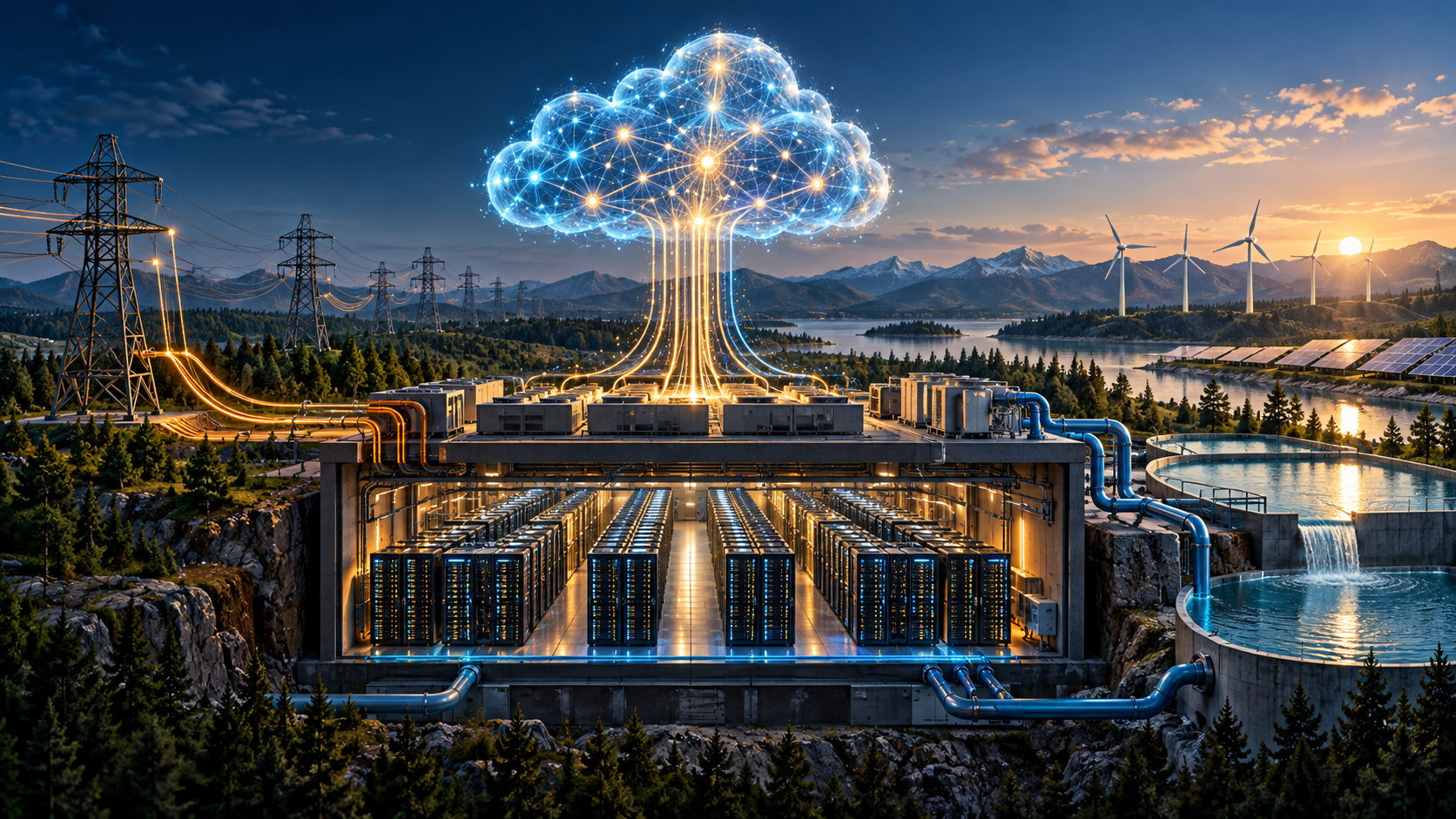
The cloud has a power socket. Behind every AI service sits physical infrastructure—and somebody has to supply its electricity.
Artificial intelligence arrives on our screens as something almost weightless: a paragraph, an image, a suggested answer. Its convenience can hide the machinery behind it. The question is not whether computers should use energy. It is whether the expansion of AI is being planned with the same care as the technology itself.
What sits behind the screen?
The International Energy Agency’s explanation of data centres describes facilities containing servers, storage, networking equipment, cooling systems and backup power. AI model training and deployment largely take place in these buildings. Electricity runs both the computing equipment and the systems that keep it working.
Training develops a model; using that model to produce an answer is a separate activity, often called inference. Both require computation. A finished model is therefore not a machine whose energy costs end when training is complete.
There is an essential qualification. Data centres also support ordinary websites, cloud storage and many other digital services. Calling their entire electricity footprint ‘the cost of AI’ would be misleading.
The scale—and the limits—of the figures
In its April 2026 update, the IEA reported that global data-centre electricity demand rose 17% in 2025, compared with 3% growth in electricity demand overall. These are estimates of annual consumption growth, not measurements of the cost of an individual prompt.
The accompanying 2026 report estimates consumption at 485 terawatt-hours in 2025 and projects roughly 950 terawatt-hours in 2030, about 3% of global electricity demand. A terawatt-hour is a billion kilowatt-hours. The 2030 figure is a central projection, not an inevitable outcome.
Those numbers deserve attention without exaggeration. Three per cent is not most of the world’s electricity. Nor does a relatively small global share mean that every town, grid or power supply can absorb the demand easily.
Why efficiency is not the whole answer
The same 2026 report describes improving energy efficiency per AI task, alongside the growth of more demanding applications. Video generation, extended reasoning and automated agents can require much more computation than simple text generation.
The arithmetic matters: using less electricity for each task can coexist with using more electricity overall if the number or complexity of tasks rises sufficiently. An efficiency gain is valuable, but it is not proof that total demand has fallen.
This also makes blanket claims about ‘one AI question’ unhelpful. A short answer and a lengthy sequence of generated video or automated work are different services. A useful environmental comparison needs to say what was produced and what its estimate includes.
A global industry with local consequences
The IEA’s 2025 demand analysis highlights a mismatch in timing: data centres can develop faster than the energy infrastructure needed to serve them. Their demand also tends to be concentrated in particular locations.
For a community considering a new facility, the relevant question is consequently more specific than the industry’s worldwide percentage. How much additional capacity does this site need? What other projects are waiting for connections? Which investments will be required, and who will pay?
The IEA’s 2026 assessment identifies affordability challenges from large, rapidly expanding loads. It also says that demand growth need not increase electricity prices when suitable policies and infrastructure investment are in place.
It would therefore be wrong to declare that AI automatically raises everyone’s bills. The fairer editorial test is whether contracts and regulation allocate the costs transparently, rather than leaving the public to discover the arrangement after construction.
Electricity is only part of the footprint
Lawrence Berkeley National Laboratory studies water used directly in data-centre cooling and indirectly in electricity generation. Its modelling considers location, cooling design and power supply. That is why water deserves its own assessment rather than being treated as a fixed accompaniment to every AI interaction.
The appropriate questions are local: which water supply would a facility use, what demand would it place on that supply, and how would it operate during shortages? An annual volume alone cannot answer all of them.
An electricity figure is also not a complete measure of environmental impact. The source of power matters, and assessing a whole system means considering the equipment and infrastructure behind the service as well as its operation.
Could AI help reduce emissions?
There is a serious case for benefits. The IEA’s climate analysis describes applications in detecting methane leaks, improving industrial processes, managing buildings and optimising transport. It also warns that adoption barriers and rebound effects can limit the gains.
These possibilities should be tested rather than dismissed. They should also be kept separate from promises. A projected saving is not an emissions reduction already achieved, and a benefit in one application does not establish the value of every other use.
The useful comparison is what a particular system changes against a credible alternative. Does it reduce waste, replace a more resource-intensive activity, or simply add a new layer of consumption?
What accountability should look like
Our view is that responsibility should begin with clearer disclosure. Operators should explain actual electricity and water use, distinguish existing facilities from proposed developments, and show how their claims are calculated.
Communities should be able to scrutinise the terms of grid expansion and water supply. Claims of environmental benefit should identify what was measured, over what period, and against which baseline.
Users can make thoughtful choices, but this is not a problem that can be solved by making every person feel guilty about a useful question. Infrastructure planning, corporate decisions and public policy shape the largest choices.
Artificial intelligence may help us understand and manage a changing planet. Whether it does so responsibly depends on decisions made beyond the chat window.
The intelligence may be artificial. The electricity, water and public choices behind it are real.
Sources and further reading
- IEA — Data centre electricity use surged in 2025 (16 April 2026)
- IEA — Key Questions on Energy and AI: Executive Summary (2026)
- IEA — Energy demand from AI (2025)
- IEA — AI and climate change (2025)
- Berkeley Lab — U.S. Data Center Energy & Water Modeling & Forecasting
Sources checked on 13 October 2026. Historical estimates and future projections are identified separately; commentary on accountability represents this site’s editorial view.