
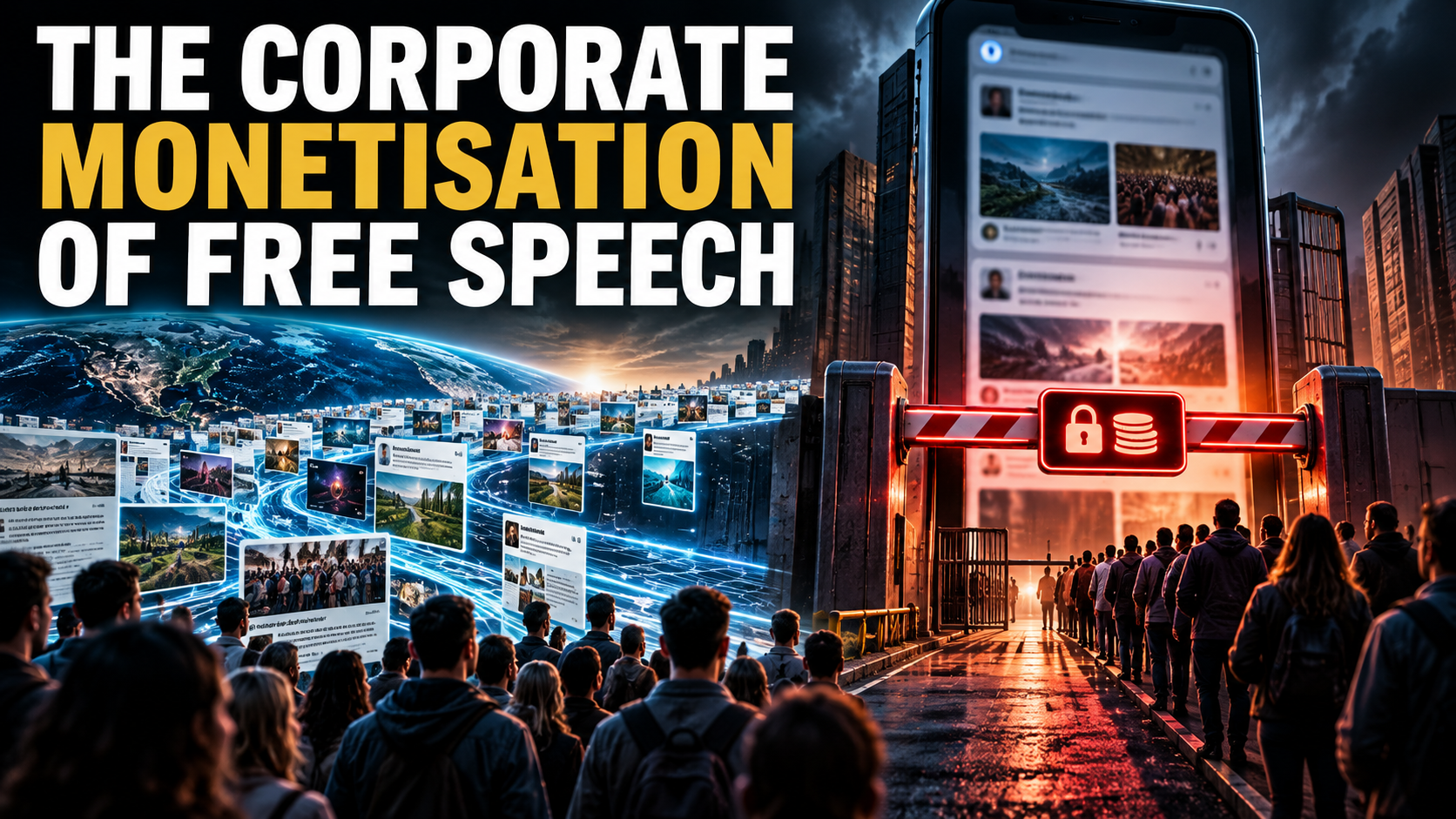
Free speech may still be free to produce. Increasingly, distribution is not.
On 12 October 2026, while trying to share a new science article about El Niño, this site encountered a small but revealing change in the economics of the social web. Facebook displayed a notice telling us that we had used our two posts with links for the month. The same notice offered Meta One as the route to keep sharing links.
Nothing had prevented us from writing the article. Nothing prevented us from publishing it on our own website. Facebook had not censored the article, banned our Page or told us what we were allowed to say.
What had become scarce was something different: the ability to use a major social platform to direct its audience to information outside that platform.
From free speech to paid distribution
Meta announced Meta One on 15 September 2026. Its launch announcement lists organic-post and reel linking under the Advanced plan, starting at US$49.99 a month. This is a published starting price, not a UK quote: features, pricing and availability vary by region, app and account.
Sprout Social’s support documentation describes a test covering selected Facebook Pages. Without a subscription, participating Pages get two link-bearing organic posts or comments per calendar month; paid plans offer higher allowances. Personal profiles and Groups are excluded, and some links are exempt. Sprout says it has observed the restriction in Facebook’s native tools, including Meta Business Suite, but not in posts sent through Sprout. This is therefore a qualified, evolving restriction, rather than a universal limit on Facebook linking.
But for Pages that are included, the principle is striking. An ordinary hyperlink — one of the basic building blocks of the World Wide Web — is becoming a metered publishing feature.
This is not the same as censorship
It is tempting to describe any restriction on online reach as censorship. That would be too simple.
Freedom of expression protects against unjustified state interference, but its legal scope is more nuanced than a simple government-versus-business distinction. The European Court of Human Rights’ Article 10 guide explains that states can also have duties to protect expression in relationships between private parties. That does not create a general entitlement to unlimited free distribution on a particular social network.
Meta pays for enormous computing infrastructure, moderation, security, product development and staff. It is entitled to build subscription products and charge businesses for professional services. A Facebook Page also remains free to publish ordinary posts, and a publisher remains free to operate its own website.
So the serious argument is not that Facebook has abolished free speech.
The question is what happens when a relatively small number of private corporations control a large proportion of the digital spaces through which speech is discovered and distributed — and increasingly monetise the routes between those spaces and the open web.
The difference between speaking and being heard
Long before social media, the ability to speak and the ability to reach a mass audience were different things. Printing presses, broadcasting licences, newspaper distribution and television networks all imposed economic barriers.
The early promise of the web was different. Anyone could publish a page, another site could link to it, and users could move freely between independent destinations. The hyperlink was not merely a technical convenience. It was part of the architecture of an open network.
Social networks initially amplified that architecture. Publishers built Pages and audiences; readers followed them; links carried those readers back to independent websites.
That relationship has been changing.
The retreat from the open web
The Reuters Institute’s January 2025 trends report used Chartbeat data from almost 2,000 news sites. It reported aggregate referral declines of 67% from Facebook and 50% from X over the preceding two years. Those are historical changes across the measured sites, not figures for every publisher or for the two years ending in October 2026.
Those declines predate Meta One and cannot be evidence of its effects. The 2025 report linked the shifts to Facebook’s retreat from news and a less publisher-friendly X, alongside the wider changes in audience behaviour and formats.
The picture is not a simple decline in Facebook’s relevance to news. The Reuters Institute’s 2026 Digital News Report found renewed use of Facebook for news among its respondents, while documenting a continuing shift towards news consumed on third-party platforms. Consuming news inside a platform and clicking through to an independent publisher are different measures.
That makes commercial sense. A user who remains inside an app can continue seeing its advertising, using its features and generating data. A user who clicks away to an independent website has left the commercial environment, at least temporarily.
The interests of the platform and the interests of the open web are therefore not always the same.
Meta’s case
There is another side to this argument, and it deserves to be represented fairly.
In its 2023 account of a Meta-commissioned NERA analysis, Meta argued that publishers voluntarily share links because referral traffic benefits them, and that news links occupy only a small share of Facebook feeds. This is evidence of Meta’s position, not an independent assessment of the fairness of that relationship.
The commercial argument is straightforward: Facebook built the platform and the audience, and publishers choose to use it. Whether that gives the company sufficient justification to charge for previously ordinary linking is an editorial judgement, rather than a finding established by the commissioned study.
There is force in that argument. A privately operated network cannot reasonably be required to provide every commercial user with every feature at no cost.
But it leaves another question unanswered.
What does following mean?
When somebody chooses to follow a Page, there is an intuitive assumption that they have expressed an interest in receiving material from it. Yet modern social networks do not simply deliver every post from every followed account. Algorithms determine visibility. Paid promotion can increase it. Recommendation systems decide what appears between posts from people and organisations a user deliberately chose to follow.
Now, for at least some Facebook Pages, outbound linking itself is being incorporated into a paid professional tier.
The result is a peculiar form of digital ownership. A publisher can spend years building an audience on a platform without ever truly owning access to that audience. The platform owns the infrastructure, sets the rules, controls distribution and can alter the economic terms.
This is why publishers increasingly talk about building on “rented land”. Followers are valuable, but an email subscriber, direct website visitor or paying member creates a relationship that is less dependent on an intermediary changing its algorithm or business model.
The unequal price of visibility
A monthly subscription is not equally significant to everyone.
For a multinational company with a marketing department, another platform fee may be negligible. For a local newspaper, community organisation, charity, independent journalist, artist, campaign group or small business, every recurring cost matters.
That creates the possibility of a two-tier information environment: organisations able to purchase professional distribution tools, and organisations whose ability to direct audiences towards independent material is more restricted.
This does not mean the highest bidder automatically controls public opinion. Organic material can still spread. Audiences can seek information directly. Other platforms exist. But the economics of visibility influence whose voices can consistently reach people at scale.
From the town square to the shopping centre
Social networks are sometimes described as modern public squares. The analogy has always been imperfect.
A public square belongs, in some sense, to the public. Facebook, Instagram, X, TikTok and other major networks are privately operated products. Their owners can redesign them, rank speech, sell advertising, introduce subscriptions and determine how easily users can leave for another destination.
A better analogy may increasingly be a privately owned shopping centre that has become so popular that much of public life happens inside it. You may speak there, build a following there and distribute material there — but the landlord controls the entrances, the signs, the foot traffic and the rent.
The issue is therefore not simply whether speech is permitted. It is who controls the infrastructure around speech.
The corporate monetisation of free speech?
The title of this article is deliberately provocative, but it should be read as a question about power rather than a claim that paid social-media features literally abolish freedom of expression.
Corporations have always monetised communication. Newspapers sold advertisements. Telephone companies charged for calls. Broadcasters sold airtime. Internet providers charge for connections. Web hosts charge publishers to keep websites online.
What is distinctive about today’s social platforms is their extraordinary combination of functions. They are simultaneously publishers’ distribution networks, advertising markets, identity systems, recommendation engines, communication tools and gateways to information.
When those functions become concentrated, seemingly modest product decisions can have consequences far beyond product design.
Free speech may still be free to produce. Increasingly, distribution is not.
The democratic concern begins when the practical ability to participate in public conversation becomes increasingly dependent on commercial intermediaries whose incentives are not necessarily aligned with an open information ecosystem.
The choice is not simply Facebook or no Facebook
The answer is not necessarily to abandon social media. These platforms remain enormously useful for discovery, discussion and community. For small publishers in particular, refusing to participate can mean surrendering access to audiences who may never otherwise encounter their work.
A more resilient response is diversification: use social networks, but do not allow any one network to become the sole connection to an audience. Maintain an independent website. Build direct readership. Use newsletters. Publish across multiple networks. Make it easy for readers to bookmark, subscribe and return without asking an algorithm for permission.
In other words: participate in the platforms, but remember that the platform is not the internet.
A small warning from a small website
Our encounter with Facebook’s link limit was trivial in the scale of global technology. Nobody was silenced. No article disappeared. We simply removed the link, published a text-and-image post instead, and used other networks to direct readers to the full article.
But perhaps that small experience is precisely why it matters.
Major changes in the architecture of public communication do not always arrive as dramatic acts of censorship. Sometimes they arrive as product updates, subscription tiers, algorithm changes and small notices informing a publisher that a previously ordinary action is now limited.
The question is not whether corporations should be allowed to make money.
The question is how much of the infrastructure of public conversation we are comfortable allowing corporations to own, meter and monetise.
Sources and further reading
- Meta — Introducing Meta One
- Sprout Social — Meta One and Facebook link limits
- Reuters Institute — Journalism, Media and Technology Trends and Predictions 2025
- Reuters Institute — Digital News Report 2026
- Meta — News Industry Reaps Considerable Economic Benefit from Facebook
- European Court of Human Rights — Guide on Article 10: Freedom of Expression
Meta One features, prices and availability can change. The Meta One and Facebook link-limit information in this article was checked on 12 October 2026.