
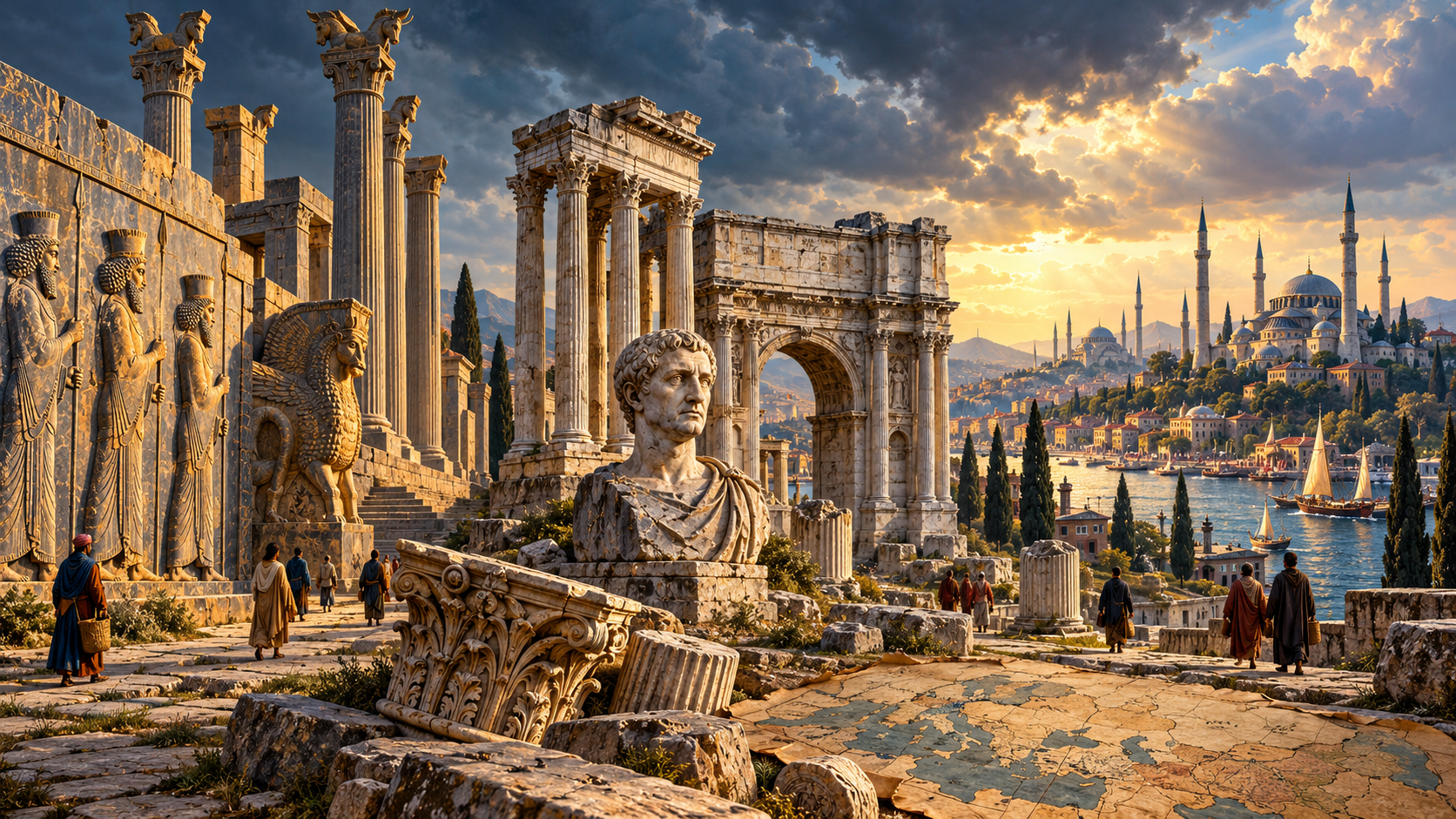
Empires, dictatorships and republics have all ended. That does not mean they failed for the same reasons—or that their endings prove the failure of every belief associated with them.
Rome fell. Persia fell. The Ottoman Empire disappeared. The Soviet Union dissolved. Those statements sound like the beginnings of an explanation, but each conceals questions. What ended: a dynasty, a constitution, an imperial frontier, a state, or the economic and social arrangements through which people lived?
The temptation is to turn history into a competition between political labels. Supporters of one system collect the disasters of another, while treating their own failures as accidents, betrayals or examples that should never have counted. The resulting argument often tells us more about present loyalties than past events.
A more useful examination begins with particular political orders, the pressures they faced and the decisions their leaders made. Ideology matters when we can show how it affected institutions and conduct. It cannot do the work of every missing explanation.
This History feature complements A Question of Democracy — Part 1 and Part 2: Power Beyond the Ballot. It is a comparative examination of selected cases, not a statistical ranking of ideologies.
First decide what “collapse” means
A ruling house can lose its throne while much of its bureaucracy continues working. A democracy can be destroyed without its country disappearing. An empire can fragment into states that retain its languages, law and infrastructure. Military conquest can remove a government whose administration remains valuable to the conqueror.
Those outcomes should not be counted as identical events. Nor is losing an election the collapse of a political system: replacing a government through its established rules may demonstrate that those rules work.
For this article, “political order” means the arrangement of authority through which a population is governed. We distinguish its replacement from territorial dissolution and from severe disruption of everyday life. These can overlap, but one does not automatically establish the others.
| Case | What ended or changed? | Why the distinction matters |
|---|---|---|
| Achaemenid Persia, 330 BCE | A dynasty and its independent imperial rule under Macedonian conquest | Administrative structures survived the defeat. |
| Roman Republic, first century BCE | Republican competition gave way to the principate | Roman imperial power continued and expanded. |
| Western Roman Empire, fifth century CE | Western imperial authority fragmented | The Eastern Roman state survived. |
| Ottoman Empire, 1918–23 | Wartime defeat, imperial dismemberment and the end of the sultanate | Several dates describe different stages; peoples and institutions remained. |
| Soviet Union, 1991 | A union state dissolved and Communist Party rule ended | The state’s dissolution is distinct from a universal verdict on socialism. |
| Weimar Germany, 1933 | Democracy was dismantled | The country continued under a radically different regime. |
Achaemenid Persia: conquered does not mean rotten
The Achaemenid Empire, conventionally dated from about 550 to 330 BCE, governed an enormous and varied territory. Its rule combined monarchy, regional administration and cooperation with local elites. Court politics mattered, but the empire was more than a king surrounded by intrigue.
The Metropolitan Museum’s historical overview warns against reading Greek and Roman accounts of luxury and decadence as a sufficient explanation of Persian history. It describes significant resistance to Alexander’s advance and rejects the assumption that the empire was simply decaying before he arrived. [1]
The accessible summary of Sabine Müller’s Cambridge chapter makes the historiographical point explicitly: traditional portrayals of a weak and doomed Persia reproduce hostile classical stereotypes. Alexander’s success depended in part on appropriating existing political and administrative structures. This article uses that published summary, not an unseen full chapter. [2]
Encyclopaedia Iranica describes a provincial system capable of collecting revenue, recruiting forces and managing local bureaucracies. Its account emphasises the adaptation of earlier administrative arrangements and their durability through the Achaemenid period. [3]
The distinction is decisive. Alexander defeated the ruling order; his victory does not independently demonstrate that monarchy, administrative diversity or an entire civilisation had become unworkable. Nor does continuity erase the violence of conquest. It establishes that the victor found parts of the defeated system worth retaining.
We should therefore ask how military leadership, resources, elite cooperation and specific campaigns produced victory, rather than treating the outcome as proof that Persian society had deserved to disappear. Retrospective stories of decadence can turn a battlefield result into a moral judgement unsupported by the evidence.
Rome’s Republic: a political order can end while power grows
The Roman Republic and the Roman Empire are not interchangeable examples. The Republic’s final civil wars ended in Octavian’s ascendancy; his adoption of the title Augustus in 27 BCE conventionally marks the principate. The Met’s educational account describes autocratic rule established within a constitutional framework that retained republican forms. [4]
That transition did not represent the disappearance of Roman government or a sudden end to Roman military power. It was a transformation in who controlled authority and how competition for it operated.
It also warns against projecting a modern democracy onto an ancient republic. Republican institutions did not imply equal political power or rights for everyone living under Roman rule. Admiration for checks on individual authority should not obscure exclusion and domination.
For comparison with the present, the relevant question is how constitutional forms can persist while effective authority changes. A senate, an assembly or the language of public service cannot by itself establish where power actually lies. That is an analytical question about institutions, not a prediction that any present country will reproduce Rome’s history.
The Western Roman Empire: which Rome, and when?
The conventional date 476 CE marks the deposition of Romulus Augustulus, but it does not describe the disappearance of Roman life everywhere. Oxford’s Centre for Late Antiquity contrasts the loss of western imperial territory with an eastern empire that flourished in the fifth century and attempted western reconquests under Justinian in the sixth. [5]
The eastern state’s survival creates a problem for explanations relying on characteristics shared across the Roman world. If a proposed cause was present in both halves, we must explain why the outcomes differed. Christianity, bureaucracy or imperial scale cannot simply be named and treated as a completed argument.
Historian Peter Heather challenges the older picture of an already ruined late-Roman economy awaiting its final invaders. He argues that external power shifts, including stronger Persian and European neighbours, placed serious pressure on Rome’s position, while acknowledging internal constraints and contingency. This is an identifiable interpretation, not a declaration that historians agree on one master cause. [6]
The Met’s overview traces military movements, the defeat at Adrianople, the western succession of political authorities and the survival of the East until the Ottoman conquest of Constantinople in 1453. Such a long and uneven chronology is incompatible with imagining a civilisation switching off on a single day. [7]
A useful working question is how warfare, territorial control and the resources needed to maintain government interacted. Losing access to a region can weaken an authority’s capacity to recover it; rival centres of command can complicate the response. Those mechanisms require regional and chronological evidence rather than the assertion that every empire inevitably becomes too big.
Environmental conditions and disease also belong in historical investigation, but including them requires dated evidence and a demonstrated connection to the events being explained. “Climate caused Rome to fall” is no more satisfactory without that work than “decadence caused Rome to fall.”
The Ottoman Empire: a long history is not one long decline
An empire lasting centuries does not have one unchanged political ideology. Ottoman institutions, forms of legitimacy and relationships between centre and province changed. A label applied to an early sultan cannot explain every policy of the empire’s final governments.
Ramazan Hakkı Öztan’s study of the Balkan Wars questions accounts that make their outcome a neat, inevitable passage from empire to Turkish nation-state. Its accessible abstract identifies the danger of organising events around an endpoint already known to the historian. [8]
Koç University Library’s specialist bibliography similarly highlights Feroz Ahmad’s interpretation of the final period through decolonisation, nationalism and Great Power involvement rather than a simple story of continuous decay. A bibliography describes a scholarly argument; it does not establish that the argument resolves every dispute. [9]
The immediate sequence also needs precision. The empire’s First World War defeat was followed by attempted partition, competing centres of authority and the Turkish War of Independence. The sultanate ended in 1922; the republic was proclaimed in 1923. These are related stages, not alternative dates for an identical event. [10]
There is a moral danger in discussing the empire only as an administrative puzzle. The Armenian genocide was an intentional campaign of persecution and destruction carried out under the wartime Committee of Union and Progress government. It cannot be softened into an unfortunate symptom of imperial stress, or explained away as something war made inevitable. [11]
That distinction shows why ideology still matters. Beliefs about belonging, loyalty and populations can shape who leaders target and what policies they regard as legitimate. But demonstrating such a connection is different from claiming that a centuries-long empire collapsed because of one timeless national or religious character.
The Ottoman case requires us to examine international war, territorial ambitions and internal choices together. External pressure does not erase the agency of imperial leaders. Their failures do not erase the ambitions or responsibilities of foreign powers.
The Soviet Union: ideology, institutions and a union state
The USSR combined Communist Party supremacy, a largely planned economy and a multinational union structure. Its dissolution cannot be explained by treating these as one indivisible feature. Economic performance, political control and the relationship between republics were separate but interacting questions.
The US State Department’s historical archive describes economic stagnation, military pressures and reform as important parts of the background. Its account gives both Soviet policy choices and Cold War competition a role. This is an official US historical interpretation, which should be read with awareness of its institutional perspective. [13]
The Office of the Historian’s account also emphasises the failed August 1991 coup, Gorbachev’s weakening authority and independence movements. By December, decisions by the leaders of constituent republics helped bring the union to an end. This series is now retired and is cited as historical background, not current policy guidance. [12]
The outcome is powerful evidence against treating the Soviet institutional arrangement as permanently stable. It is not a controlled experiment proving that every form of public ownership must fail. Equally, defining every failed implementation out of socialism would prevent examination of real institutional problems.
The serious questions concern incentives, reliable information, accountability, national claims and the difficulty of reforming a system whose sources of authority are intertwined. Which weaknesses were structural? Which decisions accelerated the outcome? Which alternatives were realistically available at the time?
Weimar and Nazi Germany: two endings that cannot be conflated
Weimar democracy’s destruction in 1933 and the defeat of Nazi Germany in 1945 are distinct cases. The first concerns the dismantling of a constitutional order; the second the military destruction of a dictatorship and its attempted empire.
The US Holocaust Memorial Museum describes Hitler’s appointment as chancellor and the subsequent transformation of Germany into a dictatorship as contingent developments involving several factors, not an inevitable outcome. Economic distress and political conflict created opportunities that specific people exploited. [14]
The museum also documents Nazi Germany’s territorial expansion, invasion of the Soviet Union and eventual defeat by the Allies. In this case, ideological ambitions for domination are directly relevant to the wars the regime chose. Defeat does not establish that the dictatorship simply exhausted itself without outside resistance. [15]
The two episodes expose a weakness in vague claims that “the system failed.” We need to identify who attacked a system, who enabled the attack and who resisted. Otherwise, deliberate destruction is presented as if institutions expired naturally.
They also remind us that regime survival is not an adequate moral standard. A government can remain capable of mobilisation and mass violence while producing catastrophic outcomes for the people it rules or attacks.
Portugal: the end of a dictatorship was not the end of a country
Portugal’s Carnation Revolution in April 1974 ended an authoritarian order. Reuters’ anniversary account identifies junior officers’ opposition to prolonged colonial wars as central to the overthrow and subsequent decolonisation. [16]
Describing that event simply as national collapse would obscure what changed: the governing regime lost power, while the country entered a contested transition towards democratic institutions. For those seeking political freedom, the regime’s failure could be an opening rather than a disaster.
This matters whenever we use longevity as a score. Keeping a ruling group in office and protecting a population’s rights are different achievements. A comparison must say whose interests count and what kind of survival is being measured.
Does one ideology collapse more often?
These cases do not justify a numerical winner. They were selected because they illuminate different endings, not because they form a representative sample of every political system.
A frequency comparison would need consistent categories, a defined period and a denominator. How many regimes of each kind existed? How long were they exposed to the possibility of breakdown? Are conquest, coups, democratic transitions and territorial dissolution counted separately? How are states whose institutions change over time classified?
Counting endings alone can mislead. A widespread system can accumulate more failures because there are more examples of it. A small category can appear stable because few cases survived long enough to be observed. A dynasty lasting centuries may still subject much of its population to exclusion or violence.
Any claim that “history proves ideology X always collapses” must also confront continuing counterexamples and define what evidence could disprove it. A claim that survives by endlessly changing its definitions is difficult to distinguish from a political slogan.
What can we compare without pretending the cases are identical?
Succession and competition: how is authority transferred, and can ambitious actors pursue power without destroying the rules? A leadership struggle, a civil war and a competitive election are different processes; the comparison concerns whether institutions can contain conflict.
Information and correction: can leaders learn that a policy is failing? Can officials, specialists and citizens challenge an account without punishment? Suppression is a plausible obstacle to correction, but each historical claim needs evidence of what was hidden and what decisions followed.
Resources and commitments: can a government meet its obligations, and can it reduce ambitions when resources change? The word “overstretch” is a hypothesis until the burdens, capacities and available choices are specified.
Belonging and legitimacy: which populations recognise the centre’s authority, and on what terms? Opposition to an empire need not be a symptom of irrational disorder. For people seeking independence, it may be a challenge to domination.
External power: neighbours and rivals change. A political order can face a stronger opponent without every domestic institution having ceased to work. Its own expansion may also help create the coalition or military response that defeats it.
These are questions to take into further research. The selected cases suggest their relevance; they do not prove a universal formula, assign equal weight to each factor or establish that institutional adaptation always succeeds.
Watch: why Rome’s ending needs more than one date
Historian Leonora Neville’s TED-Ed lesson, The rise and fall of the Byzantine Empire, provides a short introduction to the Eastern Roman continuation. It is a compressed educational overview rather than a substitute for specialist scholarship. [17]
For a second perspective, historian Mostafa Minawi’s TED-Ed introduction to the Ottoman Empire’s fall offers a companion to the Ottoman discussion. Its short format necessarily leaves substantial questions for further reading. [18]
History gives us questions, not a scheduled apocalypse
The relevance to The Last Days of Planet Earth is not that every present difficulty must be evidence of imminent collapse. It is that complex societies can possess formidable capabilities while remaining vulnerable in particular relationships: between rulers and governed, obligations and resources, institutions and the people attempting to control them.
The historical cases also resist easy fatalism. A defeated dynasty can leave durable administrative practices. A surviving state can lose democratic accountability. An empire’s end can bring independence to some and severe insecurity to others. There is no single human experience hidden behind the word “fall.”
We should assess ideologies by the institutions and actions they encourage, and examine those connections directly. Some beliefs legitimise conquest or repression. Some arrangements make correction harder. Others can provide ways to replace leaders and change policy. None of these claims should be established merely by placing a label next to a ruin.
The question is not which political order believed it would last forever. It is how that order dealt with evidence, conflict and the limits of its power—and what happened when those arrangements were tested.
Sources and limits
Research reviewed 23 October 2026. This is a selective historical comparison, not a statistical study of regime survival. Ancient evidence is incomplete and interpretations differ. Museum and university explanations are used alongside named scholarly interpretations; accessible chapter summaries and bibliographic descriptions are identified as such. Dates are conventional markers with the qualifications above. The comparison does not equate modern ideologies with ancient empires or imply that the fall of a government means the disappearance of its people.
- The Metropolitan Museum of Art: The Achaemenid Persian Empire (550–330 BCE)
- Sabine Müller (2024), Alexander and the Persian Empire, Cambridge Companion to Alexander the Great (chapter summary)
- Bruno Jacobs, Achaemenid Satrapies, Encyclopaedia Iranica
- The Metropolitan Museum of Art: Roman Art—A Resource for Educators
- Oxford Centre for Late Antiquity: The Late Roman Empire
- Peter Heather, Empire and development: the fall of the Roman west, History & Policy
- The Metropolitan Museum of Art: The Roman Empire
- Ramazan Hakkı Öztan (2018), Point of No Return? Prospects of Empire after the Ottoman Defeat in the Balkan Wars (1912–13), International Journal of Middle East Studies (accessible abstract)
- Koç University Library: Defeat and dissolution—Ottoman Studies bibliography
- Sky HISTORY: How did the Ottoman Empire fall?
- US Holocaust Memorial Museum: The Armenian Genocide (1915–16)—Overview
- US Department of State, Office of the Historian: The Collapse of the Soviet Union (retired historical series)
- US Department of State historical archive: Dissolution of the USSR and independent republics, 1991
- US Holocaust Memorial Museum: Adolf Hitler and the Nazi Rise to Power, 1918–1933
- US Holocaust Memorial Museum: World War II in Europe
- Reuters, 25 April 2024: Portugal commemorates the Carnation Revolution
- TED-Ed / Leonora Neville: The rise and fall of the Byzantine Empire
- TED-Ed / Mostafa Minawi: What caused the fall of one of the most influential empires in history?