

Democracy should describe how power works. Too often, it is used to end the discussion about power.
A country calls itself democratic. Citizens can vote. The argument is apparently settled. Questions about who can afford to stand, which alternatives can realistically win, whose interests reach decision-makers and whether leaders can be challenged are treated as secondary details.
They are not secondary. They determine how much of the promise survives contact with ordinary life.
The same habit appears when people discuss socialism, capitalism or communism. A label becomes a verdict, a historical example becomes an all-purpose explanation and the workings of a system disappear behind a word. It is possible to object to that reasoning without defending every government that has adopted the label.
This first instalment establishes the questions we intend to carry through the series. It examines ownership and authority, markets and planning, China’s development, political competition, campaign money and the difference between having a vote and having influence. It asks whether democratic claims withstand scrutiny, including in societies accustomed to judging everyone else.
Does the system give citizens broadly equal political influence, or does it give everyone a vote while allowing wealth to shape the choices and agenda?
Navigate: Labels and ownership · China · Democratic requirements · Party comparison · Money and access · Evidence of influence · Reforms and trade-offs · Videos · References.
1. A label is a starting point, not a verdict
Imagine an explanation that promises to examine socialism, then describes a state monopolising economic decisions, suppressing opposition and preventing citizens from challenging officials. Those are serious matters. Yet a conclusion about socialism as a whole requires an additional argument connecting that particular arrangement to every form being rejected.
Perhaps the connection can be defended. Perhaps concentrating economic power makes political domination more likely under specified conditions. That is a proposition worth testing. But moving from one description to another without acknowledging the change does not test it.
Likewise, showing that an elected government exists does not establish equal political influence. Showing that private businesses exist does not establish competitive markets. Showing that a constitution promises rights does not establish that people can exercise them.
The point is not that words have no meaning. It is that their meaning must remain consistent long enough for an argument to be assessed. Otherwise, the unfavourable example becomes the definition of the opposing system, while favourable examples are quietly assigned elsewhere.
2. Ownership is not the same question as political authority
The Stanford Encyclopedia of Philosophy presents socialism as a diverse tradition concerned centrally with social control of productive resources. It distinguishes that idea from state control alone and discusses alternative institutional designs, including market socialism. There are substantial disagreements within the tradition about who should control production and how.
OpenStax’s discussion of government describes totalitarian dictatorship in terms of an attempt to control all aspects of people’s lives. That concerns the reach of political authority, not simply the legal ownership of a factory. “Authoritarian” and “totalitarian” should not be treated as interchangeable insults: the latter makes a stronger claim about the penetration of power into social life.
A hypothetical worker-owned enterprise with elected managers differs from a state enterprise whose managers are appointed by officials whom workers cannot challenge. Describing both as collective ownership would conceal the difference. Conversely, the existence of private shareholders says little by itself about whether employees have voice or whether competitors can enter the market.
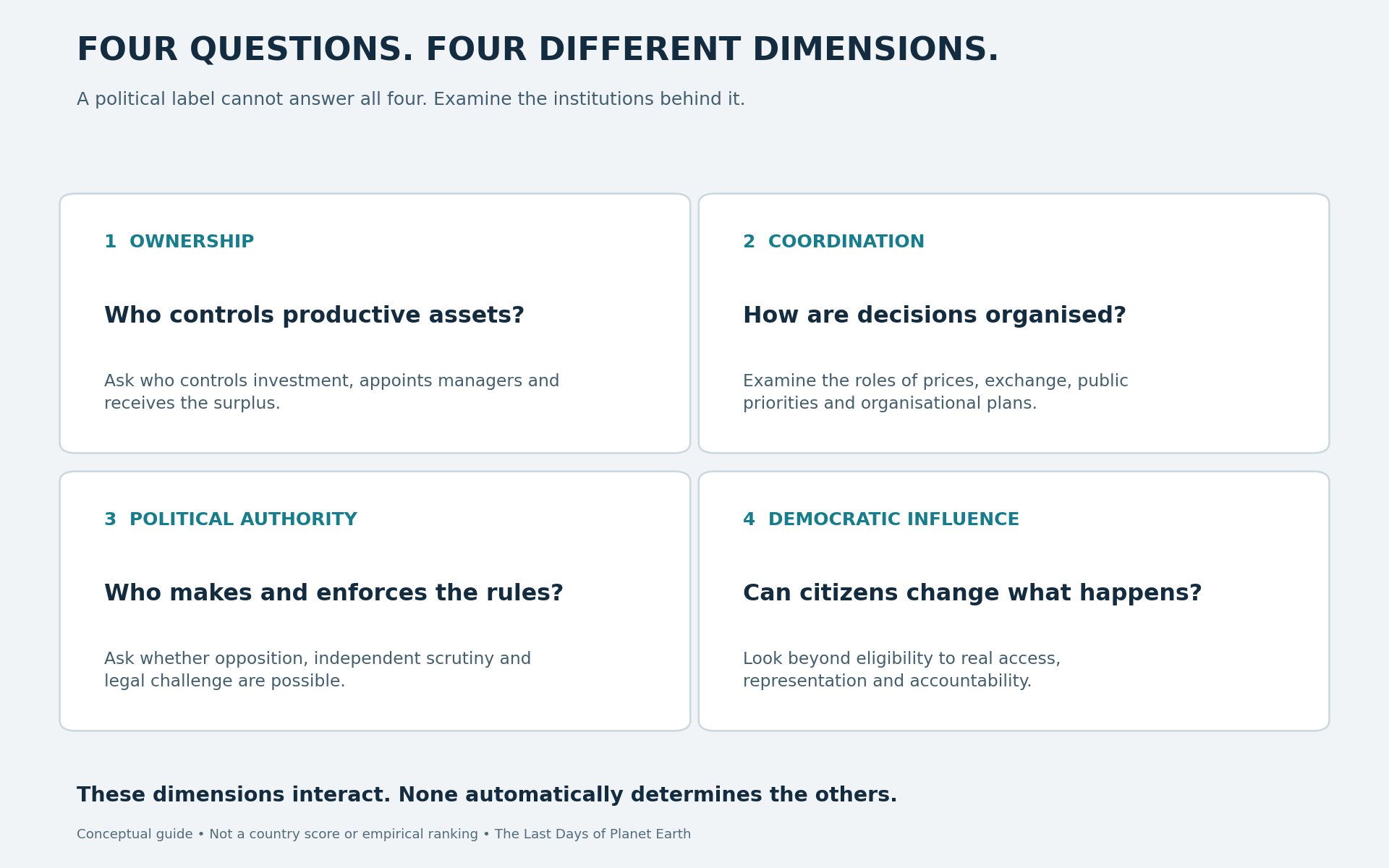
Ask who appoints managers, controls investment, receives the surplus, sets the rules and can remove those making decisions. These questions reveal relationships that a single ownership label can hide.
| Dimension | Question to investigate | What the label cannot settle |
|---|---|---|
| Ownership | Who controls productive assets and investment? | Whether workers or citizens exercise effective control. |
| Coordination | How are production and allocation decided? | Whether decisions use adequate information or respond to mistakes. |
| Political authority | Who makes and enforces binding rules? | Whether opposition and independent scrutiny are possible. |
| Democratic influence | Can citizens change leaders and priorities? | Whether formal rights translate into practical opportunities. |
3. Definitions must not become an escape from history
Separating ownership from political authority does not absolve governments that have concentrated both. A proposal to expand public ownership must explain how officials would be held accountable, how dissent would survive and what would prevent a new governing class from becoming entrenched.
Calling every damaging experiment an imperfect version of the ideal is inadequate. A serious defence must confront recurring risks in implementation. Equally, a serious critic must identify the institutions and incentives that caused harm and explain why the proposed alternative would reproduce them.
The same discipline belongs in a defence of capitalism. If its case rests on competition, examine whether competition exists. If it rests on consumer choice, consider whether people can afford alternatives. If it celebrates innovation, ask whether incumbents can block entry or transfer losses to others.
Comparing the ideal version of one system with the worst realised version of another produces an easy victory and little understanding. The relevant comparison is between actual arrangements, realistic alternatives and the conditions needed to make each accountable.
4. Markets and planning are not a complete political spectrum
Markets coordinate activity through exchange and prices. Planning involves deliberate decisions about production, allocation and priorities. Ownership is related to these mechanisms, but it does not logically determine every choice between them.
A hypothetical cooperative can sell goods in a market. A privately owned business can organise its internal production through management plans. Those examples do not establish the superiority of any entire system. They show that market versus plan and private versus collective ownership are separate questions.
Friedrich Hayek’s 1945 essay, The Use of Knowledge in Society, supplies an important argument for decentralisation: useful knowledge is dispersed among people, and prices can communicate changing scarcity without a central authority possessing every underlying fact. That is a substantive information problem. It deserves more attention than simply calling a planner foolish.
But an argument about information does not settle every dispute over ownership, public provision or democratic authority. One must still ask what a price measures, whose purchasing power it reflects and whether costs imposed on others enter the decision.
An institution might decentralise operational choices while setting collective priorities. A market might exist alongside public investment or rules against monopoly. The analytical task is to identify which decisions belong where and how mistakes become visible. “Markets work” and “planning works” are both incomplete unless we specify the task and circumstances.
5. China challenges inevitability—not the need for criticism
China’s constitution establishes Communist Party leadership, recognises public and non-public economic sectors and describes a socialist market economy. That is an official account of formal arrangements, not independent proof of democratic practice. It is nevertheless enough to show why private enterprise and markets cannot simply be edited out of a description of the economy.
A 2022 study undertaken jointly by the World Bank and Chinese institutions reported that close to 800 million people had moved above the international extreme-poverty threshold used in that study over four decades. The threshold was $1.90 a day in purchasing-power terms. That is a dated poverty measure, not a claim that everyone became prosperous or that deprivation ended.
The report discusses broad economic transformation alongside targeted support. It highlights education, infrastructure, outward orientation and policies supportive of competition. The achievement should be taken seriously, while the institutional authorship and measurement choices remain visible.
This challenges the blanket assertion that communist-led countries must always fail economically. It does not demonstrate that communist ideology caused the gains, that comprehensive central planning produced them or that the same arrangements would deliver identical results elsewhere.
Saying that China’s gains involved market reforms may identify an important mechanism. It also changes the proposition from “a communist-led country cannot succeed” to “particular policies contributed to success”. That is progress towards analysis, provided the change is acknowledged.
The IMF’s February 2026 assessment commended resilience while identifying weak private domestic demand, property-sector risks and mounting imbalances. It advocated stronger social protection and a shift towards consumption-led growth. Long-run achievements and current weaknesses can coexist.
Nor does material improvement settle questions about civil liberties, political opposition or the ability to replace rulers. Economic performance is not a substitute for political freedom. Equally, a political objection is not a reason to deny a measured improvement in living conditions. Keep the dimensions separate, then examine how they interact.
6. Success and failure require mechanisms
Ideology matters because it influences goals, institutions and acceptable policy choices. The argument is not that ideas are irrelevant. It is that the name of an ideology cannot stand in for an explanation.
A convincing account asks how policy changed incentives, access to knowledge, investment, education, bargaining power or the capacity to correct errors. It specifies the outcome and period. It examines plausible alternative explanations rather than attributing every benefit to the favoured system and every cost to outside interference.
“Does it work?” is incomplete until we know for whom. A policy can raise total output while worsening insecurity for a particular group. Another might protect access to an essential service while producing queues or administrative waste. Identifying one outcome does not make the others disappear.
That is why this series will examine workings and outcomes together. A highly efficient institution that cannot be challenged raises different concerns from an accountable institution that delivers badly. Both require criticism, but not necessarily the same criticism or remedy.
7. What are the basic democratic requirements?
Article 25 of the International Covenant on Civil and Political Rights recognises citizens’ rights and opportunities to participate in public affairs, vote and stand in genuine periodic elections, and access public service on general terms of equality. The electoral provision specifies universal and equal suffrage and a secret ballot protecting the free expression of voters’ will. These are substantive standards, not permission to count any staged vote as democracy.
As an analytical framework for this article, we distinguish a minimum competitive process from wider democratic quality. Can opposition organise? Can citizens receive information and criticise rulers? Are votes counted honestly? Can people contest decisions without intimidation? Can incumbents actually lose and relinquish authority?
The Varieties of Democracy project goes beyond the mere presence of elections, distinguishing electoral, liberal, participatory, deliberative and egalitarian principles. Its components include civil liberties, judicial independence, executive constraints, media freedom and civil society. This is a research framework, not an infallible single verdict, but its structure demonstrates why democracy cannot be measured by one ceremony.
We should therefore distinguish three claims: that a government describes itself as democratic; that it meets specified electoral requirements; and that citizens exercise broadly equal political influence. These propositions are related, but proving the first does not prove the other two.
We will not declare that a country barely meets a minimum merely because its politics is disappointing. Such a claim needs defined criteria and evidence. The same standard prevents established democracies from using their status to exempt themselves from scrutiny.
8. Formal choice and meaningful choice
Formal choice means an option is permitted. Meaningful choice asks whether selecting it can realistically affect representation, policy or the exercise of power.
Consider a voter whose preferred candidate has little chance of winning. A vote for that candidate may express a genuine preference. A vote for a less-preferred major contender may seem more effective at preventing an outcome the voter fears. The ballot offers options, while the electoral structure changes what choosing them can accomplish.
There is no simple formula that turns this difficulty into proof that voting is pointless. Expression, organisation and building future support also matter. But telling voters that another name appears on the paper does not answer the question about a realistic route to representation.
How effectively can citizens turn different political preferences into real influence when the realistic routes to national power run overwhelmingly through just two parties?
That question includes, but extends beyond, the presidency. It asks whether alternative movements can win legislative seats, bargain over policy, influence candidate selection or become durable organisations. A system can permit formal entry while making effective entry exceptionally difficult.
9. Seven countries: representation is broader than registration
A count of every registered party would answer a different question from the one we are asking. Here we compare representation in national lower houses, or the sole chamber in New Zealand. Independents are not counted as a party. The units are not identical: France reports parliamentary groups; some other labels combine organisations. Those qualifications must remain attached to the numbers.
| Country and chamber | Representation in the cited snapshot | How to read it |
|---|---|---|
| United States — House | 2 parties | Republicans and Democrats. Independents are separate; this excludes non-voting territorial delegates. |
| United Kingdom — Commons | 15 party labels | Excludes independents and Speaker; includes Sinn Féin MPs, who do not take their seats. |
| Germany — Bundestag | 7 parties elected in 2025 | Counts CDU and CSU separately despite their joint group; includes SSW. Election result, not a real-time affiliation census. |
| France — National Assembly | 11 parliamentary groups | Groups may contain multiple parties. This is not an individual-party count. |
| Ireland — Dáil | 10 party/alliance labels | Includes People Before Profit–Solidarity as one alliance; independent TDs are additional. |
| Australia — House | 8 organisational labels | Official snapshot dated 28 May 2026. Queensland LNP members sit federally with Liberals or Nationals. |
| New Zealand — outgoing Parliament | 6 parliamentary parties | The 54th Parliament; dissolution was 1 October ahead of the November 2026 election. |
Sources checked on 20 October 2026; some snapshots are earlier, as marked. New Zealand’s electoral timetable is important here: describing its outgoing party representation as a newly elected chamber would be wrong. Party switches and by-elections can change counts. This table is a comparison of published institutional snapshots, not a ranking of democratic quality.
The disparity is significant. In this comparison, the US House has a particularly narrow range of party representation. The point is not that Americans are forbidden to create other parties. It is that legal permission and representation are strikingly different achievements.
However, the British total includes parties with geographically concentrated support and very small delegations. It does not mean every UK voter chooses among fifteen locally viable contenders or that fifteen parties can independently form a government. A national aggregate can conceal constrained choice in individual constituencies.
Counting a French group as though it were one party, or Germany’s CDU/CSU as two for one purpose and one for another, can manufacture a dramatic comparison. The honest conclusion is narrower and stronger: institutional design affects which political differences acquire representation, and the American two-party pattern is not the only democratic possibility.
10. Electoral rules help produce the available choice
OpenStax’s political-science text explains the tendency for plurality voting in single-member districts to favour two-party competition. Voters and parties anticipate which candidates are competitive. This is a tendency, not a commandment applying identically to every constituency or country.
A party can attract substantial support spread across many constituencies yet win few seats if it repeatedly finishes behind the winner. Another can convert concentrated support into seats. This hypothetical mechanism explains why national vote totals and parliamentary strength need separate examination; it does not by itself supply a verdict on every election.
New Zealand’s Electoral Commission explains an alternative under mixed-member proportional representation: voters have a party vote and an electorate vote, with the party vote largely determining overall seat shares. Eligibility thresholds and electorate wins affect access, and parties often negotiate agreements to form a government.
That can give smaller parties routes to representation without making each one a plausible source of the prime minister. Coalition bargaining can translate a minority preference into policy influence. It can also make responsibility for compromises harder to attribute.
The choice is not between a perfect system and a defective one. Assess the trade-offs: proportionality, local representation, comprehensibility, stability, entry barriers and the ability to identify who is responsible. No reform should be sold as though improving one dimension automatically fixes all the others.
11. Two parties can offer real differences—and still constrain representation
Two dominant parties need not be identical. Different programmes, candidates and factions can create consequential choices. Primaries and internal party contests can offer routes to influence before a general election.
But a faction inside a major party does not have the same independence as a separate organisation able to win seats and negotiate publicly. Internal influence may depend on party rules, nomination procedures and the priorities of existing leadership.
A fair criticism asks which preferences have viable representation, not whether every individual can find an exact political replica. All representative systems aggregate interests. The question is whether the aggregation is open to challenge or persistently excludes substantial constituencies.
Conversely, a larger party count does not guarantee accountability. Multiple organisations may offer similar programmes; coalition arrangements can become opaque; small pivotal parties may wield leverage beyond their vote share. These are reasons to examine more dimensions, not reasons to stop questioning the two-party constraint.
12. Who can afford to become one of the choices?
Before a voter chooses among candidates, another selection process has already occurred. Who could afford the time, organise the campaign, obtain introductions, pay for communication and remain financially secure while competing?
Some resources are monetary; others include networks, volunteers, organisational backing and time. A cash figure does not capture them all. Yet money can acquire several of the others, making it a particularly important gateway.
A candidate need not personally possess a fortune to become financially dependent. The issue can be access to people or organisations willing to supply resources. A contest may be formally open to ordinary citizens while favouring those who can persuade a narrow set of gatekeepers that their candidacy deserves investment.
This is why the distinction between candidates, parties and outside organisations matters. Looking only at an individual campaign’s bank account can conceal substantial support around it. Equally, treating every organisation’s spending as a direct candidate donation misdescribes what the rules permit.
13. Britain and America: compare the rules before the totals
The Electoral Commission’s guidance sets out spending controls for UK parliamentary candidates, with party campaigning regulated separately. This limits regulated constituency expenditure; it does not mean the whole campaign environment costs only what appears in a candidate’s return. Timing, attribution and the distinction between local and national activity matter.
The US Federal Election Commission’s 2023–24 summary reports approximately $3.7 billion in congressional candidate disbursements. Separately, reported independent expenditures across federal elections totalled about $4.4 billion. These categories overlap: the totals must not be added as though they were mutually exclusive. Nor are they a minimum sum required of each winner.
For the 2025–26 cycle, an individual’s direct contribution to a federal candidate is limited to $3,500 per election. Super PACs can accept unlimited contributions. Those are different funding channels. A claim that an individual may donate unlimited money directly to any congressional candidate would therefore be wrong.
This contrast supports scrutiny of the scale and structure of US campaigning. It does not establish that every successful American must have a wealthy patron, that small-donor mobilisation is impossible or that British politicians are free of financial dependence.
Comparisons should match the office, period and categories. Comparing a UK constituency’s regulated campaign with an American presidential operation would exaggerate the contrast. Even a House-to-Commons comparison needs attention to campaign duration, constituency size and spending by parties or outside organisations.
The practical democratic question survives those qualifications: do the rules make electoral competition accessible, or do they reward the ability to assemble a large funding network before voters have a meaningful say?
14. Britain must not become the reassuring exception
The Commons Library’s August 2026 briefing describes the absence of a general political donation cap and proposals concerning overseas electors. A proposed restriction is not the same as a universal cap already operating. Spending limits and donation limits answer different questions.
A large permissible donation can support party infrastructure and political activity beyond one candidate’s regulated campaign. Even where local expenditure is constrained, access to a well-resourced party can remain valuable. Selection procedures, central support and organisational priorities therefore belong in the investigation.
The argument is not that British and American rules are equivalent. They are not. It is that a genuine difference should not become a national alibi. If we question Americans’ dependence on major funders, we should also question how British parties obtain resources and whose concerns their funding arrangements encourage them to hear.
Neither “lawful” nor “declared” means harmless. Those descriptions answer questions about legality and visibility. They do not settle whether influence is proportionate or whether citizens without comparable money have equivalent access.
15. Financial influence need not look like a bribe
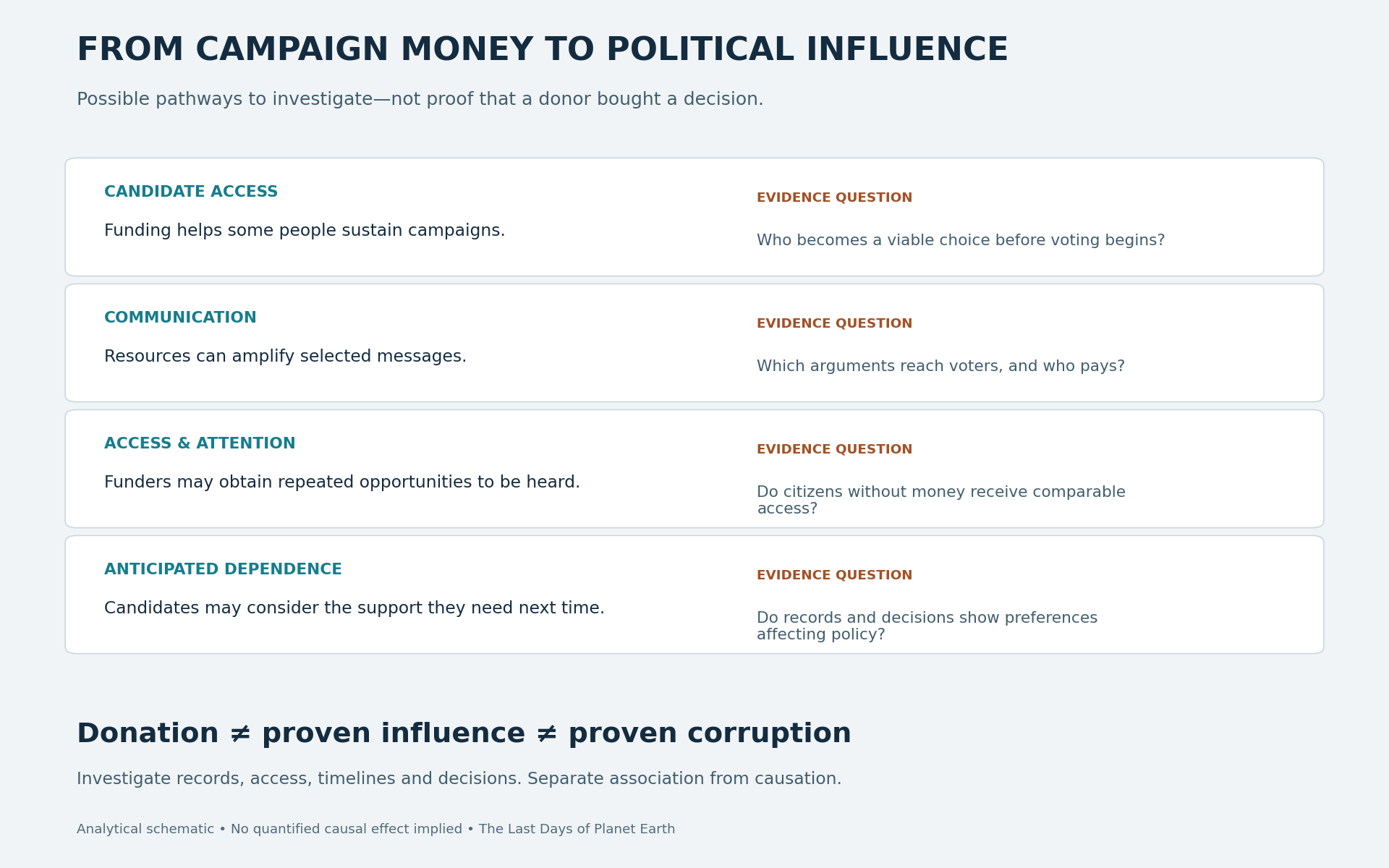
The clearest case would be an explicit exchange of money for a decision. That requires evidence and should not be alleged casually. But a system can create unequal influence without such an exchange.
Possible mechanisms include financing some candidacies rather than others; paying to amplify particular messages; obtaining repeated access to decision-makers; supplying research or expertise; and making certain priorities harder for candidates to ignore.
The distinction between persuasion and dependence matters. Hearing an argument is normal politics. Needing the speaker’s continued financial support can change the relationship, even if nobody issues an instruction. Whether it did so in a particular case is an empirical question.
A politician might anticipate funders’ preferences, avoid an issue that threatens future support or spend more time with people able to sustain the campaign. These are hypotheses to investigate through records, interviews, timelines and policy decisions. They are not facts established merely by identifying a donor.
The concern is structural: do some citizens get a vote while others obtain a vote, a louder platform and privileged opportunities to shape what is debated? If so, formally equal ballots coexist with unequal resources for political influence.
16. What research says—and what it does not
Martin Gilens and Benjamin Page’s 2014 study analysed 1,779 US policy issues. Their statistical model found substantial independent associations between policy outcomes and the preferences of economic elites and business-oriented groups, while average citizens’ preferences had little or no independent influence after other preferences were considered. That is an influential finding, not a timeless measurement of every institution or a demonstration that a specific donor bought a law.
Independent influence in a statistical model is not the same as never obtaining a preferred outcome. Different income groups may want the same policy. Separating their effects, choosing measures of preferences and specifying a model are consequential research decisions.
Mads Andreas Elkjær and Michael Baggesen Klitgaard’s systematic review, published online in 2021 and in a 2024 journal issue, analysed 1,163 estimates from 25 studies. It found an overall tendency for outcomes to reflect richer citizens’ preferences more strongly, alongside substantial variation across studies and models. Its comparative results did not support treating unequal responsiveness as uniquely American; indeed, reported disparities were weaker in the US than in other developed democracies covered by that literature.
That is an important challenge to a convenient story. Large US campaign totals do not automatically prove the US has the greatest measured inequality of policy influence. Different questions need different evidence.
The research justifies serious concern and further investigation. It does not justify declaring elections meaningless, all politicians purchased or every apparent policy agreement the product of money. A credible critique becomes stronger when it states those limits.
17. The problem is not uniquely American
The OECD’s Financing Democracy examines political-finance mechanisms and challenges across countries including Canada, Chile, Estonia, France, Korea, Mexico, the UK, Brazil and India. Its comparative scope is a reminder that influence risks cannot be assigned to one country and dismissed elsewhere.
Australia’s Electoral Commission sets out donation and electoral expenditure caps, faster disclosure and other changes commencing on 1 January 2027. At this article’s review date, presenting those major reforms as already fully operational would be inaccurate.
The existence of regulation does not prove effective enforcement. A cap can be undermined by gaps in coverage, fragmented reporting or resources insufficient to investigate breaches. Conversely, evidence of one breach does not establish that every aspect of a regulatory regime is useless.
We therefore withdraw the absolute proposition that America is the only democracy affected by money-dependent access or unequal influence. The defensible criticism concerns the mechanisms, their scale and the safeguards in each system.
18. How democratic is a country that calls itself democratic?
The word democracy becomes a crutch when it substitutes for answering awkward questions. “People can vote” is not a complete response to evidence about barriers to candidacy, restricted alternatives, intimidation, unequal access or ineffective accountability.
Nor does asking those questions mean all regimes are the same. The ability to criticise rulers, organise opposition and remove a government is consequential. An imperfect competitive system differs from one that denies genuine competition. The distinction should be defended through its workings, not invoked to excuse its weaknesses.
Democratic quality can deteriorate in particular dimensions without disappearing everywhere at once. We should identify the failing: electoral competition, access to information, judicial independence, equal participation or policy responsiveness. A precise diagnosis is more useful than repeatedly awarding or withdrawing a single badge.
If a country genuinely fails basic requirements, name the criterion and present the evidence. If the concern is that it clears an electoral minimum but distributes influence unequally, say that instead. Neither criticism needs rhetorical inflation.
19. Majority rule is not unlimited permission
One reason democratic scrutiny extends beyond counting votes is that people must remain able to participate after losing. A majority that removes opponents’ ability to organise threatens the conditions under which future choices can be genuine.
Minority protections, independent review and limits on executive authority should therefore be examined as part of the system’s continuing capacity for contestation. At the same time, institutions insulated from election need their own justification and accountability. Calling a constraint a safeguard does not establish that it is well designed.
A court protecting political participation and an institution entrenching privilege can both be unelected. The relevant questions concern authority, reasons, transparency, remedies and whose interests are protected. “Unelected” alone cannot settle the issue any more than “elected” can.
Democracy also cannot guarantee that citizens always make wise choices or that governments never act unjustly. Its promise concerns how decisions are authorised, contested and corrected. An assessment should examine that capacity rather than demand impossible perfection or accept empty procedure.
20. Choice depends on information and the ability to organise
A meaningful choice requires opportunities to understand alternatives, question claims and work with others. The freedom to speak matters, but so does whether competing views can obtain attention and whether criticism produces retaliation.
These are questions to investigate in each country: who owns influential media; how political advertising is disclosed; whether public information is accessible; whether journalists can scrutinise power; and whether organisations outside government can sustain independent activity.
State censorship and concentrated private control are different mechanisms. Analysing both does not make them identical. It recognises that the circulation of information has institutions and incentives that deserve scrutiny.
Likewise, turnout alone cannot explain participation. A person might abstain through contentment, alienation, practical obstacles or lack of a tolerable option. Before treating abstention as consent or indifference, we need evidence about those circumstances.
21. What could make political choice more meaningful?
A serious examination should lead to questions about remedies, with costs and trade-offs stated openly. None of the following is a universal prescription; each is a direction for evidence-based comparison.
- Electoral reform: would proportional or preferential arrangements widen representation, and what would change for local accountability and government formation?
- Political finance: would donation caps, expenditure controls or public funding reduce dependence without protecting incumbents or suppressing legitimate participation?
- Disclosure: can citizens identify funders and campaign spending in time to use the information, with workable protections for privacy and safety?
- Enforcement: does an independent regulator have the authority, resources and remedies to make rules meaningful?
- Candidate access: what barriers arise from selection procedures, time, personal financial security or organisational gatekeeping?
- Continuing accountability: can citizens obtain information, organise, challenge decisions and secure remedies between elections?
Every reform can acquire its own loopholes or unintended effects. Public funding needs defensible eligibility rules. Caps need boundaries that prevent evasion while avoiding arbitrary restrictions. Disclosure is useful only if information can be understood and breaches addressed.
A proposal should explain what mechanism it changes, what improvement would count as success and what evidence would reveal failure. The same scrutiny we demand of political labels should apply to reform slogans.
22. Why this belongs on The Last Days of Planet Earth
The site’s title invites questions about humanity’s future. Political systems belong at the centre of that inquiry because they shape whose warnings receive attention, whose costs are recognised and who can change the course of collective decisions.
Consider the questions raised by environmental protection, conflict, technological change and infrastructure. Whose time horizon matters? Can people affected by a decision challenge it? How are long-term costs weighed against immediate rewards? What voice is available to those with little purchasing power—or to generations not yet able to vote?
These are not proof that any particular decision was captured. They explain why governance is fundamental rather than a diversion from the site’s themes. A society’s capacity to identify danger and respond depends partly on how it distributes authority and corrects mistakes.
A democratic label cannot assure that capacity. Nor can a promise of efficient central direction. Both must be assessed through evidence about institutions, participation, results and the ability to learn.
23. The questions this series will keep asking
Future instalments can examine electoral systems, money and lobbying, media power, workplace democracy, public ownership, civil liberties and decision-making under long-term risk. Each deserves more than a passing verdict.
The common standard will be to ask who holds power, how they acquired it, who can challenge it and what happens to people affected by its use. We will distinguish formal arrangements from practice, evidence from inference and a measured failure from a total judgement on every aspect of a society.
That includes examining evidence inconvenient to our initial assumptions. China’s development does not prove ideological superiority. American campaign money does not make every wealthy donor a criminal. British spending limits do not exempt Britain from influence concerns. A multiparty chamber does not automatically confer equal power.
Democracy should be a claim that survives investigation, not a word used to prevent it. Having a vote is indispensable. Whether citizens can shape the choices, challenge the powerful and influence what happens afterwards remains a question we must keep asking.
Watch: two ways to examine political choice
CGP Grey’s Problems with First Past the Post Voting uses a simplified animated example to explore electoral incentives. It is an explanatory argument about a voting mechanism, not a current country assessment or proof that every first-past-the-post election has identical outcomes.
Watch CGP Grey’s explainer on YouTube
New Zealand’s Electoral Commission’s What is MMP? provides an official explanation of an alternative voting system. It explains the mechanism; it does not establish that adopting MMP would resolve campaign-finance inequality or every question about democratic quality.
Watch the Electoral Commission’s MMP explainer on YouTube
The video that prompted this discussion
Maxinomics: The Simple Question Socialism Couldn’t Answer prompted the questions behind this article. Readers can examine the original alongside the distinctions developed here. The creator’s official website lists the video. We are not presenting a verified line-by-line transcript or attributing quotations we have not checked. Our case rests on the separately referenced concepts, institutional descriptions and research below.
References and limits of this examination
Reviewed: 20 October 2026. This is an analytical opening to a series, not a complete census of democracies or a definitive ranking. Illustrative scenarios and explanatory diagrams are not measurements of a particular country. Parliamentary counts have the scope and dates indicated; they should be rechecked before reuse.
Official constitutional provisions describe formal commitments, not independent verification of practice. Electoral guidance describes rules, not proof of compliance. Spending figures measure reported financial activity, not its causal effect on policy. Studies of policy responsiveness have methodological limits and should not be reduced to a slogan about voters having no power.
- Stanford Encyclopedia of Philosophy — Socialism
- OpenStax — Forms of Government
- F. A. Hayek — The Use of Knowledge in Society (1945)
- Constitution of the People’s Republic of China — official English text
- World Bank and Chinese institutions — Four Decades of Poverty Reduction in China (2022 summary)
- IMF — China Article IV consultation, February 2026
- OHCHR — International Covenant on Civil and Political Rights, particularly Article 25
- V-Dem — project and measurement framework
- UK Parliament — State of the Parties
- US House Press Gallery — party breakdown
- German Federal Returning Officer — final 2025 Bundestag result
- French National Assembly — parliamentary groups
- Houses of the Oireachtas — member and party listings
- Australian Parliamentary Education Office — House composition, May 2026
- New Zealand Parliament — parliamentary parties
- New Zealand Electoral Commission — 2026 election timetable
- OpenStax — electoral-system incentives
- New Zealand Electoral Commission — What is MMP?
- UK Electoral Commission — parliamentary candidate and agent guidance
- House of Commons Library — donation-cap analysis, August 2026
- FEC — full 2023–24 financial activity summary
- FEC — direct contribution limits and super PAC distinction
- Gilens and Page — Testing Theories of American Politics (2014)
- Elkjær and Klitgaard — Economic Inequality and Political Responsiveness: A Systematic Review
- OECD — Financing Democracy: Funding of Political Parties and Election Campaigns and the Risk of Policy Capture
- Australian Electoral Commission — reforms commencing January 2027
Related reading: The Corporate Monetisation of Free Speech.