

Quantum mechanics tells us how to calculate the chances of what we will observe. But where do those chances come from? Oxford researcher Jiaxuan Zhang is examining what physicists must assume before they can answer.
A research profile based on published papers and public university material—not an interview conducted by this site. Sources and publication status checked 24 October 2026.
The researcher behind the question
Zhang is a fourth-year DPhil student in Oxford’s Department of Physics, within Atomic and Laser Physics. Her listed interests include quantum foundations, quantum information and probability theory. The focus is theoretical: understanding the structure of the rules, rather than announcing a new measuring device. [1]
Her route into the subject began with a different ambition. In Oxford’s October interview, she describes being more interested in literature as a child, before books about quantum mechanics captured her attention at 16. The measurement problem drew her in: how does the theory connect with what an observer actually experiences? [2]
She still enjoys literature and the history of science, particularly the arguments and difficulties preceding discoveries. Her account of working life is recognisable rather than mythical: reading, calculation, writing, conversations and sometimes stepping away from a stubborn problem. The attraction is not simply strange quantum effects; it is the possibility of understanding why the theory has its particular foundations. [2]
The Born rule, without the mystification
The rule named after Max Born connects the wavefunction with probabilities. Born’s Nobel lecture describes the historical move: the squared magnitude of the wavefunction gives a probability density for position. A probability density is not itself the probability at one exact point; probabilities for spatial regions are obtained by integrating it. [5]
For a simple two-outcome example, suppose a normalised quantum state has real amplitudes √3/2 for outcome A and 1/2 for outcome B, in the measurement basis being used. Squaring their magnitudes gives probabilities of 3/4 and 1/4: 75% and 25%. This is an illustrative calculation, not data from Zhang’s research.
The calculation is straightforward once the rule is accepted. Explaining why this rule belongs in the theory is a different task. A successful recipe for predictions can still leave questions about its foundations.
What Zhang’s published paper establishes
Her sole-authored paper, Summing to uncertainty, appeared in Physical Review A on 13 October 2026. It examines five influential routes to the Born rule: Gleason, Busch, Deutsch–Wallace, Zurek’s envariance approach and Finkelstein–Hartle. Zhang argues that each requires additivity, openly or implicitly, and that additivity and noncontextuality cannot simply replace one another. [3]
A crucial limit appears in the published conclusion: the analysis mainly addresses original versions of these approaches. Later refinements, including Wallace’s proof, and approaches associated with Bohmian mechanics and QBism are identified for further investigation. This is not a demonstration that every conceivable derivation must fail. [3]
Oxford presents her next step as examining those refinements and other interpretations. The programme is continuing, rather than a declaration that foundational physics has reached its final answer. [4]
Why something as simple as addition matters
For mutually exclusive outcomes, additivity says that the probability of either outcome is the sum of their separate probabilities. In the example above, A or B has probability 75% + 25% = 100%. Zhang’s analysis asks whether a derivation has already introduced a probability-like structure through such assumptions. [3]
That is a question about explanatory starting points. If a proof begins with rules that already behave probabilistically, it may explain why the probabilities have a particular mathematical form without explaining probability from wholly non-probabilistic ingredients.
There is an important distinction here. Adding probabilities for mutually exclusive recorded outcomes is not the same calculation as adding amplitudes for indistinguishable quantum alternatives that can interfere. Treating those as interchangeable would obscure the very issue under discussion.
The research that makes the question richer
Zhang’s work becomes more interesting when placed alongside the approaches it examines. These are different strategies for explaining quantum probability, not interchangeable claims that all live or die together.
Gleason and Busch: constrain the mathematics. Gleason’s 1957 theorem shows that suitable additive measures on the subspaces of a real or complex Hilbert space of dimension at least three have the familiar operator form. Its assumptions matter, including the dimensional restriction. Busch’s later theorem works with generalised measurement effects and probability assignments. Deriving the permitted form under stated assumptions is a substantive result—even if those assumptions already carry probabilistic content. [6] [7]
Deutsch and Wallace: examine rational decisions. In a many-worlds account, the quantum state evolves into branches containing different outcomes. The challenge is to explain the weights an agent should use when making decisions. Wallace’s formal treatment develops Deutsch’s strategy through explicit decision-theoretic assumptions and examines proposed counterexamples. Assessing that argument requires evaluating its particular premises; criticism of an earlier proof is not automatically a verdict on the later version. [8]
Zurek: use entanglement and symmetry. Envariance is a symmetry involving a system and its environment: certain changes on one can be counteracted through the other. Zurek argues that these relationships supply a route to quantum probabilities. Schlosshauer and Fine independently examined the assumptions entering an earlier envariance derivation. Their work shows that scrutiny of hidden premises predates Zhang, while offering useful context for her comparison. [9] [10]
Frequency approaches: distinguish repetition from probability. Caves and Schack challenged claims that properties of a frequency operator for infinitely many systems establish the probability postulate. The relevant lesson is precise: showing a mathematical statement about idealised repetition is not automatically the same as justifying the probabilities assigned to an observation. Their critique provides another point of comparison, rather than a blanket dismissal of frequency reasoning. [11]
QBism: give probability a different role. DeBrota, Fuchs, Pienaar and Stacey treat the Born rule as a constraint on an agent’s probability assignments, with additional assumptions grounded in the physical world. Their 2021 analysis uses a particular representation whose general applicability is tied to the existence of certain symmetric reference measurements. This offers a contrasting research direction: ask what extra consistency quantum physics demands, rather than insist that probability must disappear from the foundations. [12]
These papers complement the profile by showing what the disagreement is actually about. Recognising an assumption does not make a theorem worthless. It tells us what the theorem explains, what it presupposes, and where a further physical argument would be needed.
Sleeping Beauty: uncertainty about where you are
Zhang’s second work located for this profile is Sleeping Beauty in One or Many Worlds, currently presented here as an arXiv preprint. It defends the “halfer” position in a famous probability puzzle and connects it with many-worlds reasoning. The Oxford affiliation and institutional email identify it as the same researcher’s work. [13]
The setup is simple. A participant sleeps while a fair coin determines her schedule. Heads means one awakening on Monday; tails means awakenings on Monday and Tuesday. Her memory of each awakening is erased before she returns to sleep. On waking, what confidence should she assign to heads? [14]
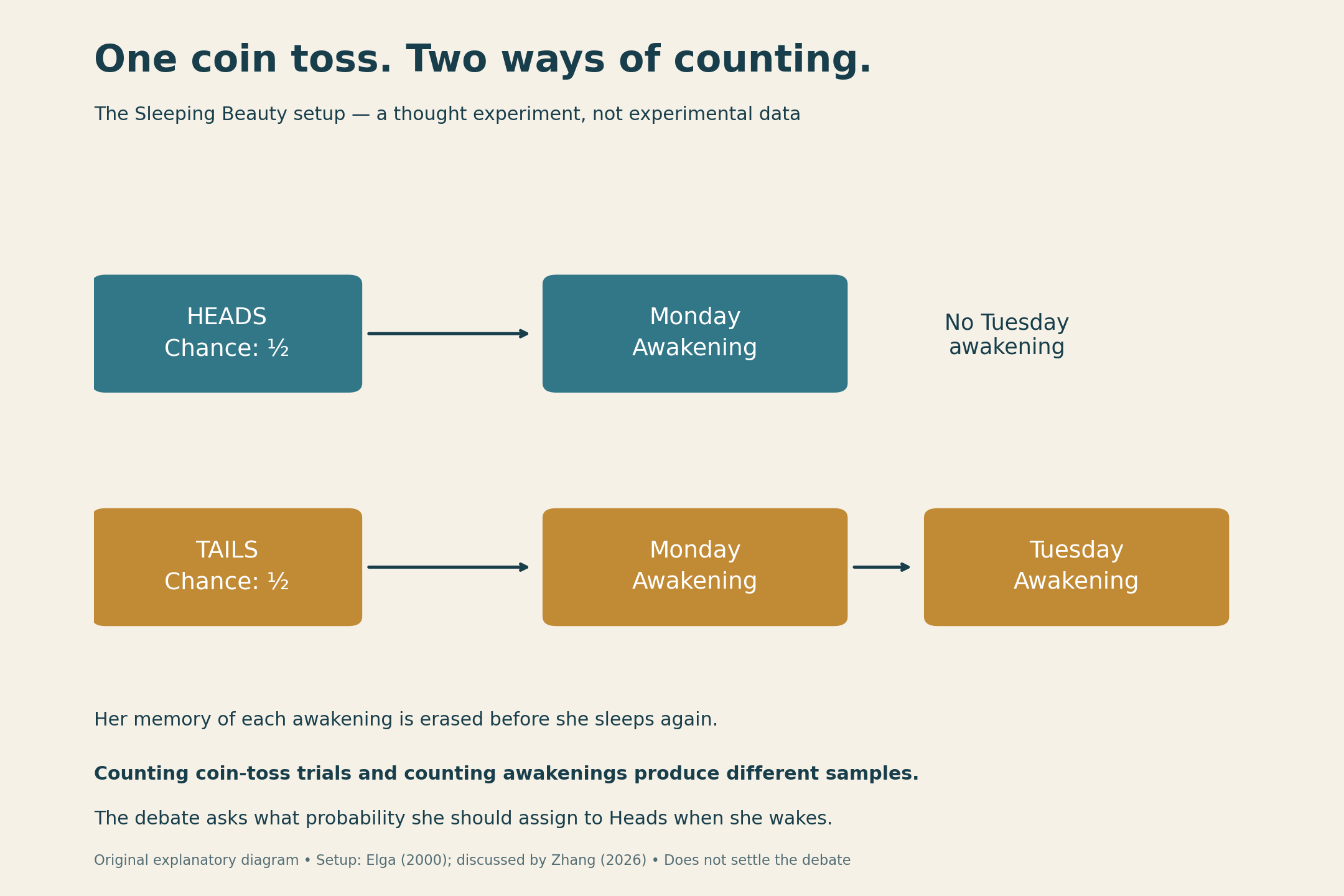
| Coin result | Chance before the trial | Monday | Tuesday |
|---|---|---|---|
| Heads | ½ | Awake | No awakening |
| Tails | ½ | Awake | Awake |
Elga argues for one third: across many trials, roughly one third of awakenings follow heads. The intuitive half answer instead emphasises the fair coin and the certainty that an awakening will occur either way. The dispute concerns how an observer’s location within the experiment should affect belief; the coin does not become physically biased. [14]
Zhang defends one half in classical and quantum versions, distinguishing event weights from probabilities and challenging several thirder arguments. Her conclusion supports many-worlds against this particular objection; it does not experimentally establish many-worlds or settle the wider interpretation debate. The paper’s position needs to be read alongside the arguments it disputes, not adopted merely because its author also has a journal publication. [13]
The connection between the papers is revealing. Both examine a move from a mathematical or experimental description to a probability assignment. What information is available? What is being counted? Which rule licenses the next step? Those questions can be easy to overlook precisely because the final arithmetic looks familiar.
Three questions that should remain separate
Quantum foundations includes several connected problems: why the Born probabilities have their form, why measurements yield definite experiences, and how interaction with an environment suppresses observable interference. Schlosshauer’s review examines decoherence and its relationship to interpretation. Decoherence supplies an important account of the emergence of stable, effectively classical behaviour; by itself it does not settle every question about a unique outcome or the meaning of probability. [15]
A result about assumptions in a probability derivation should therefore not be advertised as proof that consciousness creates reality, that parallel worlds can be contacted, or that quantum mechanics has stopped working. None of those conclusions follows from the work profiled here.
A profile of a programme still developing
Zhang’s stated ambition is to identify a minimal set of assumptions behind the Born rule, including whether the conventional state postulate is needed in a derivation. That is a carefully defined research task with room for both mathematical results and conceptual disagreement. [2]
The interest lies in seeing a young researcher make those starting points explicit. We can value that contribution without turning it into a story of one person overturning a century of physics. A clearer account of what an explanation assumes can itself be progress.
For readers, the useful question to carry forward is this: when a theory produces probabilities, have we explained their origin, their mathematical form, their role in decisions—or some combination of those? Zhang’s work gives us a reason to ask more precisely.
Sources and further reading
The bibliography distinguishes journal publications, author manuscripts and a preprint. The profile draws on public sources; personal details are attributed to Oxford’s interview. The numerical example and awakening diagram are original teaching aids, not reported measurements.
- Oxford Physics: Jiaxuan Zhang — official profile
- Oxford Physics: Meet…Jiaxuan Zhang (5 October 2026)
- Jiaxuan Zhang, Summing to uncertainty: On the necessity of additivity in deriving the Born rule. Physical Review A 114, 042208 (2026). DOI: 10.1103/mqy7-s2db
- Oxford Physics: Quantum uncertainty from addition (13 October 2026)
- Max Born: Nobel Lecture, The Statistical Interpretation of Quantum Mechanics (1954)
- Andrew M. Gleason, Measures on the Closed Subspaces of a Hilbert Space (1957), original paper
- Paul Busch, Quantum States and Generalized Observables: A Simple Proof of Gleason’s Theorem. Physical Review Letters 91, 120403 (2003). DOI: 10.1103/PhysRevLett.91.120403
- David Wallace, A formal proof of the Born rule from decision-theoretic assumptions (2009); chapter published as How to prove the Born rule (2010)
- Wojciech H. Zurek, Probabilities from entanglement, Born’s rule from envariance. Physical Review A 71, 052105 (2005). DOI: 10.1103/PhysRevA.71.052105
- Maximilian Schlosshauer and Arthur Fine, On Zurek’s derivation of the Born rule. Foundations of Physics 35, 197–213 (2005); author manuscript
- Carlton M. Caves and Ruediger Schack, Properties of the frequency operator do not imply the quantum probability postulate. Annals of Physics 315, 123–146 (2005); revised manuscript includes erratum changes
- John B. DeBrota, Christopher A. Fuchs, Jacques L. Pienaar and Blake C. Stacey, Born’s rule as a quantum extension of Bayesian coherence. Physical Review A 104, 022207 (2021). DOI: 10.1103/PhysRevA.104.022207
- Jiaxuan Zhang, Sleeping Beauty in One or Many Worlds: A Defense of the Halfer Position. arXiv:2603.03553 — preprint
- Adam Elga, Self-locating belief and the Sleeping Beauty problem. Analysis 60, 143–147 (2000); author’s text
- Maximilian Schlosshauer, Decoherence, the measurement problem, and interpretations of quantum mechanics. Reviews of Modern Physics 76, 1267–1305; DOI: 10.1103/RevModPhys.76.1267
Illustration note: the conceptual header is AI-generated and does not depict Zhang, her office or a physical experiment. The accompanying diagram represents a thought-experiment schedule and does not resolve the halfer–thirder dispute.