
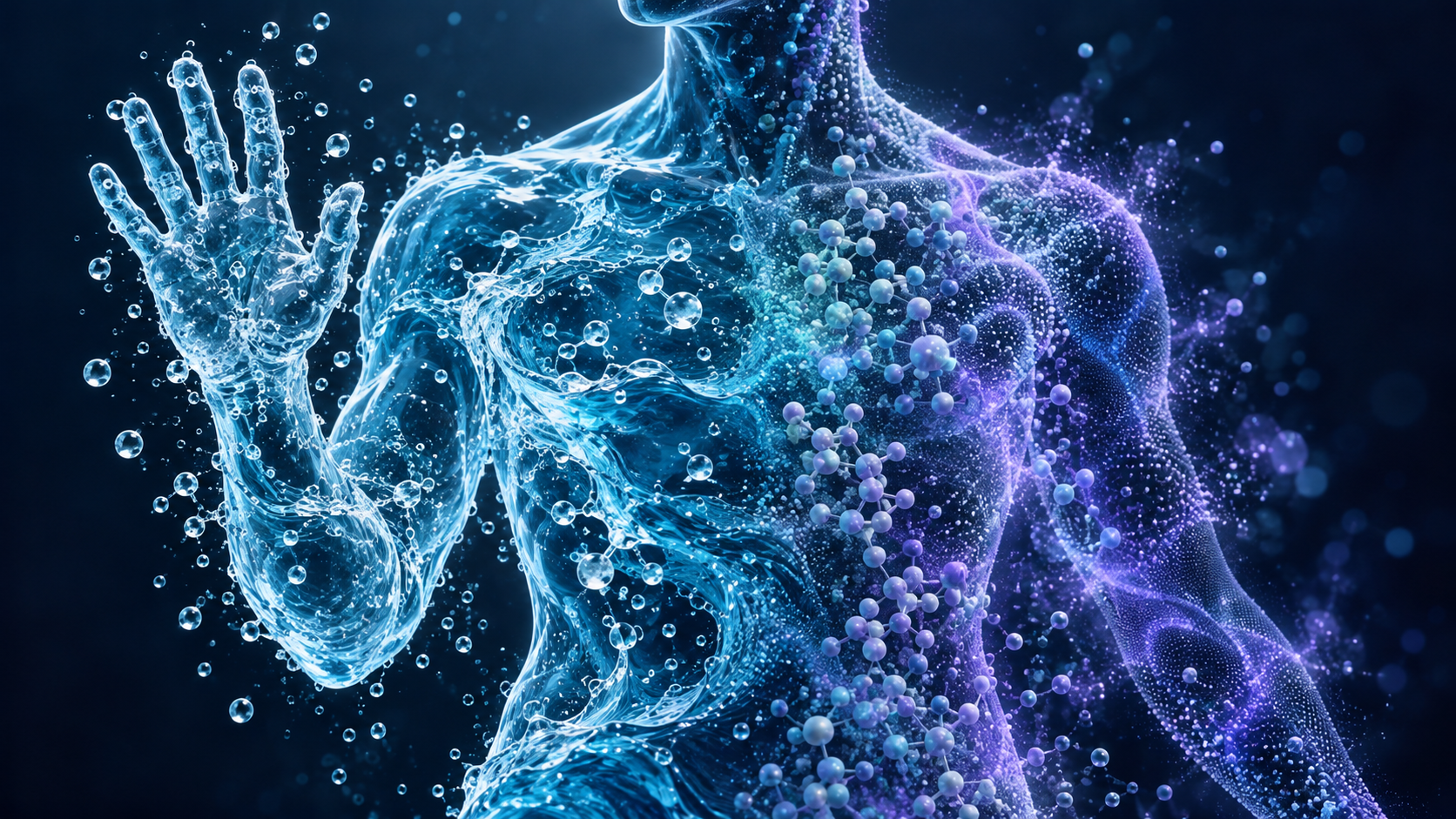
Ask about the body’s composition and you may be told that it is mostly water. Ask about atomic structure and you may hear that it is mostly empty space. Can both descriptions be useful—and what does that mean for how we perceive ourselves?
The apparent contradiction makes a good starting point, provided we do not turn it into a claim that medicine and physics disagree. They are usually answering different questions, at different scales and with different meanings of ‘mostly’.
Mostly water: a statement about mass
The US Geological Survey’s Water Science School describes water as accounting for up to about 60% of an adult human body’s weight. The proportion varies with age and body composition; it is not a fixed percentage shared by everyone.
This concerns how much of the body’s mass is attributable to water. It does not mean that a person is a hollow container with a liquid filling. Water is present within cells and in the fluids surrounding them, alongside proteins, fats, minerals and other substances.
Nor is water an alternative to atoms. A water molecule contains two hydrogen atoms and one oxygen atom. A description in terms of molecules can therefore remain compatible with a description in terms of the atomic structure of those molecules.
Mostly empty space: a statement about structure
The OpenStax astronomy text explains why solids are often described this way: most atomic mass is concentrated in nuclei that are extremely small compared with the overall extent of atoms.
There is a genuine and remarkable difference in scale. But comparing nuclear size with atomic size does not measure the percentage of a body’s mass that is ‘nothing’. One comparison concerns spatial extent; the water figure concerns composition by mass.
It would be misleading to subtract one from the other, or to treat them as rival answers in the same calculation. Before accepting a dramatic percentage, ask what is being counted: mass, volume, particles, or a model of spatial distribution.
An atom is not a tiny solar system
The OpenStax account of atomic structure traces the move from a compact nuclear model to quantum descriptions of electrons. In the quantum model, electrons are not little planets following well-defined circular tracks. Their states give probability distributions for measurement outcomes.
The familiar drawing of a nucleus, a few orbiting dots and a blank background can encourage the wrong intuition: that atoms are miniature cages containing ordinary empty gaps. The drawing is a teaching device, not a photograph.
An electron cloud is not a fog of tiny classical fragments, either. It represents aspects of a quantum description. Calling the region outside the nucleus ‘empty’ can highlight the smallness of the nucleus while concealing the importance of the electrons and their interactions.
For this reason, ‘the body is mainly made of nothing’ goes further than the structural comparison warrants. A small nucleus does not make the remainder physically irrelevant.
Why does matter resist being compressed?
If atoms are not solid little marbles, why does a table support a hand? The explanation involves the energy and quantum states of the combined material, rather than nuclei having to collide like billiard balls.
Electromagnetic interactions provide attractions and repulsions among charged constituents. The Pauli exclusion principle also restricts identical electrons: they cannot occupy the same complete quantum state. This does not mean their spatial distributions can never overlap.
The research review The stability of matter explains the essential role of quantum mechanics and the Pauli principle in the stability of bulk matter. A simple picture of electrical repulsion alone is therefore incomplete.
Changing the arrangement and overlap of electronic states changes a material’s energy. Around a stable configuration, further compression costs energy and produces resistance. Materials can still bend, deform, flow or break: atomic structure is not a universal guarantee of rigidity.
Our bodies are not rigid solids throughout, and water flows while remaining difficult to compress under ordinary conditions. ‘Feels solid’ is consequently a useful everyday description, but not a complete classification of everything making up a person.
Perception: what does touch tell us?
A neuroscience account of touch describes receptors responding to deformation, pressure, vibration and stretching of the skin. They convert mechanical stimulation into neural signals for further processing.
When we feel a surface resisting our hand, we are experiencing the outcome of physical interactions through a sensory system. We are not directly sensing whether nuclei fill most of an atom’s volume.
This is where the perception question becomes interesting. Our experience gives us information at the scale of hands, surfaces and movement. An atomic model addresses structures and interactions that unaided touch does not resolve.
The two descriptions need not cancel each other. A hand can genuinely meet resistance while the microscopic account looks very different from the everyday picture of continuous, solid stuff. Explaining a sensation does not make it imaginary.
Does observation create the body?
Nothing in the evidence discussed here establishes that consciousness creates matter, or that a body stops existing when nobody looks. Those are additional claims, not conclusions obtained from comparing water content with nuclear size.
Likewise, the ordinary act of perceiving a surface should not be silently equated with every technical use of ‘measurement’ in quantum physics. A discussion of quantum measurement needs its own argument and evidence.
We can remain curious about the relationship between experience and physical description without treating an evocative phrase as proof of a wider metaphysical theory.
Watch: solidity, electron clouds and touch
PBS Be Smart — Glass is Solid… So Why Is It Clear? (5 minutes 42 seconds, published 23 December 2020) is a useful companion. Although its title concerns glass, it also explores electron clouds, resistance to contact and the sensation of touch.
The video uses simplified illustrations and language. Read its imagery alongside the qualifications above, particularly about ‘nothing’ and the role of quantum states. The PBS episode page includes a transcript if playback is unavailable.
What our current understanding allows us to say
Within today’s understanding, biological and quantum descriptions answer different but compatible questions about the same body. Their usefulness is grounded in observation and testing, not in a requirement that they resemble everyday intuition.
These models remain open to refinement. That does not put a measured water proportion and the unsupported claim ‘we are nothing’ on equal evidential footing. Uncertainty is a reason to state a claim carefully, rather than to abandon distinctions between claims.
We can be largely water by mass, have nuclei occupying a tiny fraction of atomic extent, and still experience real resistance when we touch a table. The puzzle begins to clear when we ask what each description measures.
Related reading
Sources and further reading
- USGS — The Water in You
- OpenStax — The Universe of the Very Small
- OpenStax — The Structure of the Atom
- Nobel Prize — Wolfgang Pauli and the exclusion principle
- Elliott H. Lieb (1976) — The stability of matter, Reviews of Modern Physics
- NCBI Bookshelf — Touch and Other Somatosensory Senses
- PBS Be Smart — companion video and transcript
Sources checked on 16 October 2026. Water percentages describe composition by mass; ‘empty space’ refers to a comparison of atomic and nuclear scales, not a measured percentage of human nonexistence. Quantum illustrations are models, not literal photographs of atomic interiors.