
Editorial
Kemi Badenoch says the Conservatives would cut £36.1 billion a year from welfare by the end of the next Parliament. At the launch on 10 November, she invoked double amputees who run marathons while arguing that people can contribute despite serious health challenges. Of course they can. Many already do, and disability support can help them do it. That is the point her sales pitch skips. After fourteen years in office and a defeat that left them with 121 MPs in 2024, the Conservatives still owe voters evidence that they can govern competently. This proposal gives voters reason to withhold their trust. Guardian launch coverage · Reported policy breakdown · House of Commons Library election results
A marathon is no test for disability benefits
Personal Independence Payment, or PIP, helps with extra living costs arising from long-term disability or ill health. People can receive it while working. Assessors look at how a condition affects particular everyday activities and whether those activities can be done safely, repeatedly, to an acceptable standard and within a reasonable time. Someone can be qualified for a job and still need help getting there. Someone with a fluctuating condition may be able to do a task on Tuesday and struggle to repeat it on Wednesday. An athlete’s performance tells us nothing about either person’s support needs. GOV.UK guide to PIP · DWP assessment criteria
The Conservatives say changing sickness and disability benefits would account for £13.7 billion of their proposed savings. Their proposals include restricting claims for conditions they describe as mild and tightening eligibility. The practical question is where the line would fall for somebody who cannot reliably get around or manage daily tasks. A policy that takes support from someone already in work could make that job harder to keep. How many people face that risk, and where is it accounted for in the party’s figures? Conservative proposals as reported by Politics.co.uk · The Times on proposed reassessments
Three large items in the Conservatives’ £36.1bn annual savings claim
A smaller benefits bill can leave a bigger bill elsewhere
The rise in claims is real. The Institute for Fiscal Studies found that about four million working-age people in England and Wales received disability or incapacity benefits by the time of its study, compared with 2.8 million in 2019. Those totals tell us the scale of the change. To know whether cutting payments would increase employment, we need evidence on why claims rose, who could work with support and whether suitable jobs are available. Counting a stopped payment is much easier than answering any of those questions. IFS study of rising health-related claims
Reinstating the two-child limit puts the trade-off in plain sight. The Conservatives claim £3.1 billion in annual savings from bringing it back. The government projects that abolishing it will lift 450,000 children out of relative poverty by the final year of this Parliament. These are different projections and the government’s estimate cannot simply be reversed to calculate the effect of restoration in a later Parliament. But the comparison shows what the Conservative costing needs alongside it. Voters deserve an assessment of how many children would be pushed into hardship and what extra demand schools, councils and other services could face. Conservative savings claim · Government poverty projection
Here is a barrier to work the party could actually address
Access to Work helps disabled people start or stay in employment. The National Audit Office found that average application processing time reached 109 working days in November 2025 against a 25-day target. The application backlog was already growing during the Conservatives’ time in office and delays worsened under Labour. One organisation told auditors that some employers had withdrawn job offers when support took too long. A government serious about employment would be judged on whether a worker can get the equipment or practical help they need in time to take the job. National Audit Office report on Access to Work
Access to Work application processing time
The Conservatives have already shown what a headline can cost
In September 2022, the Truss government presented its mini-budget without a published Office for Budget Responsibility forecast. Days later, the Bank of England intervened in the gilt market because it judged that dysfunction there posed a risk to financial stability. The lesson was to test the assumptions before making an announcement that households and businesses would have to live with. OBR record of mini-budget preparation · Bank of England intervention
Watch the historical record. Kwasi Kwarteng delivers the 2022 mini-budget in full (Sky News). For Badenoch’s welfare launch, read the Guardian’s report and speech extracts.
The party also chose the post-Brexit trading settlement. The OBR assumes that relationship will leave long-run UK productivity 4% lower than if Britain had remained in the EU. That figure is a forecast against an alternative path. It still matters when the Conservatives blame the welfare bill for weak public finances. Their own choices affect the productive economy and the tax revenues that fund public services. OBR Brexit assumptions
Badenoch should resign
Badenoch inherited the party’s record. She chose to make this welfare plan a demonstration of its readiness for office. A capable shadow cabinet would have demanded a clear account of who loses support, credible estimates of how many people enter or stay in work, and a costing that tests where spending might rise elsewhere. It would have explained what help would be in place before payments ended.
The Conservatives can earn another hearing when they have a leader willing to own those trade-offs and a team capable of delivering the policy it promises. Badenoch’s pitch gives voters ample reason to keep them out of government.
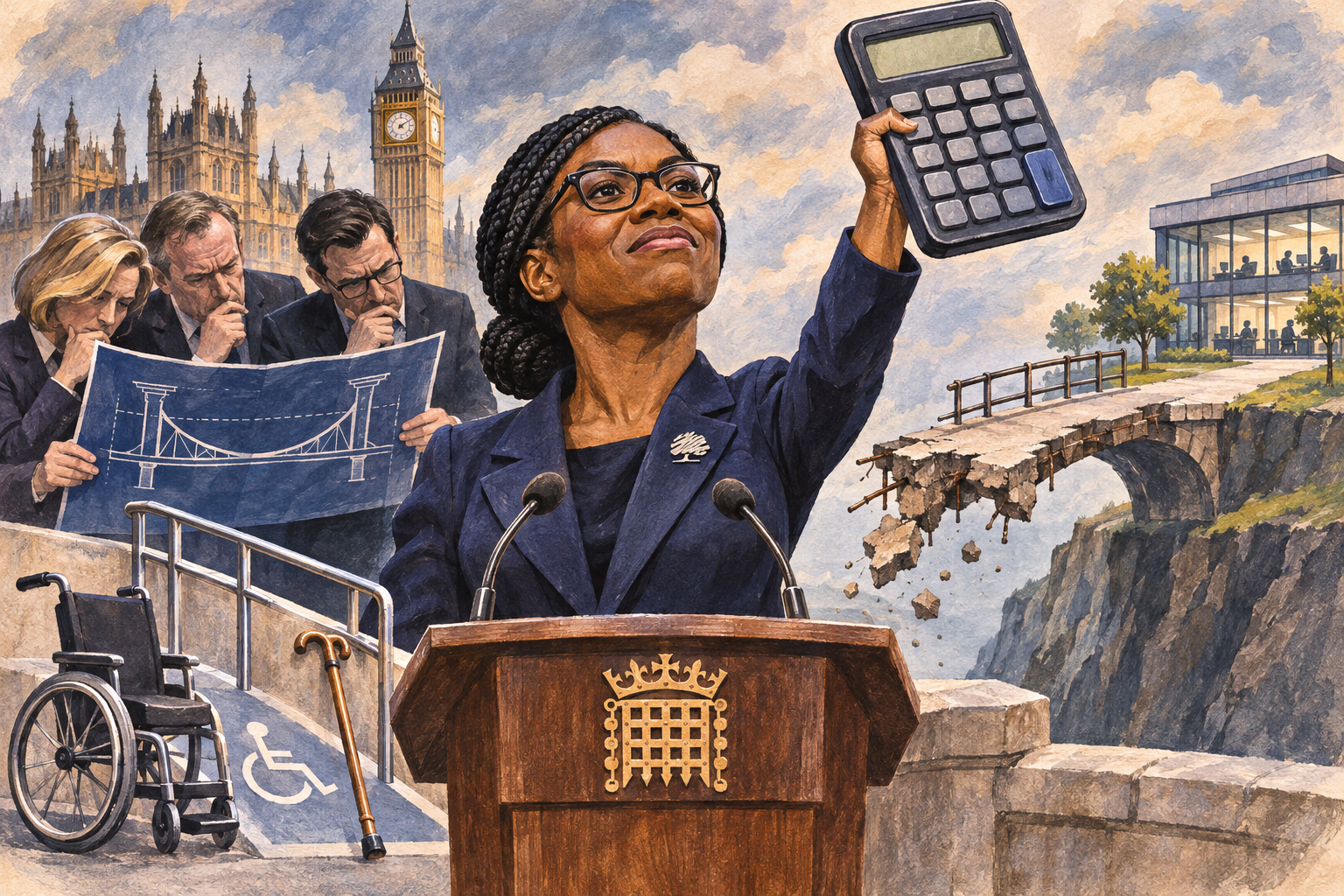
Featured image is an AI-generated editorial illustration.