
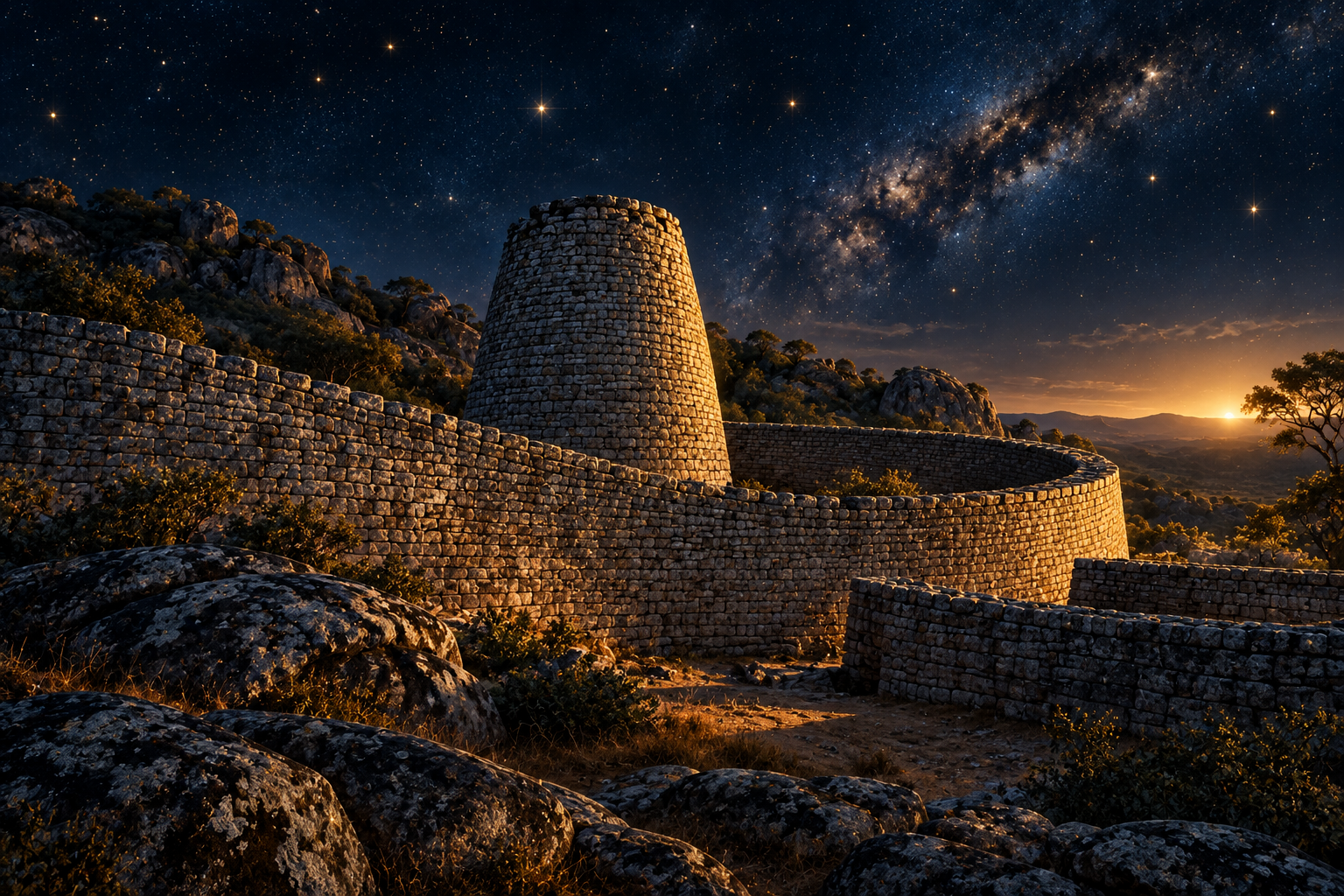
A curving wall of carefully fitted stone can look like a riddle. At Great Zimbabwe, the better question is what the surviving evidence allows us to say about the people who built it. The answer reveals an African city with skilled craftspeople and far-reaching connections, while leaving room for questions archaeology has yet to resolve.
An African city, not a vanished myth
Great Zimbabwe stands near Masvingo in present-day Zimbabwe. UNESCO identifies the monument with the Shona civilisation and dates its principal construction to roughly 1100–1450. Its main groups are the Hill Ruins, the Great Enclosure and the Valley Ruins. These names describe different parts of a settlement, rather than a single isolated building.
The city’s origins were once misrepresented. Nineteenth-century European observers attributed its architecture to outsiders. The Metropolitan Museum of Art explains that early twentieth-century archaeological investigations confirmed its African origins. That history matters: an impressive structure is not evidence that local people could not have built it.
How the walls were built
The builders used granite from the surrounding hills, fitting blocks together without mortar. Successive courses could be set slightly inward to help stabilise the wall. This was an engineering achievement grounded in available materials and developed craftsmanship.
The surviving stonework is only part of the original settlement. The Met’s architectural account describes earthen and thatched buildings associated with the walls; much of that material has eroded. A visitor looking only at stone enclosures therefore sees an incomplete picture. Walls that appear fortress-like today should not automatically be treated as proof of military purpose. Their roles in privacy and authority remain matters of interpretation.
Objects that reveal connections
UNESCO records imported glass beads and porcelain, alongside coins linked to the Indian Ocean world. Such finds support the conclusion that Great Zimbabwe participated in long-distance exchange. They do not mean that foreign traders built the city. Goods can travel through several hands before reaching the place where archaeologists recover them.
In Tawanda Mukwende’s 2025 account for The Met, local economic life includes livestock keeping, cultivation, weaving and metalworking, with gold and ivory entering Indian Ocean trade. The city depended on everyday production as well as impressive architecture. Its inhabitants were people with practical skills, livelihoods and social relationships.
What remains uncertain
Some questions concern meaning rather than construction. The carved soapstone birds associated with the site have been interpreted as religious and royal symbols. Their precise significance cannot simply be read off their appearance. A suggested interpretation should be presented as a suggestion, not as a recovered statement from a medieval resident.
Chronology also requires care. UNESCO’s principal building dates are narrower than the eleventh-to-seventeenth-century occupation span discussed in Mukwende’s account. Construction, peak influence and continued occupation need not have identical dates. Mukwende describes a decline in influence in the late fifteenth century as Khami became more powerful; that is different from proving a sudden, single catastrophic disappearance.
Why the distinction matters
A useful account of the past separates three things: what survives, what researchers infer, and what later storytellers believe. Missing information is an invitation to investigate. It is not positive evidence for an extraordinary explanation.
For a broader look at this approach, read Lost Civilizations: What the Evidence Reveals, or explore History & Mysteries. Great Zimbabwe offers a compelling subject precisely because careful evidence reveals so much while allowing honest uncertainty.
What to read next
Lost Civilizations
The Prophecies That Shaped History
Sources checked 6 October 2026. The featured image is an AI-generated artistic impression of the ruins, not a photograph or an exact historical reconstruction.