
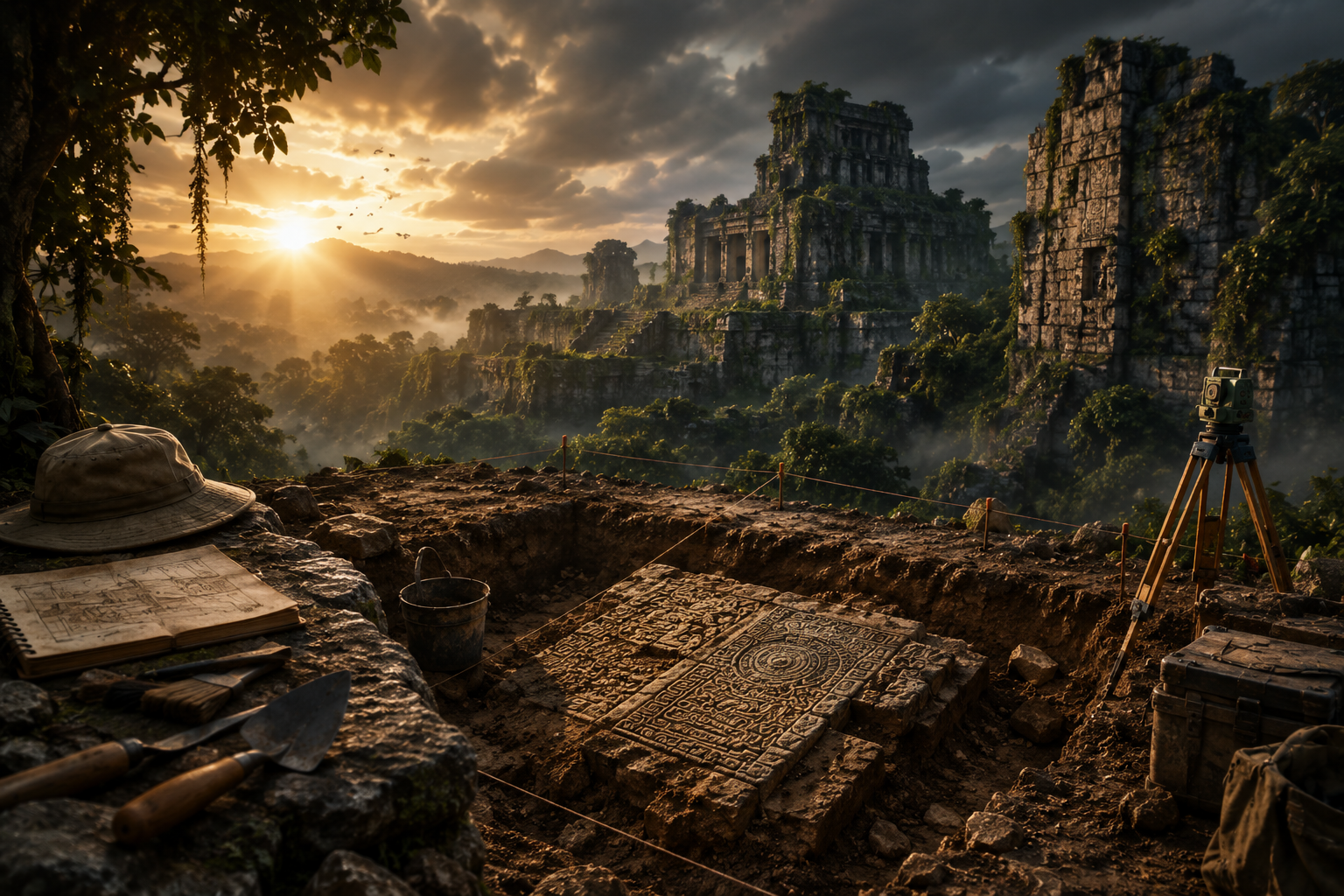
A ruined city invites an irresistible question: what happened here? Stone walls outlive the people who built them, and an empty doorway can make an entire society seem to have vanished. But the word “lost” often describes a gap in our knowledge, rather than the disappearance of a people.
To understand ancient communities, we need to look beyond the dramatic image of sudden collapse. Buildings, objects, landscapes and living traditions preserve different parts of the story. Three examples show why evidence makes these places more interesting, not less.
Mesa Verde: Leaving a Place Is Not Vanishing
The cliff dwellings of Mesa Verde are among the most striking reminders of Ancestral Pueblo life. Yet a deserted settlement is not evidence that its inhabitants ceased to exist. The National Park Service’s account of Mesa Verde’s people describes migration away from the region during the thirteenth century and the continuing connections of descendant communities.
It identifies drought, limited resources and social change as part of the context, while stressing that reasons for moving likely differed between people. Pueblo and Hopi communities today are descendants of those who lived in these places. Their histories and traditions belong in the investigation alongside the remains of buildings.
That changes the question. Instead of asking why a mysterious people vanished, we can ask how families responded to changing circumstances, where they went, and what they carried with them. A place may become quiet while its people’s story continues elsewhere.
Angkor: Read the Landscape, Not Just the Temple
At Angkor in Cambodia, the monumental buildings are only part of a larger picture. UNESCO’s description of Angkor includes reservoirs, canals, dykes and other hydraulic structures, as well as communication routes. The site brings architecture and infrastructure into the same field of view.
A temple can tell us about artistic achievement and religious life. A water system prompts questions about organisation, maintenance and the relationship between settlement and environment. Looking at both helps us imagine a functioning society rather than an isolated monument.
These remains do not justify a simple claim that one cause explains every change in Angkor’s history. They show why a convincing explanation needs to consider several connected systems. The impressive photograph is the opening scene; the wider landscape is where much of the investigation happens.
The Indus World: Objects Before Answers
The Indus civilisation occupied parts of the northwestern Indian subcontinent, including areas now in Pakistan and western India. The British Museum’s collection description provides that geographical context. Individual objects offer a closer view.
One Indus stamp-seal in the museum’s collection bears a rhinoceros and a short inscription. Even a small object raises large questions. Who used it? What did its imagery communicate? How did objects like it fit into daily transactions or social life?
A catalogue can establish material, form and recorded provenance without answering every question about meaning. This is where restraint matters. The existence of an inscription does not entitle a modern writer to invent its message. An unanswered question is a reason to seek better evidence, rather than an invitation to fill the gap with an attractive story.
What Counts as a Good Explanation?
Start by separating observation from interpretation. A damaged wall is observable; the cause of its damage may require further investigation. An abandoned building is observable; the fate of everyone who once lived there is a much larger claim.
Then ask whether independent evidence supports the proposed explanation. Do objects, settlement patterns and environmental records point in compatible directions? Does the account acknowledge people who still have cultural connections to the place? Could more than one process be involved?
Mystery is most rewarding when it leads us towards a fuller human story. Ancient societies were made up of people who built, traded, adapted and moved. Their achievements deserve attention without turning them into an inexplicable civilisation beyond ordinary human capability.
The next time a headline announces a lost world, ask what is actually lost: a settlement, a written record, a political system—or our understanding of how the evidence fits together. That question is the beginning of discovery.
What to read next
Great Zimbabwe
The Prophecies That Shaped History
The featured artwork is illustrative and does not document any particular archaeological site.