
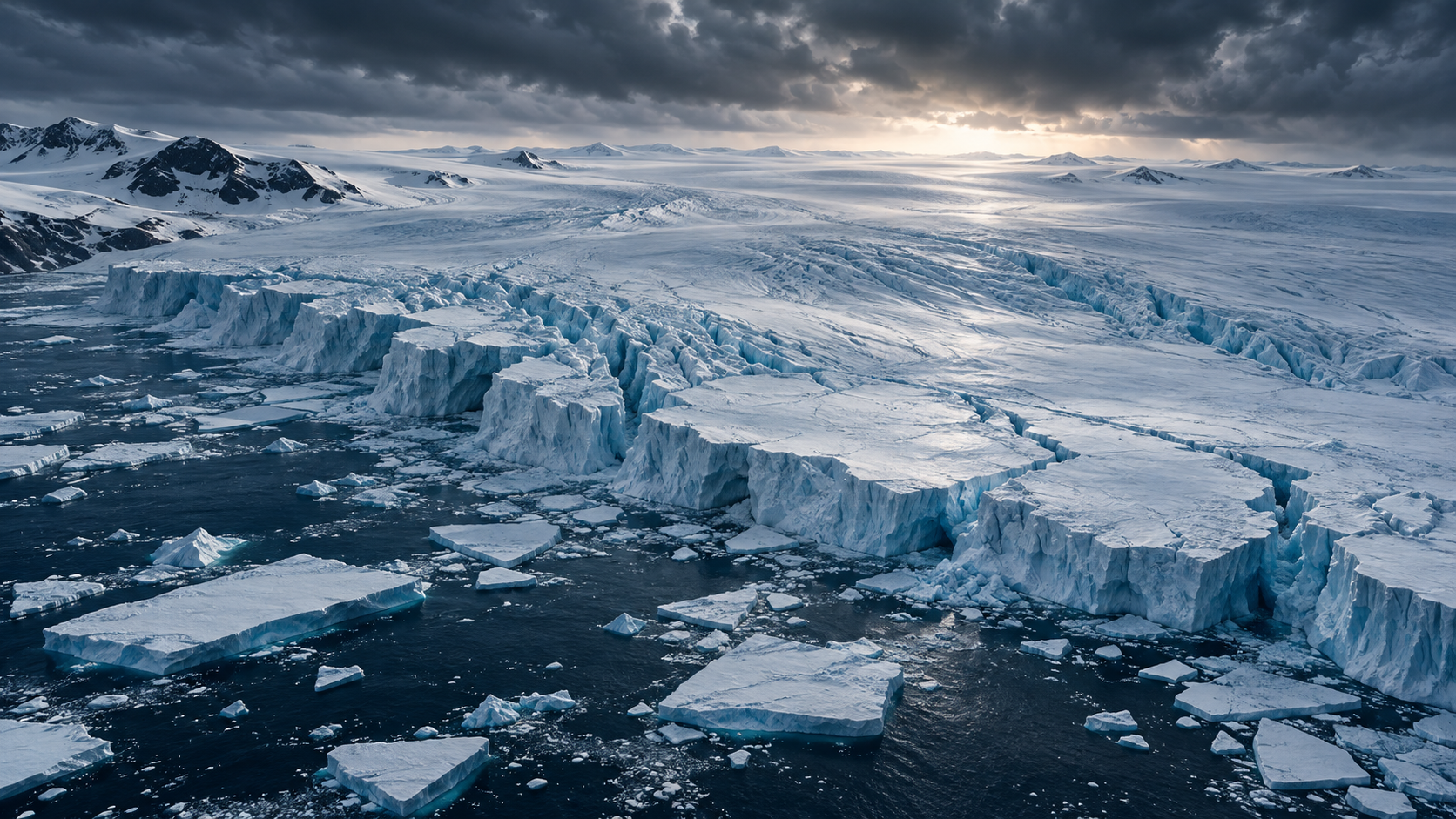
Some disasters arrive with a bang. Others quietly change the conditions under which civilisation has to live. Thwaites Glacier belongs to the second category. Its nickname—the “Doomsday Glacier”—sounds like a disaster film. The research behind the concern is more unsettling than the nickname: changes set in motion long ago may keep unfolding long after we try to stop them.
There is no scientifically defensible countdown to the day Thwaites destroys the world. There is, however, a serious question about how much coastline future generations will inherit—and how expensive it will become to remain there.
A glacier with consequences far beyond Antarctica
Thwaites is an enormous glacier in West Antarctica, comparable in area to Great Britain. Its complete loss would contribute roughly 65 centimetres to global mean sea level. That is a full-loss estimate, not a prediction for this century. The International Thwaites Glacier Collaboration’s September 2025 assessment describes accelerated retreat over the past four decades, with further retreat expected through this century and the next.
A global average is also not a local flood forecast. Ocean circulation, land sinking or rising, and other regional factors affect what happens at individual coastlines. NASA explains these differences in its sea-level indicator. The figure cannot simply be drawn as an identical new waterline around every country.
The experiment that makes this story especially uncomfortable
A paper by C. Rosie Williams and colleagues, published in Geophysical Research Letters on 25 July 2026, asked what would happen if ocean melting beneath Thwaites and neighbouring Pine Island Glacier stopped completely. The researchers tested this extreme scenario using three ice-sheet models.
Pine Island thickened and advanced. Thwaites continued losing ice throughout the 150-year simulations, although its loss rate decreased. The study concludes that some present-day loss reflects an ongoing response to historical changes, and that ocean cooling alone did not restore its earlier state over the simulated period.
The distinction matters: these simulations were designed to investigate the drivers of change, not predict the glaciers’ actual future. Nor did the experiment establish that every future retreat is irreversible. The authors explicitly distinguish that stronger claim from their result. Read the study.
British Antarctic Survey publicised the findings on 13 October 2026. Its explanation stresses that zero ocean melting is an illustrative scenario that would not occur in reality. Present warm conditions and future warming add to the problem.
The uncomfortable lesson is about delay. A system can continue responding to an earlier disturbance after the original pressure is reduced. Political decisions, meanwhile, are often made as though consequences can be switched off on the same timetable as a policy.
The danger is underneath
A glacier’s grounding line marks the transition between ice resting on the bed and ice floating in the ocean. A 2024 study in PNAS, using radar observations collected in 2023, found that this boundary at Thwaites behaved as a broad, tidally moving zone. The researchers also detected seawater intrusions extending kilometres farther inland beneath grounded ice. That gives ocean water access beyond a simple, fixed boundary.
A separate 2024 modelling study by Alexander Bradley and Ian Hewitt explored how water intrusion and melting could reinforce one another: melting opens space for more water, which promotes further melting. It identified potentially abrupt changes in grounding-zone behaviour. This describes a possible physical mechanism; it does not supply a date for Thwaites to collapse.
Direct observations also show why simplified pictures can mislead. Underwater-vehicle research published in Nature in 2023 found strongly uneven melting near the eastern grounding line, with enhanced melting along steep ice surfaces and crevasses while stratification suppressed melting beneath flatter surfaces. A single average melt rate cannot describe every part of this hidden environment.
An ice shelf breaking up is not the whole glacier collapsing
The floating eastern ice shelf and the much larger glacier feeding it are different parts of the system. The collaboration’s 2025 assessment judged full glacier collapse unlikely within the next few decades. It also reported that the eastern shelf had already lost much of its ability to restrain ice flow, so its final breakup was not expected to trigger a sudden, large acceleration of ice loss.
The wider concern reaches beyond Thwaites: the assessment says a general West Antarctic Ice Sheet collapse through the 21st and 22nd centuries cannot be ruled out. That is a risk statement with substantial uncertainty, not a timetable or a claim that the entire ice sheet will disappear when one shelf breaks.
Why floating ice still matters
Floating ice already displaces seawater. Its melting has a much smaller direct sea-level effect than adding land ice to the ocean; NASA explains the small additional effect caused by freshwater and seawater density differences.
The larger concern is mechanical. Ice shelves can resist the flow of grounded ice behind them. Their thinning or loss can weaken that restraint, as NASA’s ice-sheet research explains. The precise consequences depend on the glacier’s geometry and how much restraint remains.
Watch: why scientists are studying Thwaites
British Antarctic Survey’s International Thwaites Glacier Collaboration: What is happening at Thwaites Glacier? introduces the research programme and why the glacier matters for sea level. Published in October 2021, it provides background; the newer findings and timescale qualifications are covered in this article.
Watch the British Antarctic Survey video on YouTube.
What could this mean for the UK coast?
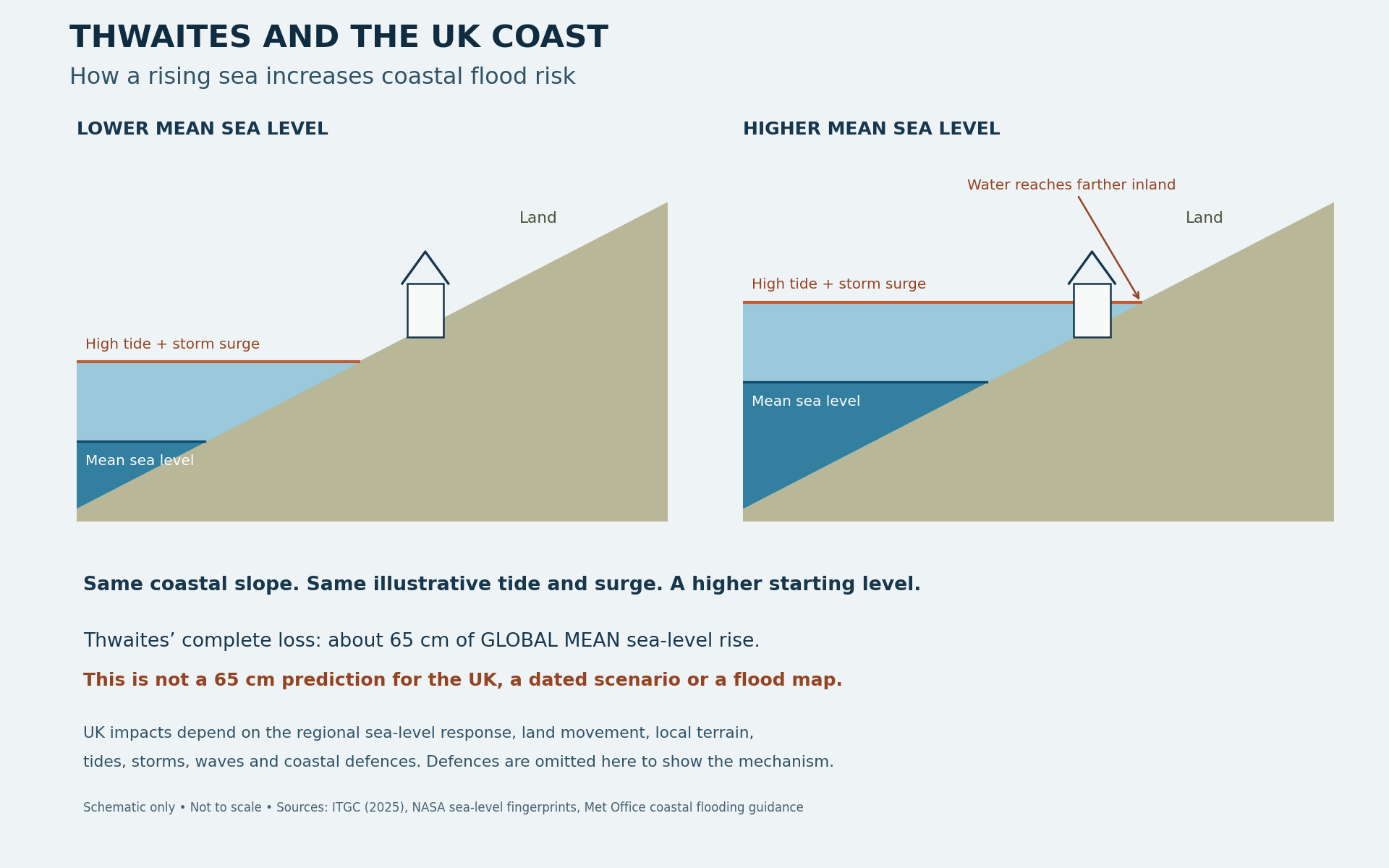
Rising mean sea level raises the starting point for high tides and storm surges. On a low-lying coast, the same illustrative tide and surge can then reach farther inland. Defences can reduce that risk, but their height, condition and operation matter. See the Met Office’s discussion of UK sea level and coastal flooding.
Thwaites’ roughly 65 cm full-loss figure is a global mean, not a uniform UK projection or a prediction for a particular year. Ice loss changes gravity and produces regional sea-level patterns, as NASA explains. A reliable local flood map also requires terrain, tides, storms, land movement and defence data; simply shading UK land below 65 cm would not provide one.
Doom does not have to mean the end of everything
The word “doomsday” can make a distant glacier feel immediately important. It can also encourage the mistaken idea that there is one final catastrophe, followed by nothing left to do.
The stakes are more human and more uneven than that. Which places can afford protection? Which communities face repeated disruption? Which generation pays for infrastructure built under assumptions that no longer hold? Those are the questions a rising ocean forces onto the agenda.
The research gives no grounds for declaring action pointless. The collaboration identifies sustained emissions reductions as the best hope of delaying ice loss and reducing wider ice-sheet risks. Preparing for rising seas and limiting further warming remain complementary tasks.
Thwaites offers a darker story than an overnight apocalypse: decisions made within a human lifetime can leave consequences unfolding over centuries. We should be careful with the word “doomsday”. We should be considerably more careful with the glacier.
Sources and reading
This article draws on the linked peer-reviewed studies, the International Thwaites Glacier Collaboration’s September 2025 synthesis, British Antarctic Survey’s October 2026 explanation, and NASA’s sea-level resources. Model experiments, observed changes and possible future outcomes are distinguished throughout. Reviewed: 16 October 2026.
Related: Climate Change: What the Numbers Actually Tell Us · What the Doomsday Clock Actually Measures.