
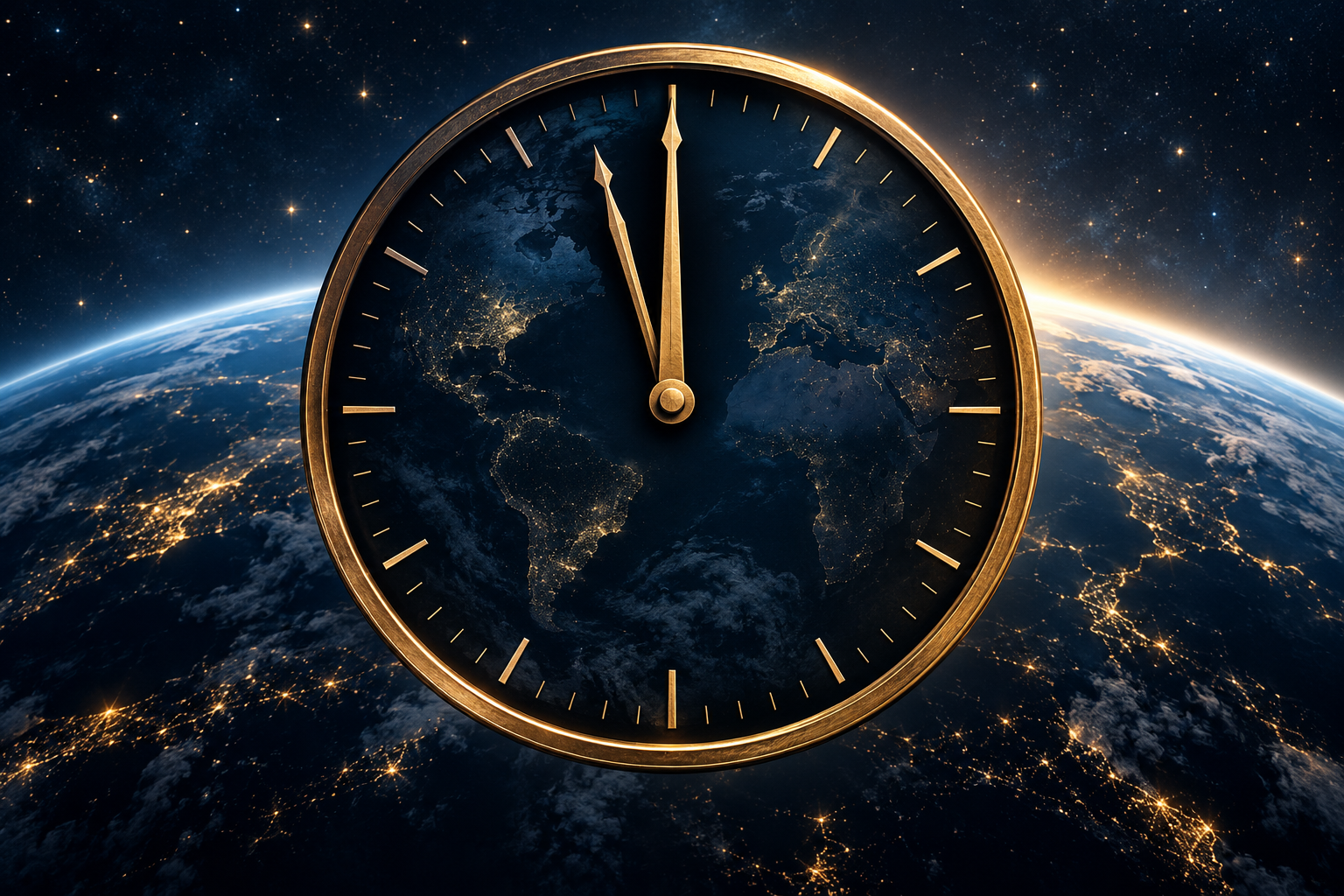
Checked: 6 October 2026. The Doomsday Clock is set at 85 seconds to midnight, following the Bulletin of the Atomic Scientists’ announcement on 27 January 2026. Read the official 2026 statement.
A clock approaching midnight is a powerful image. On our homepage, it sits beside a climate indicator to invite a closer look at the pressures shaping our world. But understanding the symbol matters as much as noticing the number.
What does midnight mean?
The Clock represents humanity’s exposure to catastrophe from technologies we have created. Midnight symbolises catastrophe; the distance from it expresses the Bulletin’s assessment of danger. It began in 1947 in the nuclear age, and climate change entered its deliberations in 2007. Source: the Bulletin’s explanation of the Clock.
Who sets the hands?
The Bulletin’s Science and Security Board makes the assessment, consulting its Board of Sponsors. It examines evidence and international developments, then makes a judgement. The setting is normally announced annually. The 2026 assessment covers nuclear risks, climate change, biological threats and disruptive technologies, including artificial intelligence. Source: 2026 statement.
What 85 seconds does—and does not—tell us
The setting does not predict a date for the end of the world. It is not a continuously running timer, and a second does not translate into a fixed number of days or years. The Bulletin explicitly describes the Clock as a metaphor, rather than a forecasting tool. Its numerical appearance should not be mistaken for a calculated probability of disaster. Source: official FAQ.
For readers, the useful question is therefore: what evidence lies behind this assessment? Look at the accompanying explanation, the date and the underlying issues. The number alone cannot tell the full story.
Can the Clock move backwards?
Yes. In 1991 it stood at 17 minutes to midnight, following the end of the Cold War and the Strategic Arms Reduction Treaty. Its history includes movement both towards and away from midnight. Source: official FAQ.
That is the hopeful part of the image: the future is open to decisions. Treating every warning as inevitable doom can obscure the practical choices worth debating. A serious discussion of risk should leave room for prevention, cooperation and accountability.
How to read the indicators on this site
Our homepage Clock displays the latest official setting available to our update system. Checking for a new announcement does not make the hands tick down. The neighbouring climate meter reports a measured temperature anomaly with its own month and reference period; it is a different kind of indicator. Always read those labels before comparing numbers.
What to read next
A World in Conflict
Climate Change: What the Numbers Actually Tell Us
We use these features as starting points for exploration. Neither establishes a prophetic timetable. For more context, read A World in Conflict and Signs in the Heavens and Earth, or explore Science & Signs.