
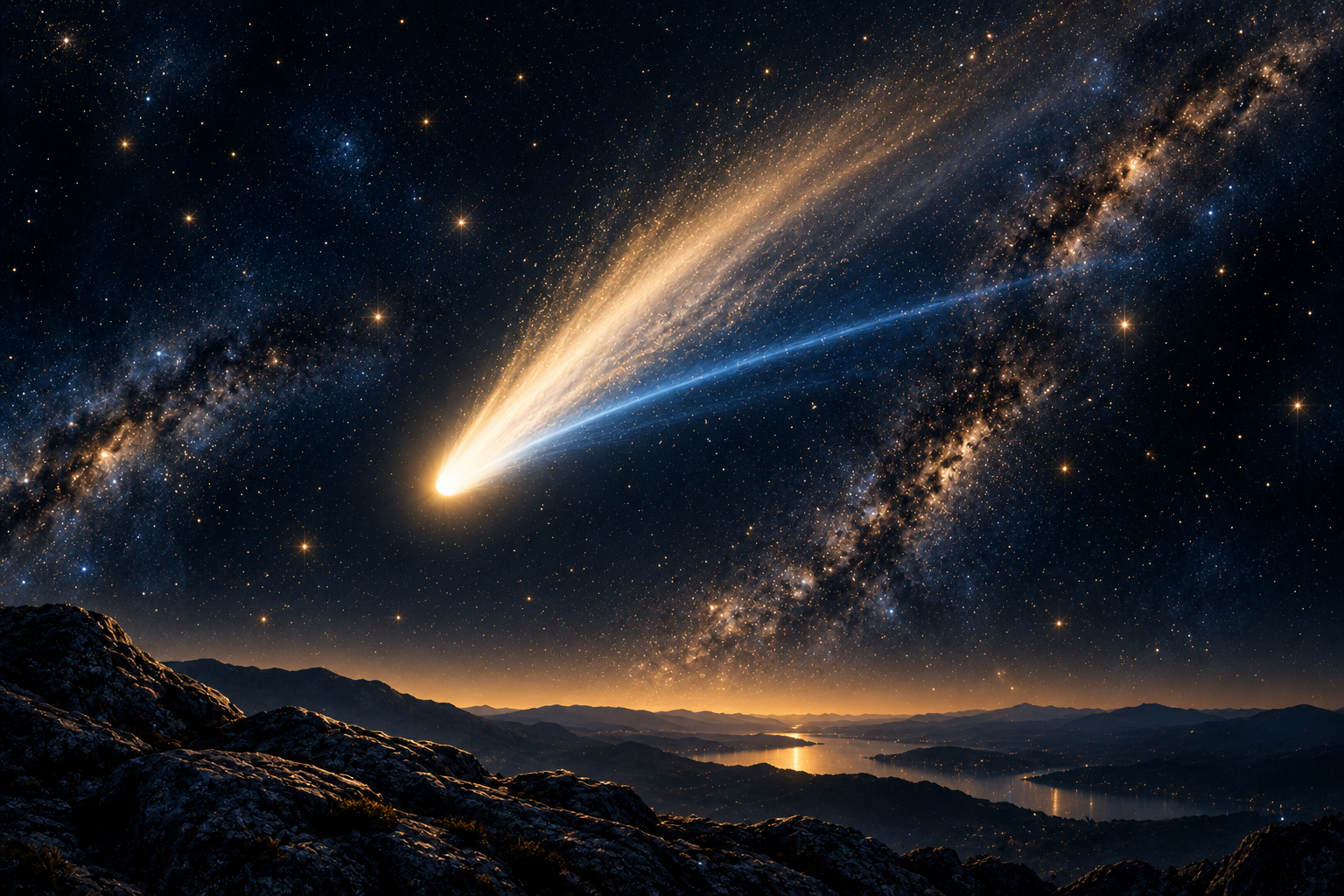
A comet can transform a familiar sky into something strange. Its luminous tail invites wonder, and its arrival can feel significant. But an object’s physical nature, the history of people’s reactions to it and a claim that it foretells events are three different questions.
What a comet actually is
According to NASA’s comet guide, comets preserve material from the early solar system. Their nuclei contain ice, dust and frozen gases. When a comet approaches the Sun, warming releases gas and dust, forming a surrounding coma.
Sunlight and the solar wind help produce the tails: a dust tail and an ion, or gas, tail. These structures can be enormous compared with the nucleus. A striking tail is therefore not a solid object stretching across space, nor is it evidence that the comet is burning through Earth’s atmosphere.
This distinction also separates a comet from the brief streak of a meteor. When someone calls a visible comet a fireball heading towards us, the description may be importing the behaviour of a different phenomenon.
Halley: a prediction that could be tested
NASA’s history of Halley’s Comet describes how Edmond Halley compared observations from 1531, 1607 and 1682. Using gravitational calculations, he proposed that they were appearances of one returning object and predicted another return in 1758. The comet returned.
That prediction matters because it specified something observable before the event. It could have failed. A calculation that predicts a comet’s return is different from an interpretation that assigns a meaning to its appearance after a political crisis has occurred.
Halley’s orbital period averages roughly 76 years, but varies between passages. Predictability does not require every journey to take an identical number of days; gravitational interactions can change an orbit.
The comet in the story of 1066
The Bayeux Museum’s online tapestry includes Halley’s appearance over England in spring 1066. It places the celestial visitor within the narrative of William the Conqueror’s accession.
A historical portrayal can tell us that a comet mattered to the people constructing that story. It cannot, on its own, show that the comet caused a conquest or carried advance knowledge of its outcome. To evaluate an omen claim, we would need the wording of the prediction, evidence that it existed beforehand and an account of what would have counted as a failure.
Does a bright comet mean danger?
Visibility and collision risk are different measurements. NASA’s Center for Near Earth Object Studies classifies objects using their orbits. An alarming photograph does not provide the trajectory, distance or timing needed to assess whether an object threatens Earth.
Nor should the word “near” be read as “on course to hit us”. A responsible assessment identifies the specific object and uses current orbital evidence. This article makes no claim about a present impact threat.
Wonder without losing the evidence
A comet can have cultural or religious meaning for an observer. That belief deserves to be described accurately, but it should not be presented as a scientific conclusion. The useful questions are simple: what was observed, what was predicted in advance, and what meaning was attached later?
The sky remains compelling when we ask those questions. Understanding an object can deepen our appreciation of it while helping us recognise the difference between a testable forecast and an interpretation.
Sources checked 6 October 2026. Featured image: AI-generated artistic impression, not a photograph of a particular comet.
What to read next
Solar Flares — how activity on the Sun can affect Earth.
Signs in the Heavens and Earth — evidence, uncertainty and interpretation.
The Prophecies That Shaped History — how predictions influence people and societies.