
The sky turns red. Daylight dims in the middle of the day. The ground moves beneath our feet. Events like these can feel as though the familiar world has briefly become strange. Their emotional impact is real—but understanding their causes begins with observation.
The word “sign” can mean a symbolic message or a measurable indication of a physical process. Science works with the second meaning. It asks what happened, how it can be measured, and which explanation fits the evidence. Three examples reveal both the power and the limits of that approach.
Auroras: A Visible Connection to Space
Auroras are light displays produced when energetic particles interact with gases in Earth’s upper atmosphere. NASA’s guide to auroras explains their connection with Earth’s magnetic environment and activity from the Sun. Their colours depend on the atmospheric gases involved and the conditions of the interaction.
What looks like a mysterious curtain of light is part of a physical relationship between our planet and its surroundings. Knowing the mechanism does not make the experience ordinary. It makes the scale of it clearer: a display visible from the ground is connected to processes extending far beyond the atmosphere.
A photograph alone, however, cannot tell the whole story. Camera settings can change how bright or colourful a display appears. A careful account should record location, time and observing conditions, and distinguish what someone saw with their eyes from what a camera captured.
Eclipses: Extraordinary, Yet Predictable
A solar eclipse happens when the Moon passes between the Sun and Earth and casts a shadow on our planet. NASA’s explanation of eclipses describes that geometry. Here, a spectacular event can be anticipated through the study of orbital motion.
This is an important contrast with a vague prediction. An astronomical calculation can specify a time and location that others can check. Its success depends on a model that makes precise predictions, rather than on finding a loose resemblance after something has happened.
The scientific explanation also gives an eclipse a wider context. The apparent disappearance of the Sun is an alignment from a particular viewpoint, not a change in the Sun itself. A striking local experience can arise from a well-understood relationship between bodies in space.
If you observe a solar eclipse, follow NASA’s eclipse-viewing guidance. Ordinary sunglasses are not suitable protection for looking at the Sun. Partial and annular phases require appropriate solar viewers; viewing through optical equipment requires correctly fitted solar filters.
Earthquakes: Knowing the Hazard, Not the Appointment
Some natural events remain far harder to anticipate precisely. The US Geological Survey explains that scientists cannot currently predict a major earthquake’s exact time, location and magnitude. Understanding earthquake processes is not the same as knowing when a particular event will occur.
That does not make research futile. Hazard assessment can inform preparation and safer construction. But a long-term estimate of risk should not be presented as a short-term prediction. The difference matters when dramatic claims circulate after unusual lights, animal behaviour or a small tremor.
A useful prediction must be specific enough to fail. If its place, timing or size can be adjusted after the event, it cannot provide a fair test. The more flexible the claim, the easier it becomes to mistake coincidence for confirmation.
A Better Way to Investigate an Unusual Event
First, establish the observation. Is there an original image or account? Do its date and location match the claim? Next, compare independent records and look for a mechanism that explains the details. Finally, state the uncertainty rather than hiding it.
An unexplained observation is not automatically evidence for a particular extraordinary explanation. It may reflect missing information, an unfamiliar process or a genuine research question. The task is to work out which possibilities can be tested.
Our world does not need invented omens to be compelling. The relationship between the Sun and atmosphere, the precision of an eclipse, and the difficulty of earthquake prediction already offer wonder and unanswered questions. Curiosity becomes stronger when we ask not only what an event might mean, but what the evidence allows us to say.
What to read next
Comets: Cosmic Visitors, Omens and What Science Reveals
Solar Flares
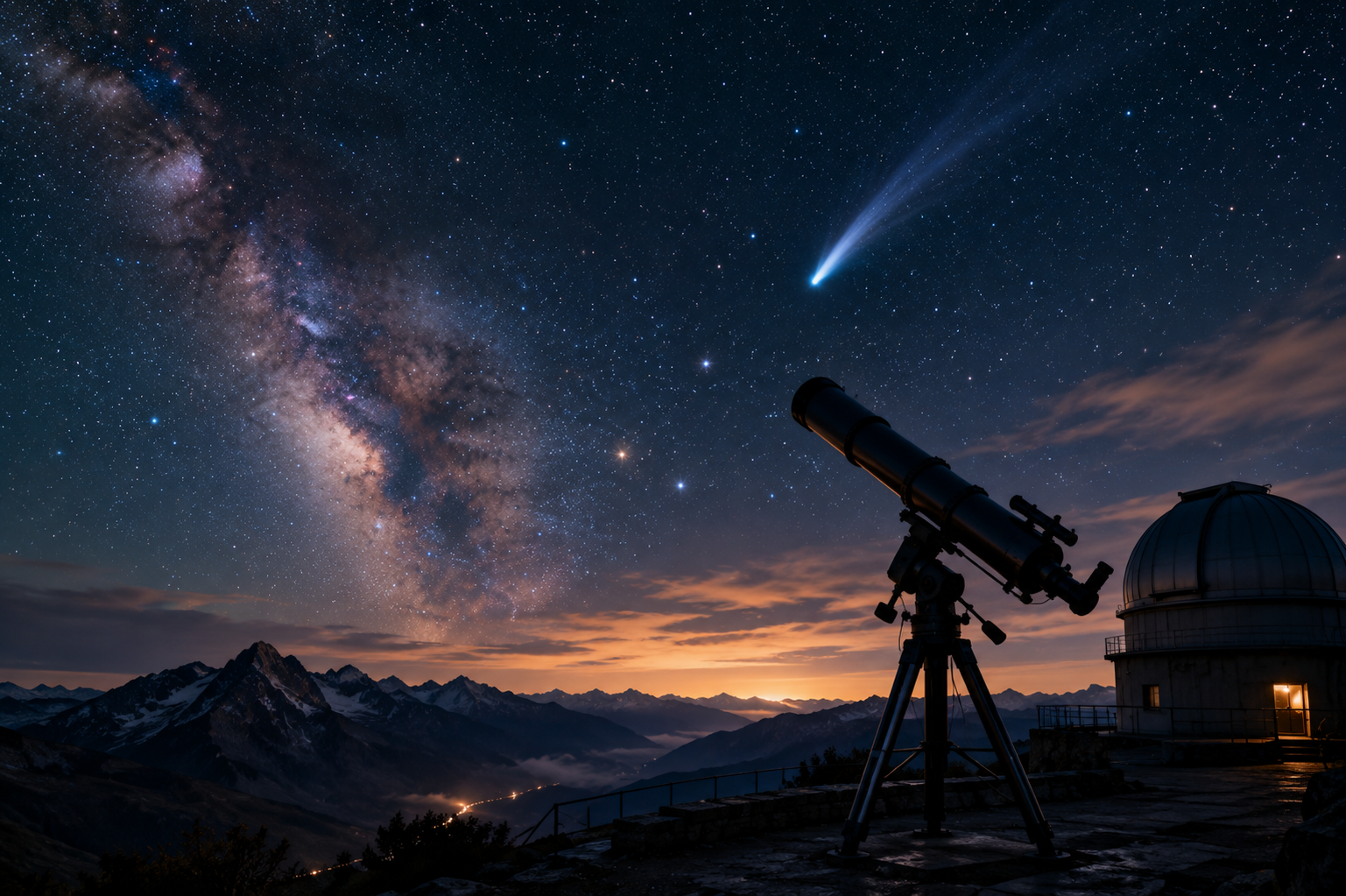
The featured artwork is an illustrative composite, rather than a photograph of one observed event.