

God Has an Excellent Publicity Department.
Where Is the Evidence?
Celestial teapots, divine disaster management and the awkward business of checking a heavenly reference.
Featured image: AI-generated celestial-teapot illustration. A philosophical visual metaphor, not a real astronomical photograph.
Invisible dragons, celestial teapots, divine disaster management and the politicians who appear to have secured an endorsement from somebody nobody can interview.
Imagine your neighbour tells you an invisible being created the universe. This being knows everything, can do anything, loves you unconditionally and has strong opinions about your private life.
Your neighbour cannot produce the being. Other neighbours describe incompatible versions. Some insist it has issued dietary instructions. Others say it has appointed a particular leadership team. Several are collecting money.
You would have questions.
Give the claim an ancient building, ceremonial clothing and a sufficiently impressive organ, however, and asking those questions can suddenly become disrespectful. The acoustics have improved. The evidence has not improved merely because the room has.
This is a sceptical argument and a work of satire. It rejects unsupported supernatural claims and examines the moral character attributed to God in particular biblical texts. It does not report biblical violence as independently verified history, diagnose believers, or pretend that every conceivable creator has been mathematically disproved.
That distinction is not an invitation to believe. We do not need to establish that an invisible dragon is logically impossible before declining to organise our lives around it.
First, which God are we discussing?
God can mean a personal being who intervenes in history, an impersonal foundation of existence, a creator who never interferes, or something so abstract that the word has almost ceased to describe a recognisable agent.
Those are different claims. Arguments against a perfectly good, all-knowing and all-powerful personal god do not automatically dispatch every possible supernatural entity. Philosophers distinguish arguments against particular conceptions from arguments against all gods. [S1]
What should not happen is a theological substitution halfway through the conversation. We begin with a god who answers prayers and issues commandments. Asked for evidence, the defence retreats to an unknowable foundation beyond space and time.
Fine. But the abstraction has not yet issued a commandment. An elusive first cause does not automatically arrive carrying the complete rulebook of one particular religion.
You cannot defend an unspecified cosmic foundation and then quietly put the collection plate back on the table.
The invisible dragon has applied for diplomatic immunity
Suppose I claim a tiny invisible dragon lives in my garage. You inspect the garage: nothing. It is invisible. You scatter flour: it floats. You suggest thermal imaging: its fire produces no detectable heat. You ask whether it makes a sound: only to people who have opened their hearts.
At this point you have not discovered an unusually sophisticated animal. You have discovered a claim being adjusted to avoid every possible check.
The question is not whether you can conclusively disprove it. The question is whether I have supplied a reason to believe it. I have not.
The same difficulty arises when divine action, divine inaction, comprehensible events and incomprehensible events can all be presented as confirmation. If every possible outcome supports the explanation equally, what is the explanation allowing us to distinguish?
Most arguments must survive examination. This one keeps trying to obtain diplomatic immunity.
The celestial pigeon is awaiting peer review
Consider a cosmic committee that created reality and subsequently became stuck approving the minutes. Or an invisible celestial accountant who maintains the planets but refuses correspondence without the correct form. Or a universe created last Thursday, complete with fossils and your convincing memory of Wednesday.
Add an undetectable teapot in space and a supernatural pigeon that created everything before losing interest after discovering chips.
These are invented examples and philosophical devices. There is no honest probability table establishing that the pigeon is 47 times likelier than God. The objection is that inability to disprove a story does not explain why one particular story deserves acceptance.
Tradition explains familiarity. It does not independently establish truth. Longevity is an impressive quality in a bridge; in an assertion, we should still inspect what is holding it up.
Reality is already ridiculous. It brings receipts.
Time passes at different rates at different gravitational elevations. In 2022 JILA researchers reported measuring that effect across approximately a millimetre within an atomic sample. Relativity also matters to satellite navigation. [S2]
To everyday intuition, this is outrageous. Move a clock slightly higher and its ticking rate changes? What sort of nonsense is that?
Experimentally supported nonsense. There are measurements, methods and opportunities to identify error. Acceptance does not depend on whether the result is comforting or ancient.
This is the useful comparison. Some astonishing ideas are established much more securely than divine intervention because they produce checkable evidence. Reality need not sound sensible. Explanations must earn our confidence.
The same distinction applies to aliens. We know technological life is possible because we are an example. That does not demonstrate extraterrestrial civilisations or predict a visit next Tuesday. It does explain why the category does not require an entirely additional supernatural ontology. Alien visitation is unestablished; divine visitation adds further unestablished assumptions.
Neither visitor is on the calendar. Both can be asked for identification.
Something must have created everything—mustn't it?
Serious cosmological arguments are more sophisticated than saying everything has a creator. Some concern things that begin to exist; others concern contingent things and the need for an ultimate explanation. Their premises and conclusions remain contested. [S3]
Even granting an ultimate cause for discussion leaves considerable work. Why conscious? Why perfectly good? Why interested in human beings? Why the god of this religion rather than another?
There is an enormous distance between reality requiring an explanation and that explanation wanting you in a particular building on Sunday. The religious details cannot travel free in the boot.
An honest unanswered question is not a vacancy that must immediately be filled by a deity. Nor does a sceptic require a completed cosmology before rejecting an unsupported answer. You can doubt that pixies broke the boiler without knowing which valve has failed.
The plumber is not entitled to accuse you of pixie-denial because you have not dismantled the kitchen.
Divine communications: an ambitious worldwide launch
Matthew and Luke locate Jesus's birth in Bethlehem; the narratives are religious sources, not independent confirmation of a supernatural birth. Matthew later presents a mission to all nations. [S4]
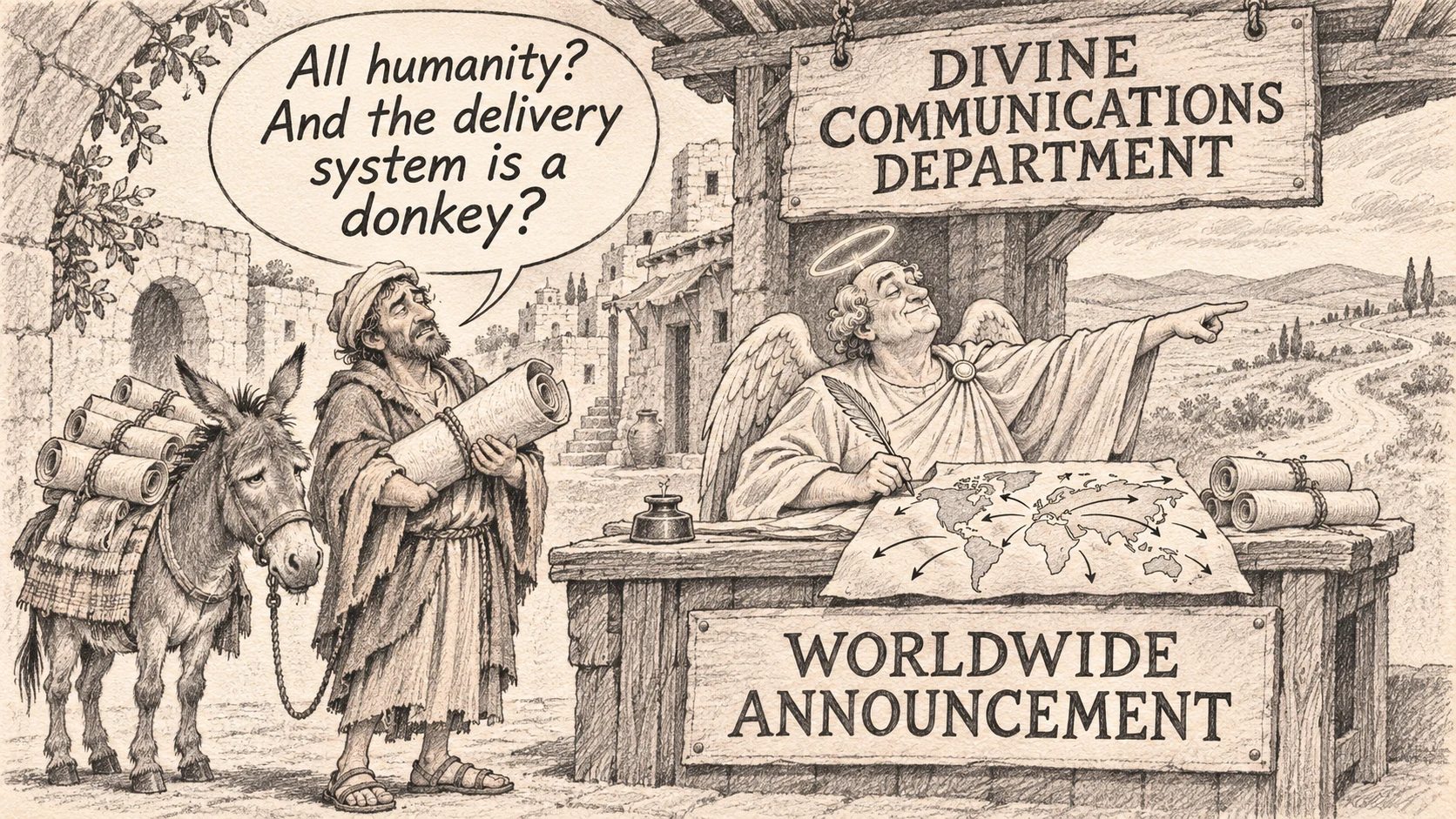
That raises an entirely reasonable question: why deliver an allegedly universal message through one local setting, then rely on travel, testimony, translation and generations of interpretation?
There was no airport in Bethlehem. No celestial broadband. Apparently the world's most consequential announcement was being distributed through a system whose premium delivery option involved sandals.
A message can begin locally and spread. There is no logical contradiction. The question is why an all-powerful communicator would choose a method so vulnerable to delay, disagreement and unequal access.
Knowing someone exists does not force you to love or obey them. Clear communication need not abolish freedom. A god could make the message available while leaving people free to reject its instructions.
In the same narratives, Mary's conception is supernatural and nonsexual; Joseph is not presented as the biological father. Criticise that claim accurately. Describing a sexual encounter with the Holy Spirit would invent something the account does not say. We have no independently verified evidence establishing that miraculous conception as a historical event. Calling it a miracle states the proposition needing support; it does not supply the support.
The missing appendix: microbes, dinosaurs and information somebody could actually use
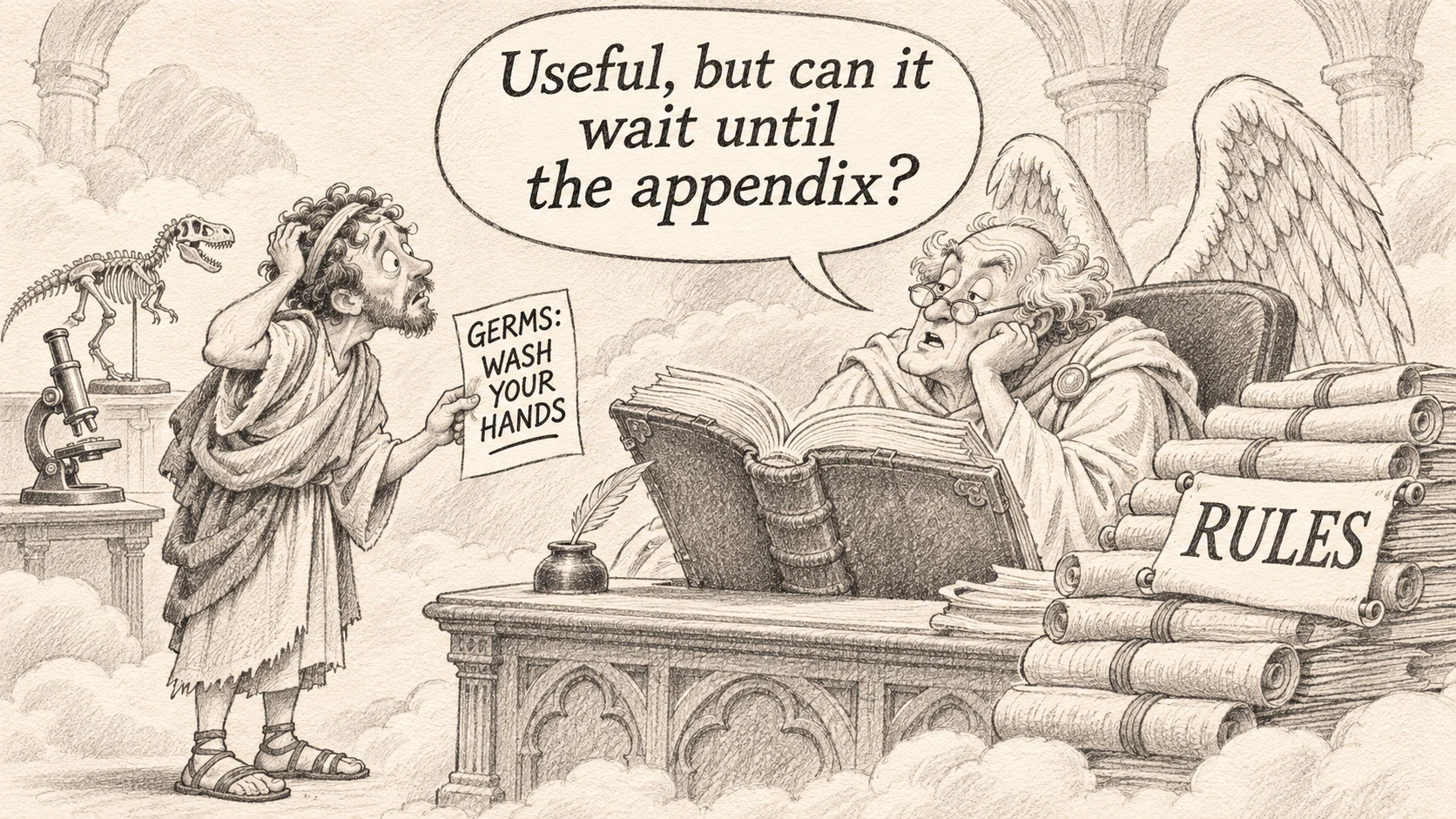
If a book is said to communicate the wisdom of an all-knowing creator, asking what knowledge it provides is reasonable. It need not contain a particle-physics degree. But surely one clear, useful discovery beyond its authors' setting would have been worth the parchment.
The Bible contains washing and sanitation instructions. Leviticus 15 includes washing; Deuteronomy 23 instructs people to bury excrement outside the camp. Pretending it contains no hygiene provisions would weaken the criticism. [S5]
Those provisions are not an explicit account of microorganisms and disease transmission. A rule may be practically useful without demonstrating supernatural knowledge of its mechanism.
Imagine a short, understandable instruction: tiny living things, too small to see unaided, can spread certain diseases through contaminated water and dirty hands; keep waste away from drinking water and clean hands before treating wounds. Those are our illustrative words, not a fabricated biblical quotation. Modern hand-hygiene evidence shows why such practical information matters. [S6]
The creator supposedly knew about bacteria. His readers could have benefited from knowing about them too. One cannot help noticing the editorial opportunity.
Then there are dinosaurs. Scripture does not provide an unambiguous, independently predictive account of non-avian dinosaurs, their deep-time history and their extinction. Proposed identifications of poetic creatures such as Behemoth in Job are interpretations, not a scientific discovery established by the description. [S7]
Calling a striking animal description a dinosaur after palaeontology has supplied the dinosaur is not the same achievement as revealing one beforehand. If the identification works only once we already possess the answer, the scientific breakthrough has arrived from elsewhere.
Atoms and protons create a related question. The word atom itself would not be a decisive revelation: ancient thinkers considered atomism. What would matter is specific, accurate information that distinguishes a modern physical account from general speculation about small constituents. A passage that readers can stretch to resemble a later discovery is not equivalent to a clear discovery-producing explanation. [S8]
Other planets require care too. Several planets are visible without telescopes and were known in antiquity. Exoplanets—planets orbiting other stars—are a different matter. NASA describes observational methods through which such worlds are detected, including the small dimming as a planet crosses its star. [S9]
And other universes? We must not put them in a list of established discoveries: a multiverse remains hypothetical. Demanding that scripture reveal a fact we have not established ourselves would be poor criticism.
The stronger question is why an allegedly omniscient revelation contains so little unmistakably useful advance knowledge of the natural world, while depending so heavily on later interpretation to claim scientific foresight.
A defender can say the Bible's purpose is spiritual rather than scientific. That is a legitimate account of its intended genre. But it concedes a limit: the book cannot then be presented as an obvious storehouse of modern scientific discoveries whenever a convenient phrase can be recruited.
Not a science textbook on Monday; a secret physics textbook on Tuesday. The publishing department needs to pick a position.
None of these omissions deductively disproves every god. They challenge a particular claim about clear, benevolent and extraordinary revelation. Human writings reflecting human knowledge are unsurprising. A document attributed to unlimited knowledge invites a higher expectation.
The universe looks designed—until we inspect the installation
Design arguments infer intelligence from order, complexity or conditions suitable for life. Identifying supposed design and identifying a designer as the God of a particular tradition are separate steps. [S10]
If we inspect the workmanship, we should inspect the whole building. The beautiful landscape belongs in the assessment. So do disease, predation and suffering that its victims cannot understand.
If benevolence can be inferred from a sunset, it is reasonable to ask what to infer from the rest of the specification. The sunset cannot be evidence while the suffering is beyond our jurisdiction.
That is less an investigation than an estate agent's brochure.
Free will is one proposed answer to human wrongdoing. It does not by itself explain an inherited illness or animal suffering unconnected to human choice. Appeals to stable natural laws, moral development or hidden goods require further argument. Could the good be achieved with less suffering? Must one person's agony finance another person's character development?
A claim of perfect goodness should intensify scrutiny, not abolish it.
Before judging the author, read the character's actual instructions
There is a second moral problem: not only suffering that God allegedly permits, but violence and domination that biblical narratives attribute to him or his representatives.
The following are examinations of texts. They do not establish that the events happened, that God exists, or that present-day believers approve of them. Jewish and Christian interpretation is diverse. Historical context, literary genre and competing theological readings matter.
But reading sympathetically cannot mean refusing to notice the victims. If a text is proposed as a source of perfect moral authority, its disturbing passages must be examined alongside its attractive ones.
These discussions concern killings of children and enslavement; the illustrations deliberately avoid depicting those acts.
The Flood: disaster management by drowning almost everybody
Genesis 7:21–23 describes the destruction of people and land-dwelling creatures outside the ark. Read within the narrative's own universal scope, that includes children and others not individually assessed. Genesis 6 supplies the preceding account of human wickedness. [B1]
The moral objection is collective punishment: belonging to the doomed population determines the outcome. A baby cannot be individually responsible for an adult society's wickedness; an animal cannot be convicted of human corruption.
One defence treats the Flood as just divine judgement. Another reads it as theological narrative or myth rather than literal history. These produce different historical claims, but neither automatically makes the action attributed to the character morally admirable.
If it is symbolic, we can still ask what moral idea the symbol commends. If it is literal, the judgement faces the question of discriminating between culpable and innocent victims. Saying a creator owns life describes power; it does not, without another argument, establish justice.
Imagine a local council responding to serious crime by submerging the district, then celebrating its flood-management strategy because one family and some livestock survived. The public inquiry would have questions.
The familiar ark imagery can turn the story into a cheerful parade of animals. But the story's moral content cannot be assessed entirely from the passengers' perspective. The people outside the boat count too.
Amalek: the infants are explicitly in the order
In 1 Samuel 15:1–3, Samuel presents an instruction as the Lord's command. The targets expressly include men, women, infants and nursing children, alongside livestock. Later, Saul's disobedience is framed around failing to carry out the commanded destruction fully, including sparing Agag and desirable animals. [B2]
Calling this merely a battle against soldiers removes the most morally significant words. The instruction identifies people who cannot plausibly be combatants.
The narrative connects punishment to Amalek's earlier conduct towards Israel. But inherited membership in a group is not personal responsibility for its ancestors' actions. A child does not acquire culpability through genealogy.
Some interpreters understand ancient destruction language as conventional exaggeration. That is relevant to what historical event, if any, a passage describes. It does not automatically explain why infants are explicitly included in the stated command, or why perfect goodness should be advertised through such rhetoric.
The issue is not whether every modern legal category maps neatly onto an ancient text. It is whether killing the defenceless is defensible simply because a religious authority attributes the order to God.
If a modern ruler's instruction named nursing children, nobody would improve the moral assessment by printing the order on more impressive stationery.
The firstborn of Egypt: the prisoner did not set foreign policy
Exodus 12:29–30 attributes the deaths of Egypt's firstborn to the Lord, extending the description from Pharaoh's firstborn to a captive's firstborn and to livestock. Firstborn denotes birth order, not a claim that every victim was an infant. The moral problem does not require that exaggeration. [B3]
The narrative concerns liberation from oppressive rule. That purpose does not itself establish the innocence of the means. A captive's family does not become responsible for Pharaoh's policy merely by living under it.
Exodus also complicates the familiar defence that Pharaoh alone brought this on everybody. Some passages describe his resistance; Exodus 10:1–2, 20 and 27 explicitly attributes hardening his heart to God. Interpretations of that hardening differ, but the wording cannot simply be omitted. [B4]
A story in which divine action reinforces a ruler's resistance and the punishment reaches people without control over that ruler creates a serious question about responsibility.
A hostage-taker saying the leader made him do it would not settle our moral judgement. Nor does it here. A worthy goal—ending enslavement—does not make every described act along the way just.
If unlimited power is part of the claim, ask why liberation required this particular suffering. The proposed rescuer is not a fallible official forced to choose from a narrowly limited set of tools.
Midian: the distinction between God and Moses matters
Numbers 31 begins with the Lord commanding vengeance against Midian. After the campaign, Moses orders the killing of male children and women who have had sexual relations, while girls who have not are spared for the victors. The later distribution treats surviving captives as plunder alongside animals, with shares assigned to religious personnel under instructions attributed to the Lord. [B5]
The killing order for the captives is spoken by Moses. We should not put quotation marks around it and claim God speaks it directly. Equally, it would be misleading to detach it from the chapter's claimed divine authorisation and the subsequent handling of captives.
The passage does not explicitly narrate rape. Claiming that it does would overstate the text. It does describe coercive captivity, a selection organised around sex and sexual experience, and the allocation of surviving human beings as spoils.
Those facts are morally disturbing without embellishment. A person spared from killing is not thereby a consenting participant in captivity. Survival under someone else's ownership is not equivalent to freedom.
A humanitarian audit cannot stop at the word spared. It has to ask what happened to the people spared, what choices they had, and whether they were being treated as persons or assets.
Slavery: the inheritance clause is difficult to misplace
Leviticus 25:39–46 distinguishes the treatment of impoverished fellow Israelites from that of slaves acquired from surrounding peoples and resident foreigners. Verses 44–46 permit acquisition and inheritance as property; the protections described for fellow Israelites do not erase that distinction. [B6]
This is why the blanket response that biblical slavery was simply temporary employment fails for this passage. Ancient systems varied, and translating every occurrence of a servitude term identically can mislead. But permission to buy people and pass them to one's children is not a modern employment contract.
An employee can leave, owns their own person and cannot be bequeathed with the furniture. If those distinctions disappear, the explanation has quietly stopped describing employment.
A common defence is that the law regulated an existing institution rather than inventing it. That may describe its historical function. Regulation does not equal abolition, and historical explanation does not establish moral perfection.
People resisting oppression can draw on other religious passages and traditions. That matters to the history and diversity of belief. It does not delete the permission in front of us.
If the moral lesson requires us to reject human ownership despite a passage permitting it, we are exercising moral judgement about scripture. We should acknowledge that judgement rather than pretend the inheritance clause says something else.
Perfect goodness, now with an exemption form
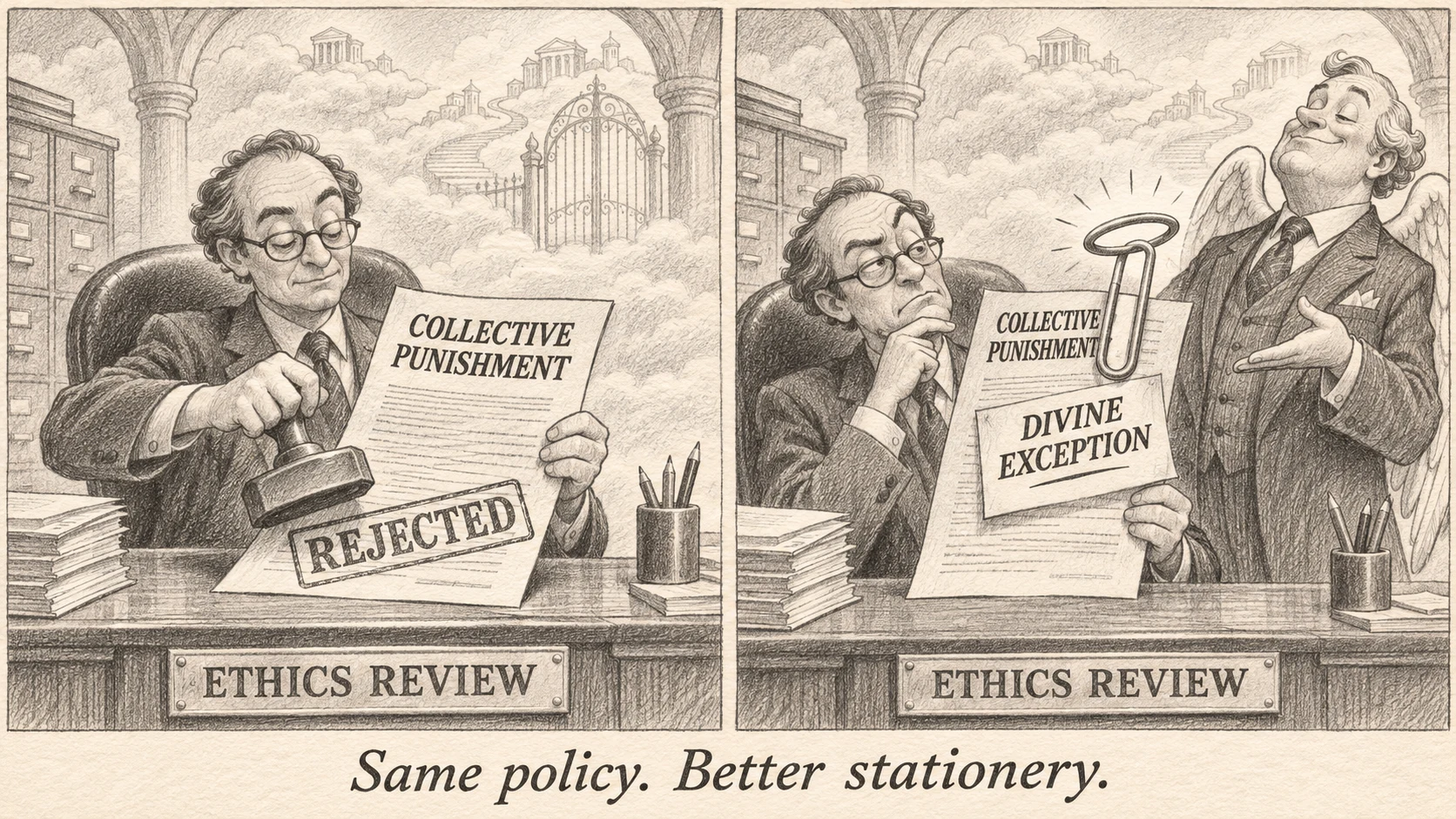
The central challenge is not obscure. Why would an act condemned when attributed to a human ruler become admirable when attributed to God?
If the answer is superior knowledge, specify the argument rather than simply assume a morally adequate reason must exist. If the answer is ownership of creation, explain how ownership generates permission to harm. If the answer is that good means whatever God commands, the declaration that God is good risks becoming circular.
Modern believers need not accept literal readings of these texts. They may understand them as human accounts shaped by history, flawed moral understandings or a developing theological tradition. That is a serious interpretive position. But it complicates claims that the entire text provides a transparent, timeless and uniformly perfect moral instruction manual.
One cannot invoke human limitation to explain away every troubling command while invoking divine perfection to certify every preferred one without explaining the selection principle.
A halo is not an argument. It is headwear.
Miracles, prayer and the missing comparison group
People can be sincere about remarkable experiences and mistaken about their causes. Hume's discussion of miracles asks how testimony should be weighed against competing explanations and wider experience. Error, exaggeration and misunderstanding must be considered rather than excluded by declaration. [S11]
An unexplained recovery remains unexplained until an explanation is established. Calling the gap God changes the label; it does not close the gap.
The 2006 STEP trial studied 1,802 cardiac-bypass patients at six US hospitals. Among patients uncertain whether they were receiving organised intercessory prayer, complications occurred in 52% of the prayer group and 51% of the comparison group. The intervention did not improve complication-free recovery. [S12]
That is not a proof about every form of prayer or a disproof of God. Prayer's emotional and communal value is a different question from this medical intervention. The fair conclusion is specific to what was tested.
It is equally unfair to welcome favourable results as divine confirmation but dismiss unfavourable results because God refuses to be tested. If practical efficacy is claimed, asking how it was established is reasonable.
The dragon cannot advertise a heating service and then complain when someone brings a thermometer.
What if faith provides comfort and moral purpose?
Comfort deserves humane treatment. It does not determine truth. An idea can be true and comforting, false and comforting, true and distressing or false and distressing. Its emotional effect does not identify the category.
Grief is not a punchline. Hoping to see someone again is profoundly human. A promise of reunion nevertheless remains a claim requiring justification, especially when made to someone vulnerable.
Morality also requires more than an asserted instruction. Are actions good because God commands them, or commanded because they are good? Philosophers offer sophisticated responses; no short dilemma dispatches all religious ethics. But simply repeating God says so does not finish the moral argument. [S13]
A secular account must also defend its principles. It can consider wellbeing, rights, fairness, obligations, empathy and the consequences of action. None becomes infallible merely because its advocate rejects religion.
We should judge arguments by their reasons and conduct by its consequences. Religious identity does not automatically make a person good; lack of it does not automatically do so either.
God has joined the campaign. Apparently nobody checked his signature.
Personal faith and a claim of divine political endorsement are different. We cannot read sincerity off a speech. We can examine what authority the words invite an audience to accept.
Trump: providence knows the slogan
In his inaugural address on 20 January 2025, Donald Trump said: “I was saved by God to make America great again.” The official transcript places this in his account of surviving the July 2024 assassination attempt. [P1]
Gratitude after surviving violence is understandable. Divine rescue is a religious interpretation. Identifying the purpose of that rescue with a political slogan goes further still.
Survival does not establish supernatural intervention; supernatural intervention, if established, would not by itself identify which tax policy or executive decision enjoys divine approval. Those are separate claims.
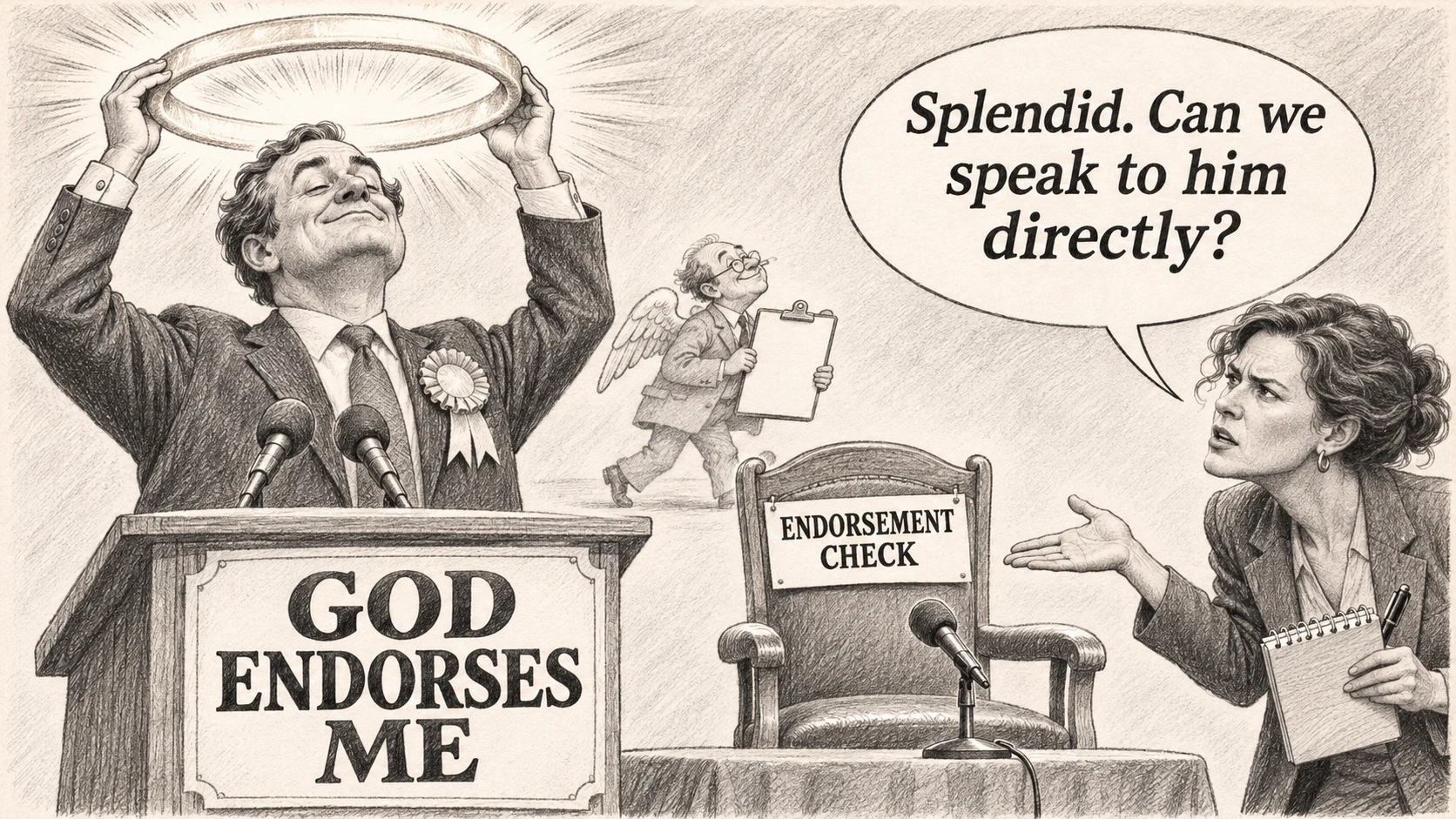
God is a convenient campaign surrogate. Nobody can book him for the opposing interview, and the endorsement never comes with an awkward clarification from the endorser's office.
Mike Johnson: a majority vote, plus heavenly references
After his election as US House Speaker on 25 October 2023, Mike Johnson said that God raises up people in authority and expressed his belief that God had ordained and allowed the members to be there at that moment. He applied it collectively, not exclusively to himself or Republicans. [P2]
That context matters. This was not an explicit declaration that every Republican policy had divine approval. It was a statement about providence and service that attached sacred meaning to a political outcome.
The question is what additional conclusion it establishes. If providence raises up authorities generally, it does not distinguish good governments from disastrous ones. If selected authorities enjoy special endorsement, somebody must explain the selection criteria.
Ideally before announcing the successful applicant.
Cameron: Jesus joins the branding team
At his Downing Street Easter reception on 9 April 2014, David Cameron said: “Jesus invented the Big Society 2000 years ago.” The official transcript places it in praise of charitable activity by Christians and a wish to expand faith organisations' role. He also acknowledged receptions for other faiths. [P3]
This is a milder example: an approving connection between a political programme and Christian service, not an explicit claim that Jesus approved a spending review. No reliable matching video has been established here; the transcript is the evidence.
The branding advantage is still plain. A contemporary slogan acquires an illustrious honorary founder without its supposed originator enduring a single policy meeting.
Charitable work may be admirable. It does not automatically establish that a government's wider funding and delivery choices are adequate. Jesus is not an impact assessment.
Blair: the tempting example we must not misrepresent
The March 2006 Parkinson interview is often recruited into claims about God and the Iraq war. Ofcom's 26 February 2007 ruling found that ITV News's interpretation of that interview breached its requirement for due accuracy. [P4]
We should not turn the exchange into a clean statement that God instructed Blair to invade Iraq. The regulator's analysis does not justify that telling.
A sceptical article must not manufacture convenient testimony. If our standard is show the evidence, it applies when a correction spoils a favourite joke.
A profession of faith is not a warranty on competence
These cases differ. Trump explicitly connected divine rescue with his political mission. Johnson gave office a providential interpretation. Cameron connected Christian service to a programme. Treating them as identical would replace analysis with a montage.
The recurring concern is authority beyond the evidence. Faith does not establish that a budget adds up, a law works or a conflict of interest disappears. A politician's professed devotion tells us what they profess. Their conduct tells us how they govern.
Believers have reason to resist political appropriation too. A party does not own a religion. A politician is not its authorised spokesperson merely because a speechwriter has located a biblical quotation.
Explain the policy. Produce the evidence. Defend the consequences. Accept scrutiny.
If the argument works, it can be examined without a supernatural signature. If it fails, adding God at the bottom will not repair it.
The best religious argument deserves a better reply than a bad meme
A thoughtful believer can offer a cumulative argument involving existence, order, consciousness, morality and experience. A thoughtful sceptic can question whether those features establish a deity, whether they identify one religion, and how the proposed explanation handles suffering and hiddenness.
Divine hiddenness concerns sincere nonbelief and why a perfectly loving God would permit it. It is a contested philosophical argument, not a laboratory disproof. [S14]
Science has not completed every explanation of consciousness or cosmic origins. Pretending otherwise makes an atheist argument worse. But an incomplete natural explanation does not establish a supernatural one. The gap belongs on the list of questions, not in the column headed confirmed deities.
Religious people differ enormously in interpretation and certainty. Criticism should distinguish them rather than attribute the worst argument to everyone. A claim's cultural importance does not exempt it from examination, but neither does disbelief make ridicule an adequate substitute for reasoning.
The joke lands best when the argument underneath it is solid.
God can submit evidence like everybody else
We have no honest table ranking God, dragons and cosmic pigeons by numerical probability. We do have a distinction between claims that earn confidence through evidence and claims repeatedly shielded from checking.
We can reject unsupported miracle claims without claiming to have disproved every conceivable god. We can condemn the violence attributed to a biblical character without pretending to have established its historical occurrence. We can challenge divine political endorsements without pretending to know a speaker's private motives.
These distinctions strengthen the case. They prevent it becoming another demand for unearned certainty.
The moral issue is particularly plain. If an infant's life matters, it matters in a religious narrative too. If owning another person is wrong, an inheritance clause does not become humane because it appears in sacred law. If a policy needs evidence, divine branding is not an exemption.
The invisible dragon does not become visible when somebody puts it in a cathedral. And the pigeon does not become an explanation because we teach it to say mysterious ways.
Sources, quotations and editorial checks
Checked 27 November 2026. These links support the identified factual or textual claims; the satire and moral conclusions are the author’s arguments. Biblical links use the KJV for a consistent reading reference; comparison with modern translations is encouraged. No claim is made that a biblical event is independently established by citing its narrative.
- S1 — Atheism and Agnosticism — Stanford Encyclopedia of Philosophy
- S2 — JILA atomic clocks and millimetre-scale time dilation — NIST, 16 February 2022
- S3 — Cosmological Argument — Stanford Encyclopedia of Philosophy
- S4 — Matthew 1–2 and 28; Luke 1–2 — biblical narratives
- S5 — Leviticus 15; Deuteronomy 23:12–14 — washing and sanitation
- S6 — Handwashing evidence — CDC
- S7 — Job 40:15–24 — Behemoth passage; dinosaur identification is not established by this source
- S8 — Ancient Atomism — Stanford Encyclopedia of Philosophy
- S9 — The search for other Earths — NASA methods fact sheet
- S10 — Teleological Arguments — Stanford Encyclopedia of Philosophy
- S11 — David Hume, Enquiry, Section X: Of Miracles — primary text
- S12 — Benson et al., STEP randomised trial, American Heart Journal, 2006; DOI 10.1016/j.ahj.2005.05.028
- S13 — Religion and Morality — Stanford Encyclopedia of Philosophy
- S14 — Divine Hiddenness — Stanford Encyclopedia of Philosophy
- B1 — Genesis 6–8 — Flood narrative
- B2 — 1 Samuel 15 — command presented through Samuel
- B3 — Exodus 12 — Egyptian firstborn
- B4 — Exodus 10 — hardening of Pharaoh’s heart
- B5 — Numbers 31 — campaign, Moses’s captive-killing order and division of spoils
- B6 — Leviticus 25 — distinction between Israelite service and foreign hereditary slavery
- P1 — Trump inaugural address, 20 January 2025 — official White House transcript
- P2 — Johnson, 25 October 2023 — official Congressional Record, H5048–H5053
- P3 — Cameron Easter reception, 9 April 2014 — official delivered transcript
- P4 — Ofcom Broadcast Bulletin 79, 26 February 2007, printed pages 4–8 — ITV due-accuracy ruling
- V1 — Life of Brian (1979), “You’re all individuals” — 44-second excerpt, third-party Vimeo upload
Accuracy safeguards: no invented probability ranking; no claim that all religious conceptions are disproved; explicit distinction between God and Moses in Numbers 31; no claim that the chapter explicitly narrates rape; firstborn is not synonymous with infant; hygiene passages acknowledged; multiverse not treated as confirmed; Cameron’s statement distinguished from Trump’s; Blair/ITV correction retained. Cartoons are AI-generated satire, not evidence. No film footage downloaded or rehosted.
Let Brian have the last word
The relevant ending is the scene in Monty Python's Life of Brian in which Brian urges the crowd to think independently and receives collective agreement in return. The comedy catches the contradiction of outsourcing independent thought to a leader.
It applies to an atheist audience as well. Do not accept this article because it mocks something you already dislike. Follow the passages. Check the quotations. Examine the objections. Disagree where the reasoning fails.
The excerpt below appears within FIRE's publisher-hosted interview with John Cleese; its own transcript identifies the film insert and links to approximately 3:50. This is an external player, not a film file copied or hosted by this site. [V1]
There is no theological loyalty test at the exit. Just the unfashionable request to use your own judgement.
Final viewing: you’re all individuals
A 44-second excerpt from Monty Python’s Life of Brian (1979), via Vimeo. Film credit: Python (Monty) Pictures. The uploader is Empower The People, not an official Monty Python channel.