
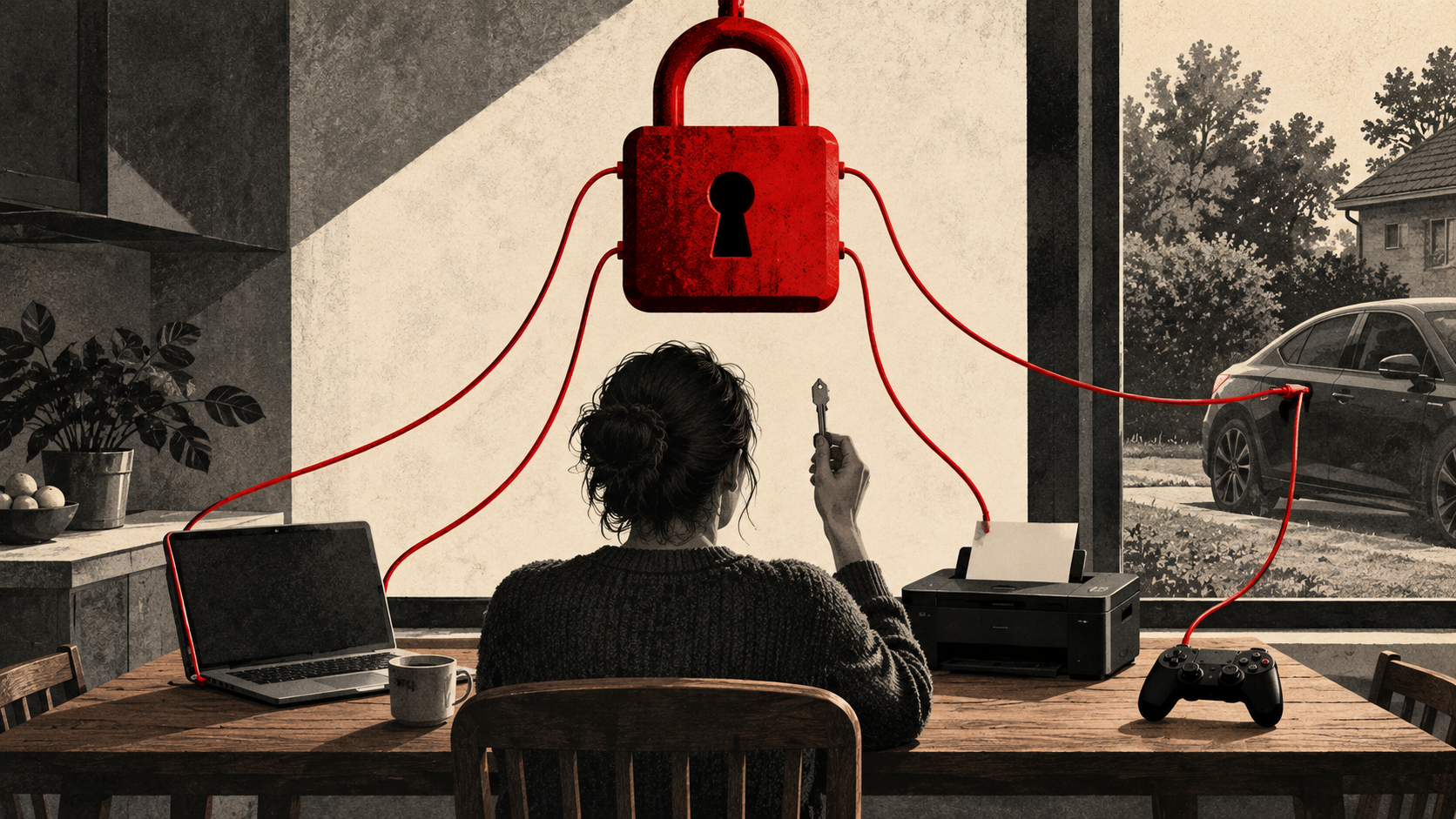
You can buy the device, keep it in your home and still need a company’s continuing permission to use parts of it. The subscription economy is changing more than our monthly bills. It is changing who remains in control after we have paid.
There was a reassuring finality to buying something. You handed over the money, took it home and used it until it broke, wore out or no longer suited you. The manufacturer might sell you a better version next year. You could carry on using the old one.
That arrangement has not disappeared. But alongside it sits a different proposition: pay for access, keep paying, and accept that continued use may depend on an account, an internet connection and a supplier’s business decisions.
A subscription can be useful. The trouble begins when we mistake continuing access for lasting possession—or discover that an object we own contains functions someone else still controls.
The ink is still there. Permission is not.
HP’s Instant Ink service makes the distinction unusually tangible. HP says its subscription cartridges stop working when the subscription is cancelled, even if they still contain ink. The arrangement is a printing service, rather than an ordinary purchase of each cartridge. [1]
That does not mean cancelling permanently disables the printer. Customers can switch to compatible regular cartridges. That qualification matters: claiming otherwise would exaggerate the case.
The narrower fact is striking enough. A usable consumable can remain physically inside a machine while permission to use it has ended.
Some customers will prefer automatic deliveries and predictable payments. They are entitled to make that choice. They should also understand exactly what remains theirs when the payments stop.
Your work remains. Your tools may not.
Adobe says access to paid Creative Cloud apps and services ends when the current billing period finishes after cancellation. It also says files saved on your own computer remain accessible there. Cancelling does not mean Adobe takes ownership of your local work. [2]
But keeping a project file and retaining the same ability to edit it are different things. Other software may handle it well, partially or inadequately, depending on the format and features involved.
For someone with years of projects, established workflows and collaborators using the same tools, leaving can involve more than cancelling a payment. It can mean exporting archives, learning replacements and checking that important work still opens correctly.
A subscription can fund updates, support and genuinely useful online services. The question is whether customers can stop buying those future services while retaining a workable route to their past work.
A purchase can depend on a server too
The problem extends beyond monthly payments. In its announcement about the original The Crew, Ubisoft said the game would become inaccessible across its supported platforms after its servers closed on 31 March 2024. The company cited server infrastructure and licensing constraints. [3]
This was a server-dependent game sold to players, as well as offered through subscription access. It belongs in this discussion because the underlying issue is similar: payment did not give customers independent control over continued play through the official service.
That announcement documents Ubisoft’s shutdown decision. It should not be read as a claim about every subsequent community preservation effort.
Nobody can reasonably require every company to run every server forever. But it is reasonable to ask, before selling a game, what customers will retain when official support ends. Offline modes, community hosting and published end-of-service plans are possibilities to consider during development, rather than after the closure notice.
“Buy” does not tell the whole story
Steam’s subscriber agreement explicitly describes its content and services as “licensed, not sold”. It also uses “Subscriptions” as a contractual term for access rights, including rights that do not involve a monthly payment. A one-off Steam game purchase is not thereby a recurring bill. [4]
Software licences themselves are hardly new. Buying a boxed game never meant acquiring its copyright or permission to reproduce it commercially.
The practical question is how much control the customer has over their copy. Can they install it offline? Keep a backup? Continue using it without repeated authentication? What survives a service closure?
Those questions tell us more than the reassuring appearance of a title in an online library. A library entry records an entitlement. It does not, by itself, establish independence from the systems that enforce it.
The car on the driveway
This distinction reaches physical products too. Mercedes-Benz Canada’s Digital Extras terms describe paid services available through subscriptions and permanent enhancements. They give acceleration increases for electric vehicles as an example of a possible one-time enhancement. Availability depends on the vehicle and market. [5]
It would be wrong to claim every Mercedes owner must subscribe to accelerate normally, or that every optional feature is rental-only. The significant development is that a vehicle purchase can coexist with separately controlled, paid digital functions.
Owners therefore need clear answers about what is included, what expires and what transfers with the vehicle. A car’s physical condition is no longer the whole explanation of what it can do.
Small payments, lasting dependence
Recurring payments can lower the initial cost of access. They can make an expensive tool affordable for a short project and let customers leave services they no longer need.
But a lower entry price is not the same as a lower lifetime cost. As a simple illustration, five services costing £10 each per month amount to £600 a year, or £3,000 over five years, assuming unchanged prices. Those are illustrative figures, not a survey of household spending.
The greater concern is what happens when income falls. With something independently usable that you have already bought, stopping new purchases can preserve what you have. With rented access, reducing expenditure can also remove useful capabilities.
That distinction matters especially for tools used to earn a living, maintain records or access years of creative work. The more difficult the exit, the weaker the customer’s practical freedom to reject a price increase.
Digital does not have to mean dependent
GOG provides a useful counterexample. Its developer guidance requires offline functionality to work without its Galaxy client or an internet connection, while recognising that online features need connectivity. It also documents offline installers. [6]
That does not confer ownership of a game’s intellectual property or guarantee compatibility with every future computer. It does give customers a practical way to keep installation files and use offline functionality without continually asking a storefront for access.
The wider principle is straightforward: design can preserve independence. Local storage, useful export formats, offline operation and clear support commitments are choices suppliers can make.
Ownership needs an exit
Customers should be able to see the full commitment before paying: the upfront cost, recurring charges, cancellation consequences, connectivity requirements and support period.
Where a product relies on remote infrastructure, its end-of-service arrangements should be explained. Where people create or store their own work, they need a realistic way to retrieve and migrate it. Optional online services should be clearly distinguished from the basic functions of a purchased product.
These are reasonable expectations for a market that asks people to commit their money, time and trust.
The best test is simple: if I stop paying, disconnect from the internet or the supplier closes tomorrow, what can I still use?
The answer will differ between a streaming service, a professional application, a game and a printer. It should never be a surprise.
A product’s usefulness should not be confused with the supplier’s continuing willingness to let us use it. Before we celebrate another convenient subscription, we should ask what control we are giving away—and whether we can ever get it back.
Sources and further reading
- HP Instant Ink: official service information and cancellation conditions. The restriction described concerns subscription cartridges, rather than permanent disabling of the printer.
- Adobe: Account access after plan cancellation. Explains app access and the distinction between cloud storage and locally saved files.
- Ubisoft: An Update on The Crew. The publisher’s original explanation of its official server closure.
- Valve: Steam Subscriber Agreement, especially sections 1 and 2. Its contractual use of “Subscriptions” does not mean all purchases require recurring payments.
- Mercedes-Benz Canada: Digital Extras Terms of Use, especially section 4.5. This is a Canadian example; products and terms vary by market.
- GOG developer guidance: No DRM, No Problem; Offline installers.
Sources checked 26 October 2026. This article distinguishes contractual access, practical control and intellectual-property ownership; they are not interchangeable.